Garment Care Symbols Explained: A Practical Guide
This is some text inside of a div block.

1963 is the first milestone to remember, and five symbol groups always form the reading order - washing, bleaching, drying, ironing, then professional care. If you're holding a new shirt at the laundry basket or checking a blouse before its first wash, those icons are the label's instructions, not decoration.
You can read them the same way in Singapore's home laundry routine and in a professional counter workflow because garment care symbols were built as an internationally legible system, not a local shorthand. The practical job is simple, follow the symbols in order and treat each one as the maximum safe treatment for that garment, so you don't push heat, bleach, or agitation beyond the limit.
You've probably stood at the hamper with one hand on a work shirt and the other on a blouse, wondering whether they can go in the same wash. That's the moment garment care symbols earn their keep. They turn a risky guess into a process, and the process starts with the same five categories every time, washing, bleaching, drying, ironing, and professional care.
The reason this works so well in Singapore is historical as much as practical. The internationally recognised symbol system began with GINETEX in 1963, and ISO support for global standardisation followed later GINETEX history. That matters because the label language was designed to travel across borders, which fits a market where workwear, travel wardrobes, uniforms, and delicate occasion pieces often move between countries and care systems.
At a laundry counter, the first question isn't “Can I wash this?” It's “What's the label asking me to avoid?” A high-heat dry cycle can ruin a shirt even if the wash was fine. A bleach mistake can do more damage than a warm wash ever would.
Practical rule: read the symbols as a sequence of limits, not as a shopping list of options.
That way of reading is why the laundry best practices guide for Singapore fits naturally with the same logic used at the counter. The icons tell you what a garment can tolerate, and the safest choice is the one that stays inside every limit shown on the tag.
Care labels look local, but the system behind them is international. The standard used in Singapore-relevant garment handling follows the same sequence used across many markets, and the symbols are intentionally language-independent so a label can support sorting in a multilingual environment without long written instructions care labelling guide.
That design choice is important in Singapore. A single label may need to guide a household, a hotel laundry room, a uniform provider, and a dry-cleaning counter, all without much time for reading. Symbols keep the decision fast and compact, which is why they work so well in intake and sorting workflows.

The standard sequence is washing, bleaching, drying, ironing, then professional textile care, and it's written to communicate the most severe treatment that will not cause irreversible damage ISO 3758 standard summary. That wording matters. It means the label is not inviting experimentation, it's setting a ceiling.
The same source also makes the scope clear, domestic washing, bleaching, drying, ironing, and professional dry and wet cleaning are covered, while industrial laundering and some upholstery or mattress items are outside the standard ISO 3758 standard summary. So if you're handling a sofa cover or a mattress protector, don't assume the same label logic applies without checking the exact product guidance.
An important local takeaway is that the symbols are a compact notation system, not a full explanation on their own. Recent standards material makes that point plainly, users may still need guidance to interpret them correctly GINETEX textile care symbols PDF. That's why a plain-language reading guide helps, especially when a garment is expensive, sentimental, or hard to replace.
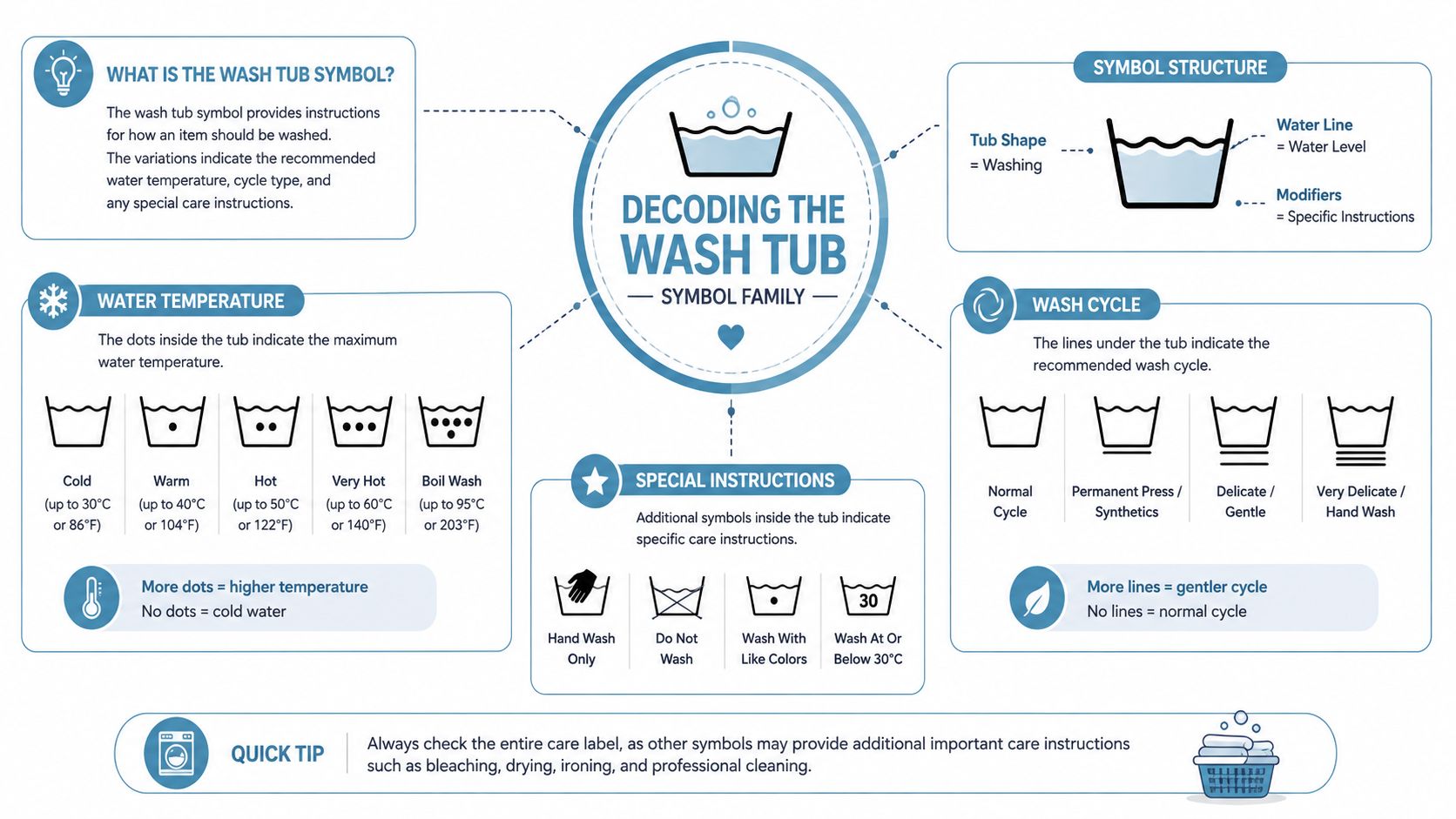
The wash tub is the first gate in the label. If you get this one wrong, the rest of the label won't save the garment, because washing sets the maximum level of water action, temperature, and agitation the item can handle.
A plain tub means the item can be washed. A number inside the tub tells you the maximum water temperature. In practical terms, a cotton work shirt can usually tolerate more than a delicate blouse, but the label still wins over habit. If the tub has one or two bars underneath, that's a signal to reduce mechanical stress, so you'd choose a gentler cycle rather than a standard heavy one.
The hand-wash symbol is even more restrictive. It tells you to skip the machine and wash by hand with minimal agitation. A crossed-out tub means don't wash it at home at all, which is the moment to stop guessing and move the garment to a professional workflow.
Use the tub as the ceiling. If later symbols allow more than the tub does, the tub still wins.
For a printed tee, it's worth protecting the decoration before you ever get to the dryer, and this guide on protecting prints with Raccoon Transfers is useful when the garment itself carries a printed finish that can't take rough handling. The same logic applies to uniforms, silk blends, and anything with embroidery or bonded details.
Read more on cold wash versus hot wash
Singapore laundry providers and consumers can depend on compact label icons instead of long text, which is useful in a multilingual environment and in commercial garment-care workflows where fast, accurate sorting is essential care labelling guide.
Read: How Tumble Handles Indoor Drying to Avoid Musty Smells
The triangle family causes more damage through overconfidence than through complexity. People see white fabric and assume bleach is automatically fine, but the triangle is really a permission label with strict boundaries.
An open triangle means bleach is allowed. A triangle with diagonal lines means only non-chlorine bleach is allowed. A crossed-out triangle means no bleach at all. That's the whole family, but the difference between them matters a lot in real handling, because bleach isn't just a cleaner, it's a chemical treatment that can weaken fibres and strip colour.
White cotton towels often tolerate a wider bleaching window than coloured work uniforms, but the label still has the final word. If a garment has stretch, decoration, or mixed fibres, don't treat “white” as a free pass. The triangle tells you what the fabric can handle, not what the stain wants.
Bleach symbols do not stand alone. If the wash tub already limits temperature or agitation, the bleaching step has to stay inside that same boundary. That is especially important when you're dealing with mixed-fibre clothing or uniforms that need colour stability more than stain aggressiveness.
Practical rule: if the triangle is crossed out, skip bleach entirely and choose a different cleaning path.
That's often the point where professional handling becomes safer than a home shortcut. Some garments need stain treatment, solvent-based care, or a gentler process than bleach can provide. Once the triangle says no, forcing the issue usually costs more in fabric damage than it saves in stain removal.
Drying is where many garments go wrong in Singapore, not because the climate is difficult, but because people use the wrong method for the fabric. A garment can survive a careful wash and still warp, shrink, or fade in the wrong drying setup.
A square by itself points to drying guidance. A square with a circle inside means tumble drying is allowed, and the dots inside the circle show heat level. One dot means low heat, two dots mean lower than that, and a crossed-out tumble symbol means no machine drying at all. If the square has a vertical line, you're looking at hang-dry. Two vertical lines mean drip-dry on the line, and a horizontal line means dry flat.
The square also gives you the environmental clue. Diagonal lines mean dry in the shade, which matters when direct sun could fade colour or weaken delicate fibres. That's useful for Singapore flats, corridor racks, and any spot where airflow is decent but sunlight is harsh.
Heavy cotton towels can usually handle a more straightforward hanging or tumble-dry setup, while a wool sweater is much safer laid flat so it doesn't stretch under its own weight. A garment that says dry flat is telling you that gravity is part of the risk.
Manufacturers were allowed to begin using symbols in place of written instructions, and later could use symbols without written instructions in some cases, which is why the square drying symbols became a primary reference in many markets care label guide. That shift is why reading the square correctly matters so much now.
Read: How to Dry Clothes Indoors without Musty Smells
The iron icon is small, but it's one of the easiest ways to ruin a garment if you ignore the dots. Heat decisions matter here because the wrong setting can leave shine on fabric, flatten texture, or scorch the surface.
One dot means low heat. Two dots mean medium heat. Three dots mean high heat. A crossed-out iron means don't iron the garment at all. If steam lines are crossed or marked as restricted, dry ironing is the safer route, which means no steam burst through the fabric.
That's a big deal for silk, synthetics, and blended fabrics, which can react badly to a setting that feels harmless on cotton. Cotton and linen can usually tolerate more heat, but the label still sets the boundary. The safest habit is simple, start low, then move up only if the label allows it.
For structured items like blazers, a steamer can reduce direct contact with the fabric, which is useful when you're trying to freshen a garment without pressing it flat. If you want a practical walkthrough, this guide on how to use a garment steamer on blazers shows the basic handling approach.
Traditional and formal garments in Singapore need extra care here. A baju kurung, cheongsam, or embellished work blouse may need medium heat with a cloth barrier rather than direct iron contact. That extra layer keeps embroidery, trim, and sheen from being damaged by pressure or heat.
Read: Ironing from Home with Less Risk
The circle is where many labels stop being household instructions and become a professional handoff. People often read it as “dry clean only” and leave it there, but the letters inside the circle carry more useful detail than that.
A circle with P means the item can be cleaned with petroleum solvents. A circle with F points to hydrocarbon solvents. A circle with W means professional wet cleaning is acceptable. Those distinctions matter because they tell a laundry or dry-cleaning operator which process fits the garment, and they can influence fabric lifespan, cleaning cost, and the environmental tradeoff of the chosen method.
A plain circle means the item is suitable for professional cleaning, while a crossed-out circle means do not dry clean. Bars under the circle indicate a gentler process requirement, so the garment needs a reduced-intensity professional treatment rather than a standard one.
Curtains, business suits, structured dresses, and ceremonial or traditional wear are the items most likely to carry these symbols. The decision is rarely just “clean it or don't.” It's whether the item needs solvent cleaning, whether wet cleaning is acceptable, and whether the fabric can survive home handling at all.
Recent standards material stresses that care symbols are only a compact notation system and users may need explanatory guidance alongside them GINETEX textile care symbols PDF. That's exactly why the circle deserves a slower read than the rest of the label.
Read: How Dry Cleaning Works
A mixed laundry basket gets easier when you stop thinking about individual symbols in isolation and start reading them in order. The label is already organised for you, washing first, then bleaching, drying, ironing, and finally professional care.
Start with the wash tub, because it sets the ceiling for the whole garment. Then check the triangle, because bleach can override a lot of assumptions about whiteness or stain removal. After that, read the square and the iron, and only then decide whether the circle sends the item out of the home workflow.
A basket with cotton work shirts, a silk blouse, a wool cardigan, and a dry-clean-only blazer is easier to sort when you follow that sequence. The shirts may stay home, the silk may need gentler handling, the cardigan may need flat drying, and the blazer may move straight to professional care. The order keeps you from making one bad choice early and carrying it through the rest of the load.
Capsule wardrobe checklist ideas by age are useful when you want to keep the weekly basket simpler, because fewer complicated garments means fewer symbol conflicts at the counter.
The same order helps at home and in a service setting. Tumble Laundry's dedicated loads per customer keep items separated during processing, which supports the same sorting discipline a careful household uses at the machine. That matters when a load contains uniforms, formalwear, and delicate pieces that shouldn't be mixed casually.
Some garments are cheaper to clean professionally than to replace after a mistake. That's especially true when the label points to dry cleaning, wet cleaning, or a delicate process that's hard to replicate reliably at home.
Home washing gives you control, but it also puts the burden on you to match temperature, drying method, and finishing. A professional laundry or dry-cleaning service reduces that decision load, especially for workwear, traditional garments, and curtains that need special handling. It also helps when you don't have enough space to air-dry properly or when you want items returned ready to wear.
Tumble Laundry offers wash and fold, Clean & Iron by piece, and curtain cleaning, and its Clean & Iron service delivers items on hangers in protective sleeves. Dedicated loads per customer mean laundry isn't mixed with other customers' items, which is a practical advantage when symbols point to careful separation and itemised tracking Tumble Laundry.
The decision is often simple. If the label is lenient, home care works. If the label is restrictive, if the garment is structured, or if the fabric is sentimental or expensive, professional handling is the safer route. That's not an upsell, it's a risk decision.
A quick lookup is useful when you're standing at a laundry counter with a mixed pile and no time to second-guess yourself. Read the symbols in sequence, and use the first restricted symbol you meet as the decision anchor.
Crossed-out symbols always mean prohibition, not a softer suggestion. The wash tub sets the ceiling, and the circle can send an item straight out of the home routine if the label requires it. If a garment needs that level of care, a service built for garment handling, like Tumble Laundry, can take over the workflow without guesswork.
If you want your clothes returned in a condition that matches their labels, use the symbols before you choose the machine. Visit Tumble Laundry to compare wash and fold, Clean & Iron, and curtain cleaning, then hand over the items that need professional handling instead of taking a risk at home.

We make laundry days fast and easy for you. We collect, clean and deliver your laundry and dry-cleaning.
53 Ubi Ave 1 #03-43, Singapore 408934
Mon - Fri | 8:30 am–5:30 pm
Sat | 8:30 am–12:30 pm
hello@tumble.sg
+65 62554222
Whatsapp Us


