Dry Cleaning Process: From Solvents to Spotless
This is some text inside of a div block.


You're standing in front of the wardrobe, half dressed for work, holding a silk blouse or a wool suit jacket and staring at a mark that wasn't there yesterday. In Singapore, that usually means a quick decision, ignore it, try a home wash, or hand it to a professional who knows how to treat delicate fabric without flattening its shape. The dry cleaning process exists for exactly that moment, when the garment matters more than a guess.
A Singapore professional drops a silk blouse at the counter after lunch, points to an oil mark near the cuff, and asks the question everyone asks in a rush, can this be saved without ruining the fabric? That's the exact kind of garment that home washing can punish. Silk, wool, and structured tailoring don't just need cleaning, they need controlled handling, because water and agitation can distort fibres, shift linings, and change the way the piece hangs.
The core promise of dry cleaning is simple, cleaning without water immersion. That matters because the garment is not being tossed into the same environment as a T-shirt or bedsheet, it's being treated in a way that protects drape, finish, and shape. The historical roots of the method, from early solvent-based techniques to later industrialised machinery, explain why today's providers can work carefully on delicate garments and formalwear instead of treating them like everyday laundry, as outlined in the historical record from Thomas L. Jennings' 1821 dry scouring patent and later dry-cleaning milestones.
Practical rule: if the garment has structure, surface texture, or sentimental value, treat it like a piece of construction, not just a piece of cloth.
The most common mistake is assuming “clean” means “washed.” In reality, the garment's shape and fibre behaviour matter just as much as visible dirt. A jacket with padding, a formal dress with embellishment, or a blouse with a delicate weave can come out of a washing machine technically cleaner, but physically worse.
That's why care-label reading matters before any cleaning decision. If you're unsure how the symbol works, the care-label guide on Tumble Laundry's blog is a practical place to start.
Once the garment is accepted, it doesn't vanish into a generic wash cycle. It's tagged, checked, sorted, cleaned with a solvent-based method, then finished and returned on a hanger or in a protective sleeve. That sequence is the mental map to keep in mind, because the dry cleaning process is a controlled workflow, not a single machine step.
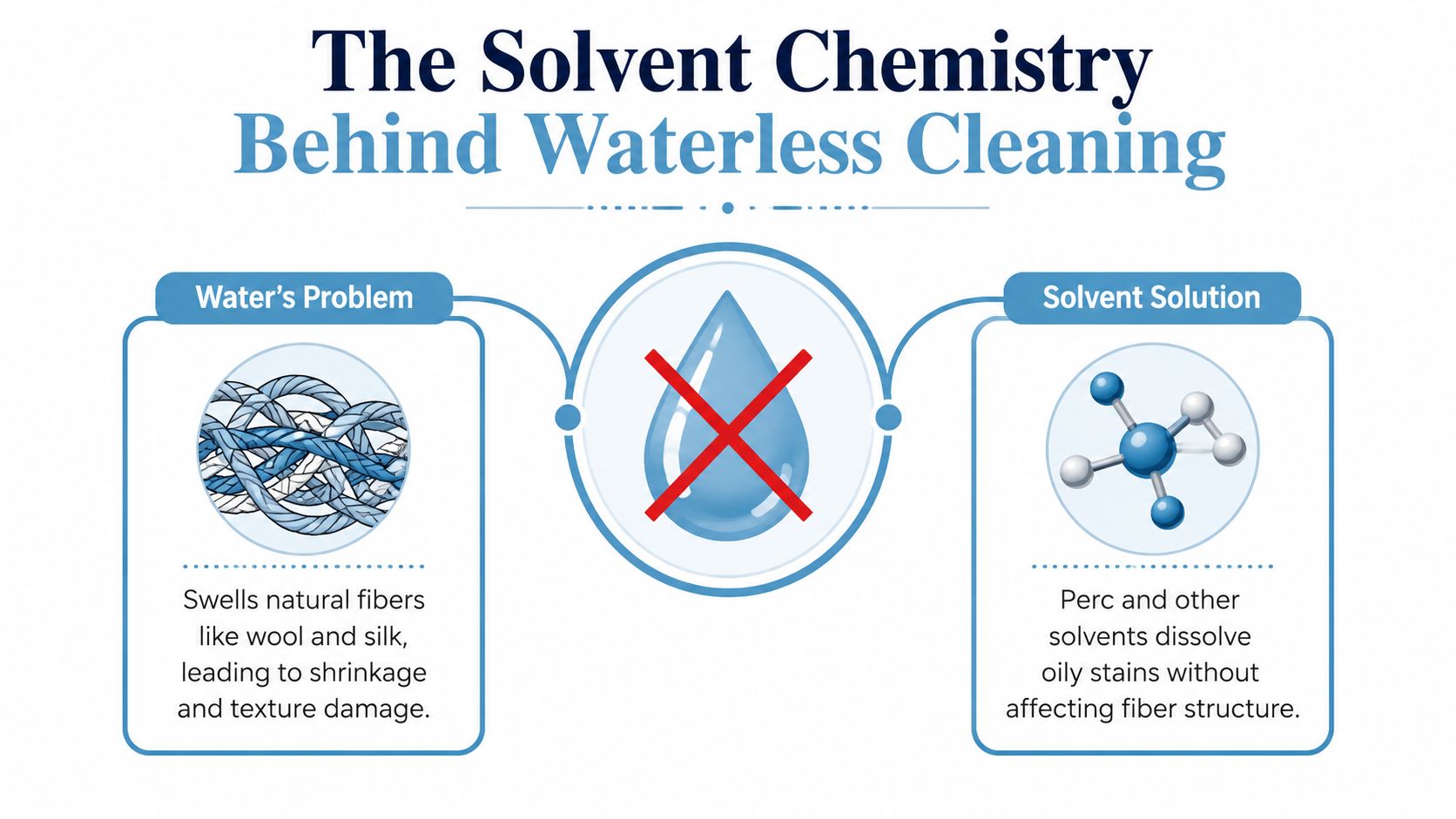
Walk into a dry-cleaning counter in Singapore with a silk blouse, a wool blazer, or a dress with stitched structure, and the cleaner is usually thinking about one question first, how will this fabric react to water? Water and oil do not mix well, and that simple fact explains most of the dry cleaning process in plain language. Sweat, food grease, makeup, collar soil, and many everyday marks are oil-based or partly oily. A water bath can spread some of those soils around, while a solvent can lift them away without forcing the fabric to swell the way water does.
Natural fibres like wool and silk behave differently from cotton or polyester when moisture enters the cloth. They can swell, relax, or change shape, and under the wrong conditions that can lead to shrinkage or a rougher surface. That is why the process was built around solvent cleaning, not around making water behave better.
The chemistry story also matters. A major turning point was the adoption of perchloroethylene, or perc, in the 1930s. Industry history identifies it as the dominant solvent by the mid-1930s because it was more effective and less flammable than earlier petroleum-based solvents, a shift that helped dry cleaning operate more safely in dense urban settings like Singapore's city environment, according to this historical overview of dry-cleaning chemistry.
Professional systems do not just splash solvent around and stop there. The workflow includes a recovery loop, which means the solvent is reclaimed, filtered, and reused inside a closed system. Sector guidance from the European Environment Agency explains that the solvent-recovery step is central to conventional dry cleaning, because it affects residual solvent on garments and the amount lost to the air or waste stream, as described in EEA's sector guidance for dry cleaning.
That is why technicians pay attention to pre-treatment, agitation control, and hot-air drying. The garment has to come out deodorised, clean, and stable in appearance. The chemistry is not an add-on. It is the reason the garment survives the trip.
Bottom line: the most important variable in dry cleaning is not the hanger or the press, it is the solvent choice and how tightly the system controls it.
The solvent works like a targeted carrier. It reaches oily soils that water struggles with, then it is removed from the fabric by spinning, drying, and recovery. That controlled loop is why the same blouse can be cleaned without the kind of soaking and agitation that would be perfectly fine for a towel but risky for silk.
If you want a local example of how that workflow is presented to customers, Tumble Laundry's dry cleaning service page shows the service as a managed process rather than a single machine step.
The first thing a trained technician does is look closely, not wash. That sounds obvious, but it's where most quality mistakes are prevented. A garment arrives with its own history, a faint tear, a loose button, an old stain, a tricky seam, and those details have to be logged before any machine touches it.
At intake, each item is inspected and tagged so it can be tracked through the facility. Existing damage gets noted, and obvious marks are pre-spotted before cleaning starts. That early stain work matters because once a stain goes through heat, it can become harder to remove later, and the technician loses flexibility.
The video walkthrough of a dry-cleaning workflow shows the same basic logic in motion, check first, clean second, finish last.
After inspection, garments are sorted by fibre type, colour, and soil level. This prevents dye transfer, avoids over-agitation, and keeps heavier items from roughing up lighter ones. A wool blazer doesn't belong in the same treatment lane as a lightly soiled blouse, even if both look “just a bit dirty” to the customer.
The cleaning stage takes place in a sealed machine where the garment is agitated in solvent rather than water. Once the cycle ends, the solvent is spun out, which reduces what's left in the fabric before thermal drying begins. That extraction stage is a big part of why the process is safer than leaving solvent trapped in the garment.
Then warm air finishes the job, evaporation completes, and the item moves to pressing, steaming, or reshaping. Finishing is not cosmetic fluff, it restores the drape and silhouette that made the garment worth dry cleaning in the first place. For a clearer view of how a provider organises this work, the store and service information on Tumble Laundry's locations page gives a practical sense of how the front counter connects to the back end.
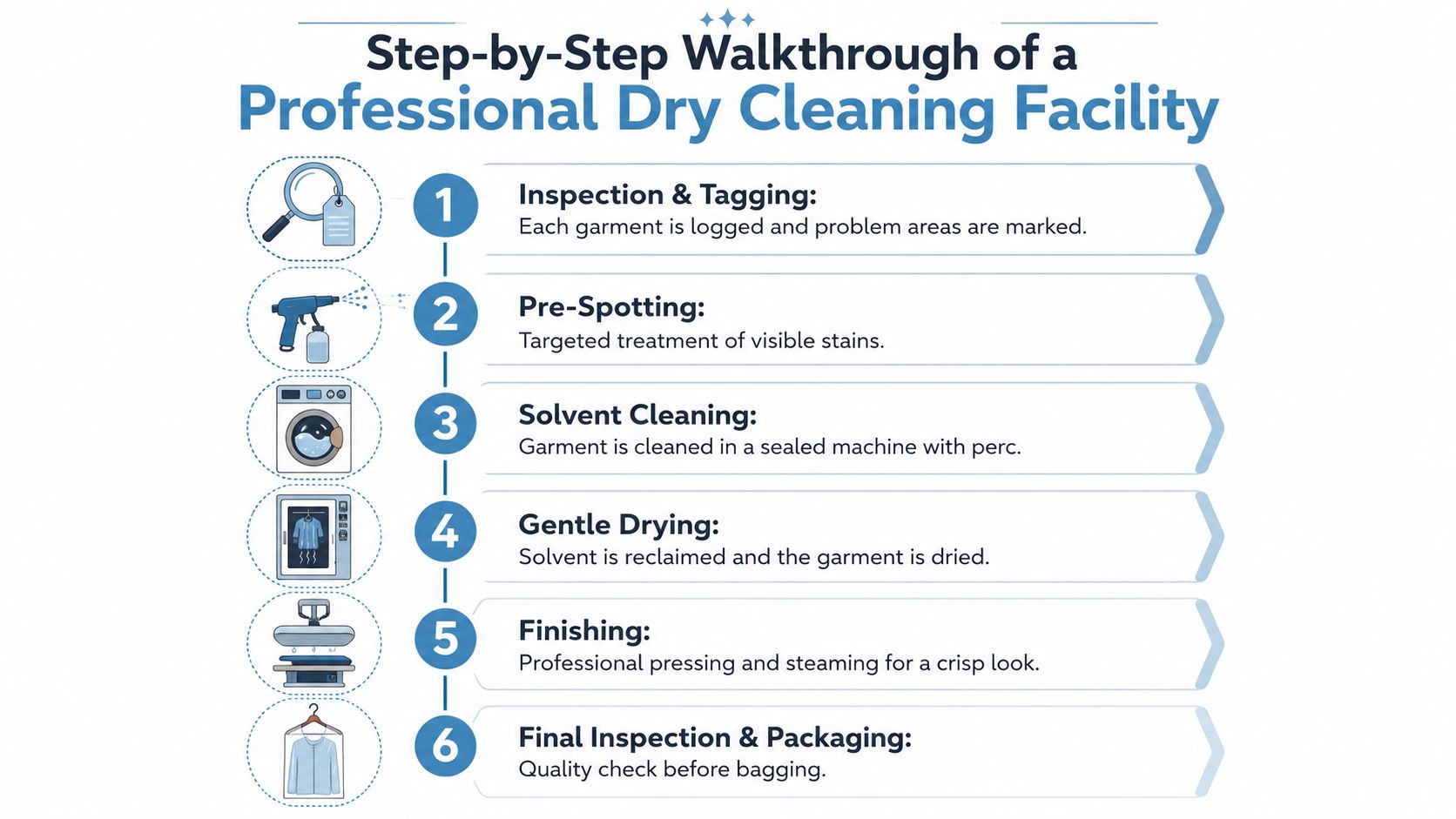
This process takes longer than a standard wash because each stage needs human judgement. The technician has to check what's safe, the machine has to run a controlled cycle, and the garment has to cool, dry, and be finished properly before packaging. Speed is useful, but with delicate clothing, repeatable handling matters more than haste.
Stains are where customers most often see the value of professional care, because not every mark behaves the same way. A coffee splash, a grease smear, and an ink line may all look like “stains,” but they sit in different chemical families and need different pre-treatment approaches. The best results usually come when the customer tells the counter staff what caused the stain, not just where it is.
Protein-based stains like blood or dairy respond differently from oil-based stains like makeup or dressing. Tannin-based stains, which include coffee and wine, often need a different agent again. Dye-based stains are the hardest to promise on, because they can transfer or bind into fibres.
Stain FamilyCommon SourcesPre-Treatment AgentExpected OutcomeProtein-basedBlood, dairyProtein-focused spotting treatmentOften improved when treated earlyTannin-basedCoffee, wineTargeted stain remover matched to the markGood chance of reduction, depending on ageOil-basedMakeup, greaseSolvent-based pre-spottingStrong response on many fresh marksDye-basedInk, colour transferSpecialist spot treatmentVariable, sometimes partial removal
That table keeps the decision practical. The point is not to memorise chemistry terms, it's to understand why a technician asks what happened before reaching for a spotting tool.
Some stains are called permanent because the pigment or residue has bound too tightly into the fibre, or because heat, friction, or home treatment has already set it. That doesn't always mean nothing can be done, but it does mean the cleaner has to give a realistic expectation before work begins. A thoughtful cleaner protects the garment first and avoids overpromising.
For a useful home reference on how stain removal principles differ for textiles and soft furnishings, The Drapery Company's care guide is a sensible read because it shows how fabric type changes the cleaning decision.
Bring the item in as soon as practical, point out the mark, and say what caused it if you know. Home remedies often push the stain deeper, especially on delicate fibres, and that makes the professional job harder. The cleaner can do more with clear information than with a mystery stain that's already been rubbed and heated.
Traditional dry cleaning and professional wet cleaning are not the same service, even though both can be suitable for garments that you wouldn't casually throw in a home machine. Perc-based cleaning uses solvent, while professional wet cleaning uses water with controlled detergent chemistry and specialised finishing. The key question for many Singapore customers is not which sounds more modern, it's which one protects the garment best for that specific fabric and stain.
Perc remains a strong choice for structured garments and oily soils because it handles grease well and preserves shape under a controlled process. Wet cleaning can be a better fit for garments that tolerate moisture but still need professional handling, especially when the cleaner uses careful agitation and finishing rather than standard laundry methods. Environmental pressure has pushed the industry to think harder about solvent recovery, emissions control, and lower-impact alternatives, which is why this comparison keeps coming up in modern garment care discussions, including the NPS museum preservation paper on changing dry-cleaning practices.
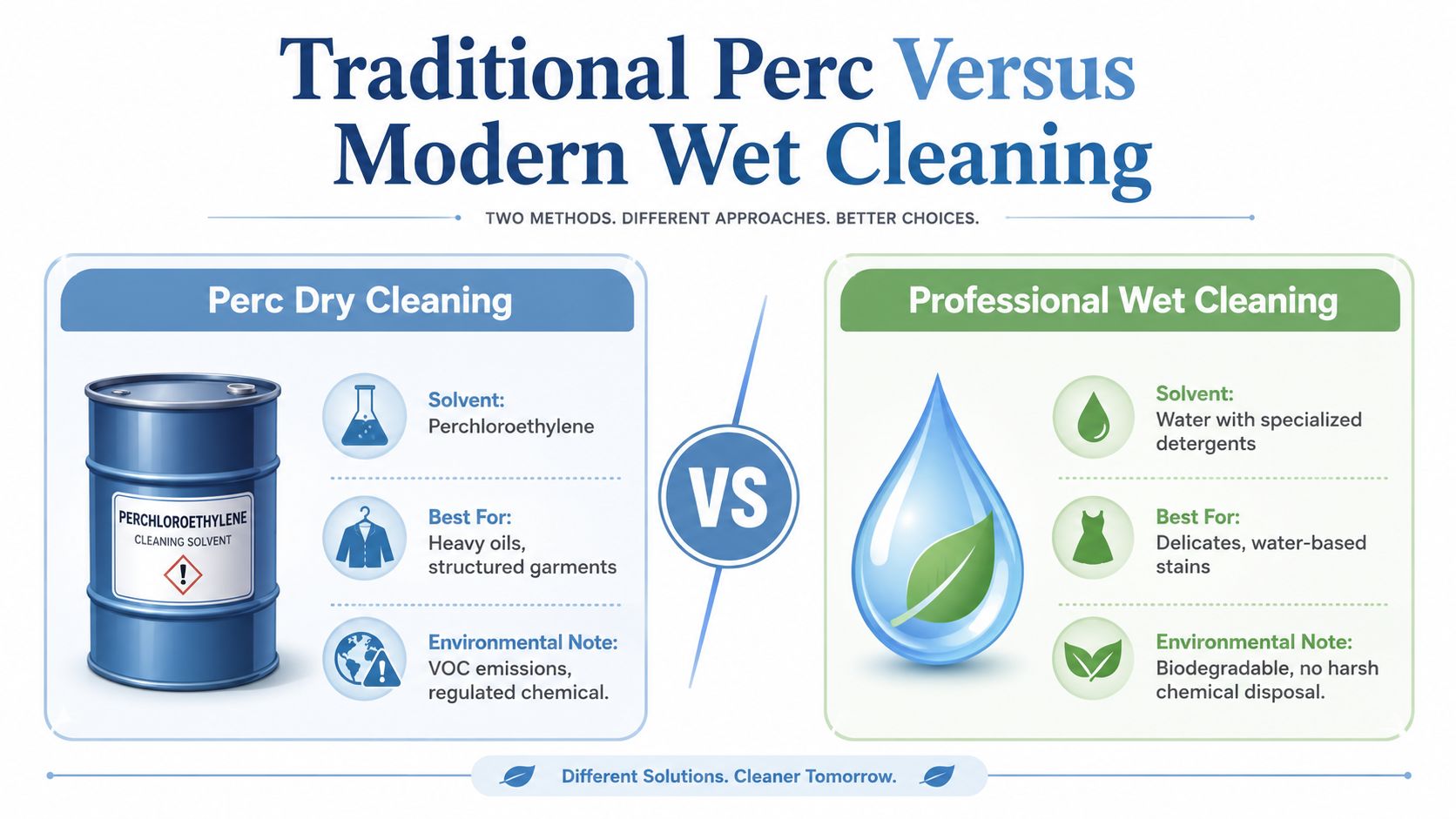
A heavily structured suit, oil-soiled silk, or a garment with linings and padding often still belongs in the dry-cleaning lane. A cotton blend blouse, a synthetic work top, or a lightly soiled garment may do well with professional wet cleaning if the facility has the right equipment. The fabric outcome is what matters most, hand-feel, colour retention, and drape all need to survive the process.
Some cleaners also use other solvent systems or hybrid garment-care approaches, but the logic stays the same, match the method to the fabric's tolerance and the stain's chemistry. If you want a plain-language explainer of one common detergent ingredient used in cleaning contexts, Fillaree's page on sodium carbonate is a useful reference point for understanding alkaline cleaning help in a broader sense.
Practical rule: choose the process that protects the garment's structure first, then ask whether the result also fits your environmental preferences.
The internal comparison between care methods is also useful if you're deciding between professional services and standard laundry, and this laundry versus dry cleaning guide from Tumble Laundry lays that distinction out in everyday terms.
For many Singapore households, convenience isn't a bonus, it's the deciding factor. A jacket that needs cleaning shouldn't require a detour across the island, and a business shirt shouldn't sit in a bag for days because the drop-off window didn't fit your schedule. Pickup and delivery turn the dry cleaning process into a managed service, not another chore.
What the logistics layer adds
A good provider starts with collection scheduling, then brings the garments into an in-house facility for inspection, cleaning, finishing, and packaging. That centralised model matters because the cleaner sees the item from start to finish, rather than passing it between multiple vendors. Tumble Laundry, for example, describes islandwide pickup and delivery with in-house processing, so the garments stay under one operational system instead of being outsourced midstream.
That structure supports the details customers care about, itemised tracking for by-piece orders, care-label checks at intake, and dedicated loads so your items aren't mixed with everyone else's. It also makes it easier to request preferences such as hypoallergenic finishing or special handling at the point of collection.
The service doesn't end when the garment leaves the press. Finished items should come back on hangers, in protective sleeves, and with the shape preserved enough that you can put them straight into the wardrobe. That final delivery stage is part of quality control, because a flawless cleaning job loses value if the garment arrives creased, crushed, or poorly packed.
If you're comparing options, subscription plans and pay-as-you-go services become useful rather than abstract. They let households choose a rhythm that matches how often they need cleaning, and they keep the process simple for uniforms, office wear, and special-occasion pieces.
Pickup, tracked cleaning, finishing, and return delivery form one chain. If any link is weak, the service feels inconsistent. If every link is controlled, the garment care feels effortless to the customer and exacting to the technician.
Not every garment needs the same treatment, and that's the simplest way to avoid damage and waste. Structured suits, silk pieces, wool items, beaded garments, and heavy oil-stained clothing usually belong in professional dry cleaning because they benefit from solvent handling and careful finishing. Casual cottons, many synthetics, and everyday basics often do fine with standard washing if the care label allows it.
The label still comes first. “Dry clean only” is a clear instruction, while “dry clean” usually means the garment can be dry cleaned but may have other care possibilities if the fabric and construction allow it. If a piece is expensive, structured, or sentimental, the safer choice is usually the one that preserves its shape.
Airing out a garment after wear can reduce how often it needs treatment. Rotating suits and jackets gives fibres time to recover, and storing cleaned pieces on proper hangers helps preserve the line of the shoulders and sleeves. Those habits don't replace professional care, but they make each visit count for longer.
Dry cleaning should be the method you choose for preservation, not the method you reach for by default.
If you want a service that handles pickup, cleaning, pressing, and return delivery in Singapore, Tumble Laundry offers islandwide collection and door-to-door return with in-house processing. For garments that need careful handling, it's a practical way to move from stained or wrinkled to ready-to-wear without managing the facility work yourself.

We make laundry days fast and easy for you. We collect, clean and deliver your laundry and dry-cleaning.
53 Ubi Ave 1 #03-43, Singapore 408934
Mon - Fri | 8:30 am–5:30 pm
Sat | 8:30 am–12:30 pm
hello@tumble.sg
+65 62554222
Whatsapp Us


