Commercial Laundry Trolley on Wheels: Buyer's Guide 2026
This is some text inside of a div block.


You know the scene if you've ever walked a Singapore laundry floor at 7 a.m. Linen bags are already piling up, one lift is being shared with housekeeping, and the trolley that looked fine on paper starts dragging at the first tight corner. In a facility like that, a commercial laundry trolley on wheels is not a side purchase, it's part of the workflow that keeps sorting, washing, drying, ironing, and dispatch moving without staff backtracking every few minutes.
A good trolley disappears into the routine. A poor one becomes the thing people complain about, because it slows collection runs, scuffs floors, and makes every turn feel heavier than it should. That is why trolley selection in Singapore needs to be judged against corridor width, lift access, cleaning chemistry, and actual load handling, not just the brochure photo.
A central laundry room in Singapore rarely has the luxury of wide, open aisles. More often, staff are steering sacks of linen between sorting benches, washer-extractor banks, dryers, finishing stations, and a dispatch point that seems to sit just a little too close to the corner. In that kind of layout, the wrong trolley doesn't just move badly, it creates a small traffic jam every time someone turns around it.
That matters because Singapore's commercial laundry sector is large enough that PUB has issued a dedicated commercial-laundry water-efficiency guide, which is a strong signal that the sector carries real operational weight here. It also fits the local operating model, where centralized facilities serve hotels, institutions, and recurring contract clients across a dense city-state. A trolley that works in a spacious warehouse in another market may be awkward in a compact back-of-house setting here, especially when staff need to move linen through service lifts, loading bays, and islandwide collection routes.
The first failure mode is speed. If a trolley catches on door thresholds, needs two staff to steady it, or forces extra trips because it can't take a full batch comfortably, the whole line slows down. The second failure mode is damage, either to floors, walls, or the trolley itself. The third failure mode is fatigue, because repeated pushing and pulling in narrow spaces wears people down long before the shift ends.
Practical rule: if the trolley makes staff slow down at every transition point, the trolley is already costing you more than the purchase price.
It's also worth comparing laundry handling with other back-of-house workflows. The best kitchen trolleys for restaurants article is a useful reference point because it shows how much value there is in choosing transport gear around real movement patterns, not just capacity labels. For Singapore laundry teams, the same logic applies, but the space constraints are usually tighter and the load cycles are heavier.
For a local operating lens, the habits in this guide pair well with the practical advice in Tumble's laundry best practices in Singapore, especially if your site runs recurring contract work and has to keep carts moving on a predictable schedule.
Capacity is the first spec buyers check, and it is also the one most often misread. In Singapore, commercial laundry trolleys used in industrial and healthcare settings are commonly specified with safe working loads in the 200 to 300 kg range for standard models, while heavier-duty trolley and castor assemblies are published at 400 kg, 500 kg, and even 1,000+ lb class capacities in the local market Allinton trolley castor guidance. That range only helps if you relate it to the way loads move through service lifts, narrow corridors, and loading bays.
The test is not whether a trolley rolls when empty. It is whether it still tracks properly when one side is heavier, the load shifts, and the trolley meets a threshold or uneven tile. Full linen cages and bundled bag loads do not sit neatly on a spec sheet. They lean, settle, and move during push-pull cycles, which is usually where weak castor sizing shows up first.
A useful local rule is to size the total rated castor capacity at at least 1.5 times the trolley's maximum working load. That margin gives you room for turns, ramps, floor transitions, and the sideways nudges that happen in tight back-of-house routes. If the trolley will be loaded unevenly or used by staff who have to correct its path often, that buffer protects bearings, frames, and confidence at the point of use.
Load format matters too. A trolley that is technically strong enough can still feel unstable if the weight sits high or is stacked to one side. That is why commercial laundry bags should be part of the sizing conversation, not an afterthought. The bag shape changes how the load settles on the platform, and that affects stability more than many buyers expect.
A trolley rated too close to your real load often looks fine in procurement and becomes a daily problem in service.
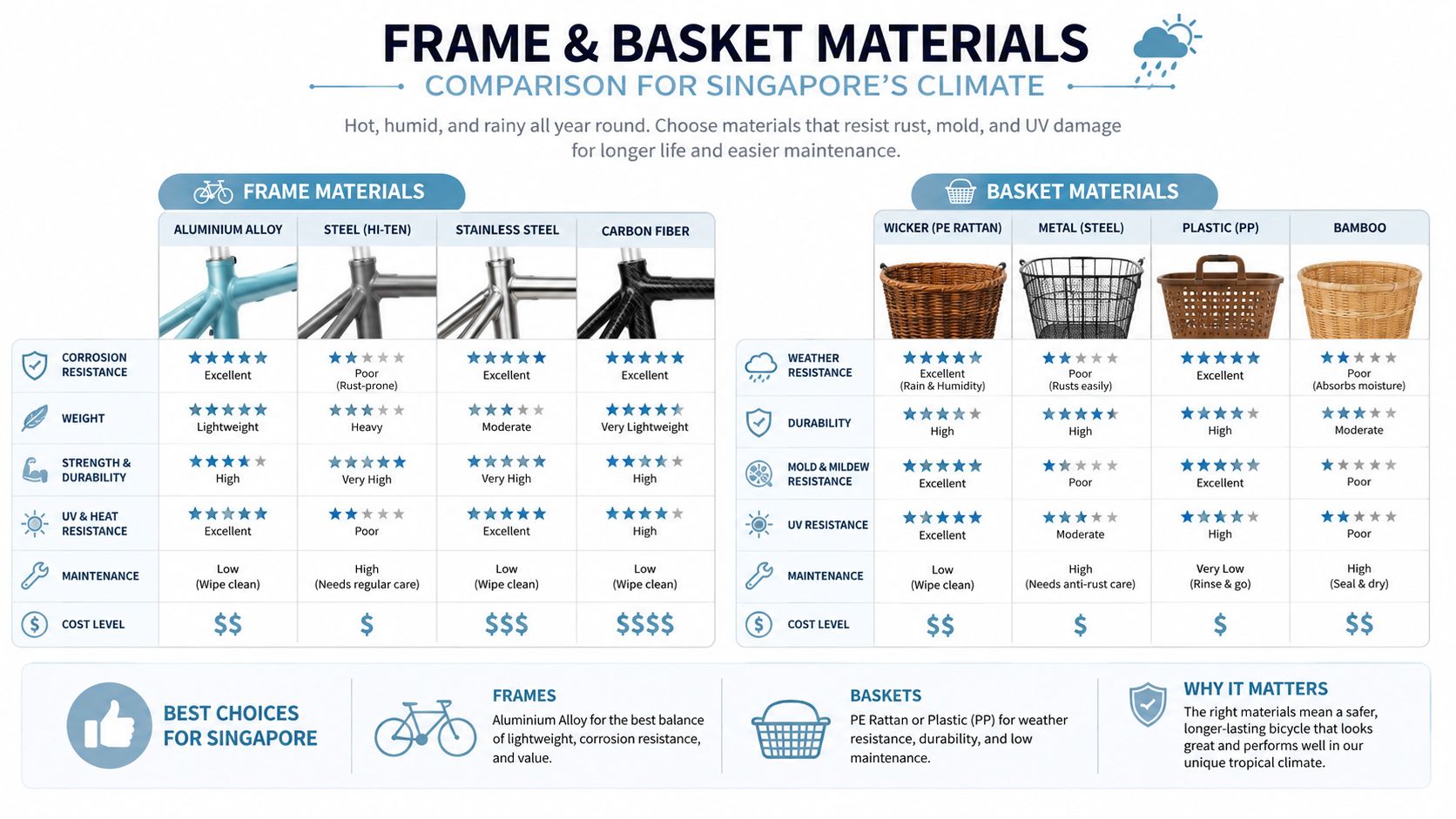
Singapore's humidity changes what “durable” means. A trolley that looks sturdy on delivery can still become a maintenance problem if its frame rusts, its finish chips, or its basket traps moisture and detergent residue. That is why material choice should be based on both corrosion resistance and how often the trolley needs to be washed down.
Stainless steel is the most obvious choice when hygiene and longevity matter. It usually costs more up front, but it holds up well in wet environments and is easier to keep presentable in facilities that care about appearance, especially hotel-facing operations. Powder-coated mild steel is a workable middle ground, but once the coating is damaged, corrosion can spread quickly if the trolley is exposed to repeated washing or harsh chemistry.
Aluminium is lighter, which helps when staff are moving carts repeatedly or when the trolley has to be lifted into vehicles. The trade-off is that lighter frames can feel less forgiving under rough handling, so they need to be chosen with care if the trolley will live in a heavy-duty industrial environment. Heavier frames also eat into usable payload, so the strongest-looking option is not always the most efficient one.
Basket material matters just as much as the frame. Heavy-duty polyethylene is easy to wipe down and is often a practical choice where contamination control matters. Wire mesh improves airflow during transport, which helps when linen needs to breathe between wet and dry stages, while canvas liners are gentler on delicate items but need more attention to cleaning and wear.
The coastal edge of Singapore matters too, because salt air and frequent cleaning can shorten the life of the wrong finish. If your team already struggles to keep equipment clean between shifts, a material that resists staining and does not trap residue saves time every week.
A good visual reference for material trade-offs is below.
If your operation sits under a structured finishing workflow, curtain steam cleaning is a useful reminder that soft goods handling often needs equipment that is both cleanable and gentle, not just strong.
The best frame is the one your team can keep clean without thinking about it twice.
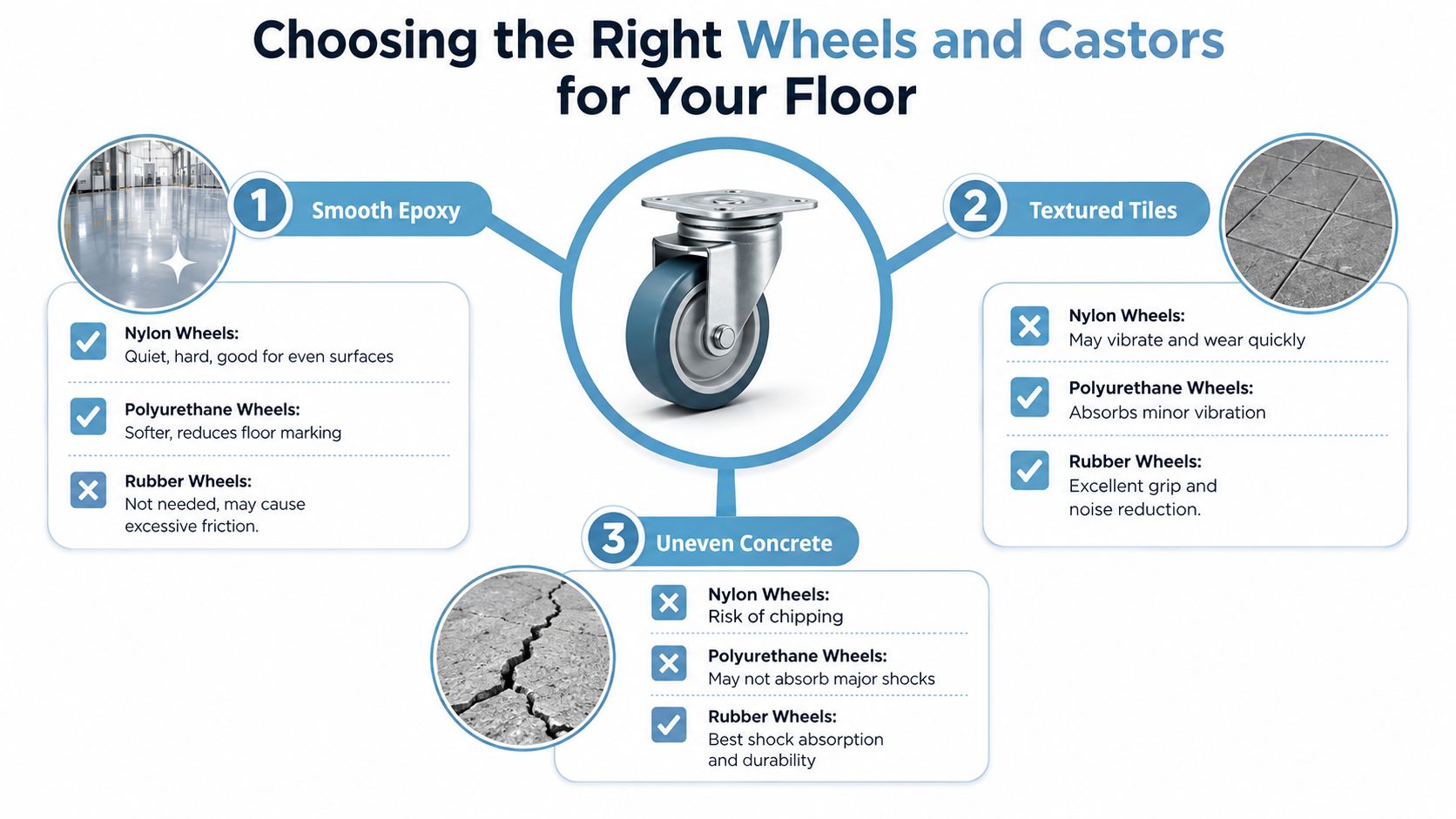
A trolley that runs well in one Singapore facility can be a nuisance in another. Smooth epoxy floors in a central laundry plant, textured tiles in a hotel back corridor, and patched concrete at a loading bay all place different demands on the wheel. The cart that feels quiet and light in the showroom can rattle, mark the floor, or fight the turn once it meets real service conditions.
Nylon wheels suit smooth floors and roll with little effort. They are a practical fit for clean epoxy surfaces, but they pass more vibration and noise into the trolley, and they are less forgiving on rough ground. Polyurethane is often the middle ground for local operations because it rolls well, stays quieter, and is kinder to floors. Rubber gives better grip and shock absorption on uneven concrete or in areas where noise control matters, though it can feel heavier under load.
Swivel castors help staff turn through narrow back-of-house routes and tight corners. Fixed castors keep the trolley tracking straight, which suits longer runs and reduces wandering when the cart is heavily loaded. In practice, many facilities use a mixed setup because full swivel can feel loose in cramped rooms, while full fixed can be awkward where manoeuvring space is limited.
Brakes are necessary wherever a trolley may rest on a slope, in a vehicle, or near a ramp. A trolley that rolls during loading creates a safety problem, not just an inconvenience. Larger wheel diameters help with thresholds and small debris, but they still need to clear the undercarriage and avoid pushing the centre of gravity too high.
Practical rule: Match the wheel to your floor type, load weight, and turning requirements, quietness alone is not the deciding factor.
The selection guide below is a practical visual reference.
For teams managing multiple cart types, Tumble's commercial laundry overview is a useful way to think about handling flow as a system rather than as a single purchase.
A trolley can be structurally sound and still fail the first practical test; it may not fit. In Singapore, that risk is higher because service lifts, corridor widths, and loading areas often leave little spare room. If your trolley needs diagonal angling, repeated repositioning, or manual lifting at the doorway, the spec is wrong even if the capacity looks impressive.
The constraint is usually the tightest point in the journey from delivery vehicle to final storage. If the trolley fits the bay but not the lift, the entire route breaks down. If it clears the lift but can't turn comfortably into the laundry room, staff end up doing awkward manoeuvres that damage walls and slow every run.
Stacking and nesting features matter because storage is always at a premium in centralised Singapore operations. A compact nesting profile can reclaim valuable floor space at the end of a shift, which is especially helpful when the trolley fleet has to sit beside production equipment. On the transport side, islandwide collection often means a trolley also has to fit sensibly inside a van or truck without triggering oversized movement complications.
CBRE's note that 76% of logistics occupiers in Asia Pacific plan to expand their real estate footprint over the next three to five years is a reminder that logistics users are still under pressure to make better use of existing space CBRE Singapore logistics release. That pressure is easy to feel in Singapore industrial sites, where every unnecessary centimetre of trolley footprint affects circulation.
The constraint diagram below shows why the lift often becomes the deciding factor.
If the trolley cannot pass the service lift cleanly, the rest of the route doesn't matter.
That is why a real site test matters more than a catalogue measurement. Roll the trolley from receiving to dispatch, through the narrowest corridor, into the lift, and back again under load. A trolley that behaves well in that loop is usually the one that will keep working after months of daily use.
The best trolley is not the one that carries the most linen. It's the one that lets staff push safely, repeatedly, and without unnecessary strain. In repetitive hotel, hospital, and laundry work, that difference affects fatigue, injury risk, and how long people can keep doing the job comfortably.
Singapore's Workplace Safety and Health guidance is direct on the basics. Loads should be placed evenly, secured so they do not slip, not overloaded or piled too high, and pushed rather than pulled on level ground TAL WSH transport guidance. Those are simple rules, but they are often ignored when teams are under time pressure and try to squeeze one more bundle onto a cart.
Handle height changes force more than most buyers expect. One study found 110 cm handle height minimised pushing force, and a 150 mm wheel diameter helped reduce discomfort during trolley pushing TAL WSH transport guidance. That lines up with daily experience, where a handle that is too low bends the back, and one that is too high makes it harder to keep control through turns.
Grip positioning also matters. A handle that allows a neutral wrist position is easier to hold across a whole shift, especially when staff are moving between wet and dry zones or between rooms with different floor friction. Trolley geometry matters too. A narrow base may turn easily but tip more readily when the load is uneven, while a broader stance can feel safer but may be harder to work through tight doors.
If your operation includes mixed garment handling, dry cleaning process workflows are a good reminder that careful movement is part of quality, not separate from it.
Staff notice the difference between a trolley that rolls and a trolley that fights them.
The long-term cost of poor ergonomics is usually invisible at purchase time. It shows up later in slower shifts, more care needed around manual handling, and equipment that gets abandoned in favour of whatever staff find easiest to use, even if it's the wrong tool for the job.
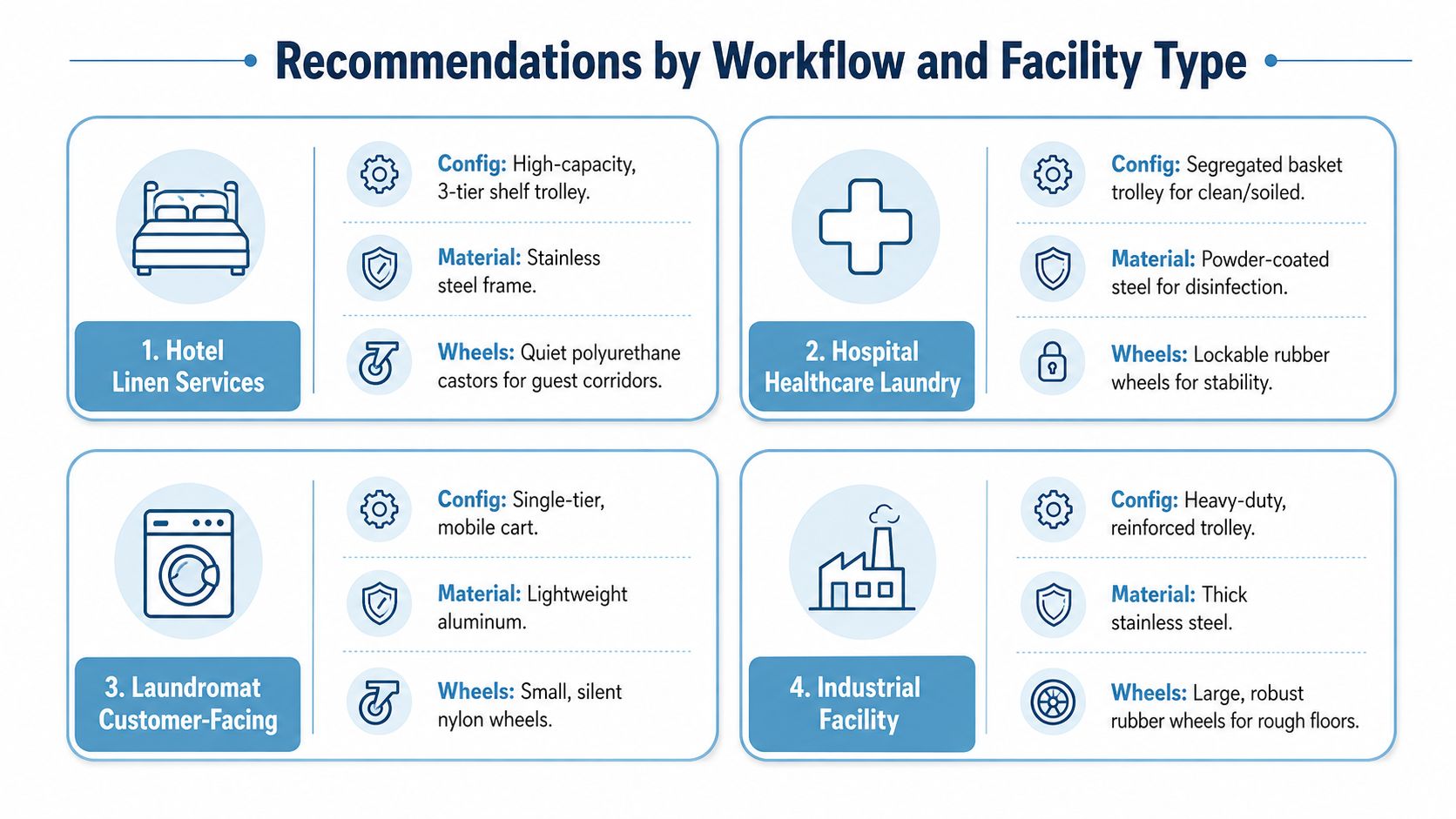
Hotel laundries usually need a trolley that moves, looks clean, and keeps linen organised between guest-facing and back-of-house zones. A stainless steel frame with polyurethane castors is often the best practical combination, because it balances appearance with floor protection and low noise. If the route passes through guest corridors, the wheel choice matters almost as much as the load rating.
Hospital and healthcare operations should treat segregation and stability as the main priorities. A trolley with clear clean-soiled separation, easy-to-wipe surfaces, and lockable wheels makes sense when hygiene and control matter more than appearance. Powder-coated steel can work if maintenance is disciplined, but it needs close inspection because damaged coating becomes a weak point quickly.
Laundromat or customer-facing operations usually want mobility and visual simplicity. Lightweight carts are easier to reposition and less tiring when staff are constantly moving loads from intake to finishing. In those settings, a quieter wheel choice and a compact footprint usually deliver more value than aggressive heavy-duty specifications.
Industrial contract laundries sit at the other end of the scale. They need reinforced frames, higher load tolerance, and wheels that tolerate rougher floors and repeated abuse. If the site runs rough concrete, rubber castors are often the safer bet because they absorb more shock and hold grip better under heavier loads.
A summary reference is useful here.
Run the trolley over the actual path it will use, not a showroom floor. Load it with real linen weight, push it through the narrowest corridor, and check whether the wheels chatter, drag, or mark the floor. If the supplier won't let you test under load, that's a warning sign.
Warranty terms matter too. Ask what counts as normal wear, what is covered on the frame versus the castors, and whether replacement parts are available locally. If the supplier cannot support that conversation clearly, the trolley may be cheap for the wrong reasons.
For teams reviewing service fit alongside equipment choice, Runera's commercial cleaning solutions can be a useful benchmark for how operational support should be framed around real facility needs, not generic product descriptions.
If you're buying for a hotel, hospital, industrial site, or mixed laundry operation in Singapore, Tumble Laundry can help you think through the handling chain from collection to delivery with a practical local lens. Visit Tumble Laundry to see how islandwide laundry service, in-house processing, and recurring commercial support fit into the same operational reality your trolley has to serve.

We make laundry days fast and easy for you. We collect, clean and deliver your laundry and dry-cleaning.
53 Ubi Ave 1 #03-43, Singapore 408934
Mon - Fri | 8:30 am–5:30 pm
Sat | 8:30 am–12:30 pm
hello@tumble.sg
+65 62554222
Whatsapp Us


