Curtain Steam Cleaning: A Guide for Singapore Homes
This is some text inside of a div block.


After the monsoon, it's common to pull back a set of curtains in a Singapore flat and catch the same three clues at once, dust along the folds, a faint musty smell, and wrinkles that never quite drop out, no matter how long the windows stay open. In a high-rise home, that mix is stubborn because the fabric has been sitting in humid indoor air, urban dust settles quickly, and there's rarely enough space to dry panels properly once they've been washed.
That's why curtain steam cleaning gets so much attention here. It sounds like the neat answer, fast, low-fuss, and gentle on fabric, but in Singapore it's not always the right default. Some curtains really do benefit from a controlled steam refresh, while others need a deeper clean, careful takedown, or a different method altogether.
The local context matters. Singapore's housing stock is heavily apartment-based, with about 79.9% of resident households in HDB flats and about 18.4% in private condominiums or apartments, according to the Singapore Department of Statistics' latest household data in the brief, and that same source context puts the country at about 1.41 million resident households in 2023. In homes like these, practical decisions matter more than theory, because drying space is limited and reinstallation is a chore.
A lot of Singapore homeowners reach for steam after they've already tried the usual fixes, opening windows, running the fan, and hoping the curtains will look fresh again on their own. The problem is that curtains don't just hold wrinkles, they hold dust, cooking residue, and humidity that settles into the fabric over time. In a compact apartment, that combination is hard to ignore because the curtains are always part of the room's air, colour, and smell.
The local housing reality makes the decision more specific than it sounds. With most resident households living in HDB flats and a substantial share in private condominiums or apartments, curtains are usually installed in spaces where taking them down is inconvenient and drying them is even more awkward. That's why a service that can refresh fabric without a full wash often feels like the obvious answer, especially after a wet season or a busy stretch of cooking and air-con use.
But steam has a reputation that's stronger than its actual use case. It can smooth, freshen, and reduce surface odour, yet it can also be the wrong tool for curtains that are heavily soiled, lined, coated, or too close to walls and electrical fittings. A good decision starts with understanding what steam does well, what it doesn't touch, and when the safer move is a proper clean or dry-clean treatment.
For Singapore homes, that distinction matters more than in drier markets because moisture behaves differently here. Curtains can look fine on the surface while still carrying the kind of trapped buildup that steam won't remove. Once you know the limits, you can stop treating steam as a universal fix and start using it as one tool in a more sensible curtain-care routine.
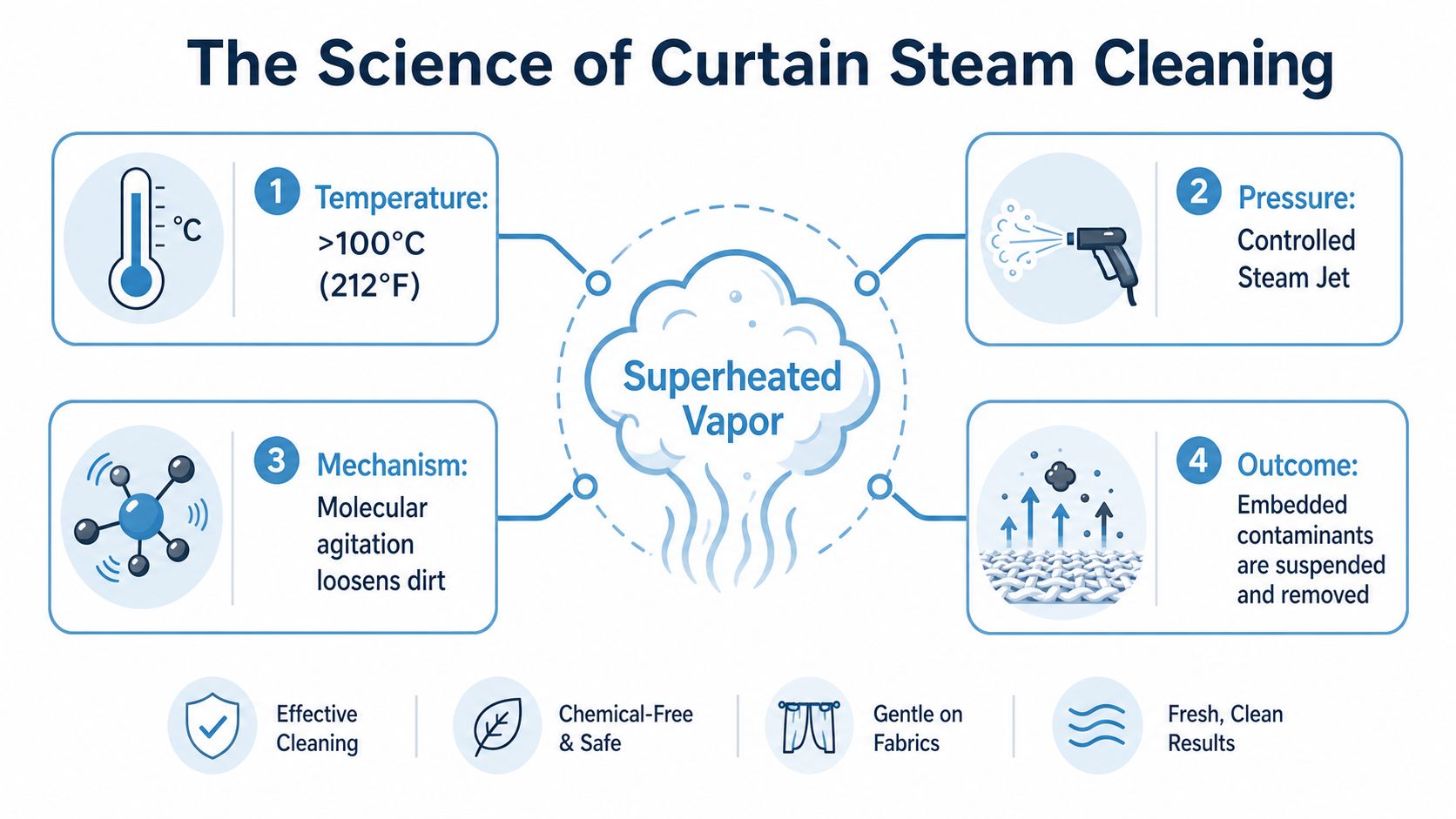
Curtain steam cleaning uses superheated vapor to relax fibres, loosen surface soil, and release wrinkles without soaking the fabric the way a full wash does. The steam rises through the textile, works into the weave, and helps shift particles so they can be lifted away more easily. It is a targeted refresh, not a full restoration.
The limitation shows up fast in real homes. Steam can soften dust and reduce a stale smell, but it does not pull out embedded grime the way washing or extraction can. Curtains in Singapore often collect cooking residue, air-con dust, and humidity at the same time, so the surface may look acceptable while dirt stays trapped deeper in the fabric.
A quick facial steam and a deep-cleansing mask work at different levels. Steam opens and loosens fibres, while washing removes more of what has settled inside them. That difference matters because many homeowners treat any hot vapour treatment as a substitute for cleaning, and it is not.
Practical rule: steam is useful when you want the curtain to look and smell fresher, not when you need to strip out embedded grime.
The local housing setup makes the choice more specific. Many resident households live in HDB flats, and many others live in private condominiums or apartments, so curtains often hang in spaces where taking them down is inconvenient and drying them is even more awkward. Steam can still appeal because it avoids full immersion and the long dry-down that comes with washing, which is useful in a humid high-rise home where airing space is limited.
That convenience has boundaries. If the curtain is structurally sound, only lightly marked, and suitable for moisture and heat, steam can be a sensible maintenance method. If the panel is lined, coated, delicate, or visibly dirty, steam often works as a surface refresh rather than a real clean. For a closer look at heat-based fabric care, see Tumble's steaming vs ironing guide, which helps show where steaming fits and where ironing or another method makes more sense.
The value of steam is speed and convenience. The limit is depth. Once those two points stay separate, it becomes much easier to choose the right treatment for a curtain in a Singapore home.
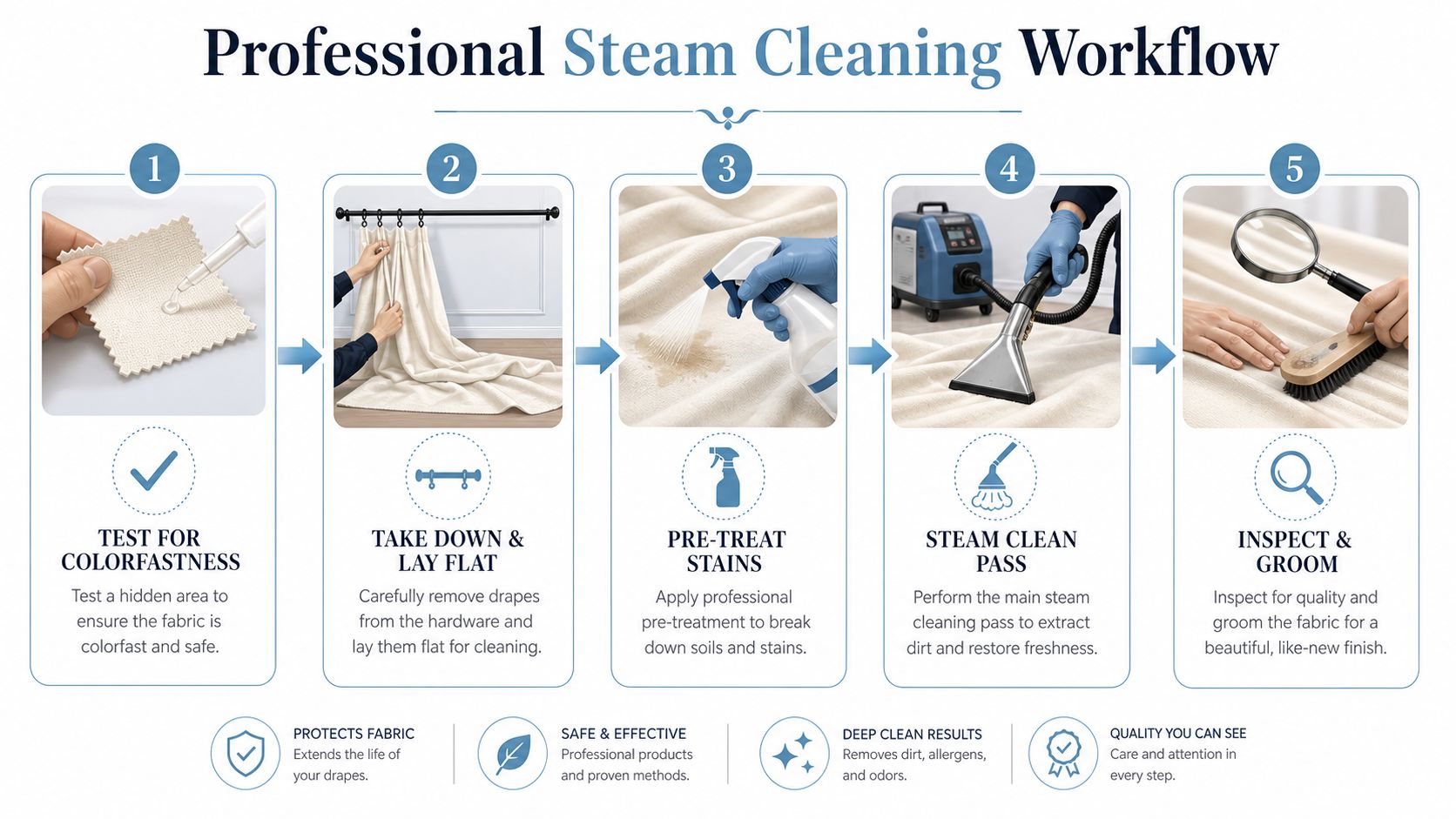
A professional job starts before any steam touches the curtain. The first check is always the fabric itself, because labels and fibre type decide whether the panel can handle heat and moisture at all. That's where a trained cleaner slows down instead of pushing ahead, since the wrong treatment can leave permanent shine, shrinkage, or lining damage.
The next step is often overlooked by DIY users, pre-vacuuming. One guide in the brief notes that thorough pre-vacuuming can remove 70 to 80% of surface dust before steam is applied, which matters because loose dust is easier to lift before it gets driven deeper into the weave. After that, a cleaner tests a hidden patch, especially if the fabric is unfamiliar or delicate. That small check can prevent a costly mistake on a whole set of curtains.
Cleaners do not steam first and hope for the best. They inspect, test, and only then treat the full panel.
From there, technique becomes the difference-maker. Professional guides recommend holding the nozzle roughly 5 to 15 cm from the fabric, then moving in slow vertical passes from top to bottom rather than blasting directly into the cloth. The point is to let the vapor loosen the fibres without flooding them with condensation, because excess moisture is what creates tide marks and ripple distortion.
Equipment matters too. The brief notes commercial curtain-steam units around 1,094 W with an 8 L clean-water tank, while consumer-style drapery steamers commonly sit around 1,200 to 1,700 W with tanks of about 180 to 300 ml and runtimes from roughly 10 to 27 minutes. On larger curtain jobs, the bigger tank reduces refill breaks and helps keep drying more even across panels.
The process finishes with airflow-assisted drying and a final grooming pass. That last phase sounds minor, but it's what keeps wrinkles from resetting while the fabric is still warm and slightly damp. For a service overview in Singapore, Tumble's curtain cleaning page gives a practical sense of how takedown, cleaning, and rehanging fit together as a single job.

Steam has real strengths. It refreshes the look of fabric quickly, softens wrinkles, and can reduce the stale smell that builds up in rooms with limited airflow. That's why it works well as a maintenance method for curtains that are otherwise in decent condition and just need a reset after months of daily use.
The convenience is the main selling point. Curtains stay up, the room doesn't need to be turned upside down, and the cleaning session can feel less disruptive than washing, drying, and rehanging. In Singapore's humid climate, that matters because a process that creates less downtime is often the one people follow through on.
But steam also has clear limits, and those limits are easy to ignore when the curtains only look a little tired. Steam adds moisture, so it can be a poor choice if the issue is embedded dust, cooking grease, or buildup trapped in lining layers. It also won't extract soil the way a proper wash or dry-clean process can.
Plain truth: if the curtain smells stale because it's holding on to deep dust or residue, steam may only make it look better for a while.
A Singapore-specific guide in the brief is blunt about this point, saying steam cleaning is useful for maintenance and quick odor control, but doesn't work as a substitute for real cleaning on heavier or more soiled curtains, which is exactly the nuance many consumer guides skip. That caution matters in humid apartments because a curtain that seems fine at arm's length can still be carrying buildup that returns as smell once the room closes up again. For that musty-fabric problem, this explanation of why curtains smell musty is a useful companion read.
The right way to think about steam is as a maintenance tool, not a restoration tool. It can improve appearance, reduce surface odour, and help curtains look cared for between deeper treatments. It cannot rescue fabric that has crossed into heavy soiling, moisture damage, or layered contamination.
Steam is only as safe as the fabric allows. That's the part many homeowners miss, because a curtain can look sturdy and still react badly to heat, moisture, or a too-close nozzle. The biggest mistake is assuming all curtains tolerate steam equally well.
Some fibres are straightforward, others are not. Polyester can lose its finish or deform under excessive heat, while blackout curtains can delaminate if their adhesive layers overheat. Care symbols matter here, especially when they indicate no water, dry-clean-only, or low-heat tolerance, because those instructions exist to stop exactly that kind of damage.
Fabric TypeSteam ToleranceKey RiskRecommended Max TemperaturePolyester blendModerate, only with controlShine loss, deformationKeep near the lower end of the usable rangeBlackout curtain with liningCautious, test firstAdhesive delaminationUse very short bursts and avoid excess heatLinenModerate, often needs careShrinkage or texture changeKeep heat controlled and avoid lingering passesCottonUsually manageableUneven drying, wrinkling resetModerate heat, with airflow after treatmentDelicate or care-labelled no-water fabricsLow or unsuitableSurface damage, distortionAvoid steam unless a professional confirms compatibility
The brief also notes a real temperature tradeoff. One source cited there recommends keeping steam at or below about 105°C with very short contact, under 8 seconds per 10 cm², to reduce surface damage, while another points out that steam above 120°C is often used for stronger microbial reduction but can exceed what delicate fabrics tolerate. That isn't a neat yes-or-no answer, it's a technical compromise.
If you're dealing with linen curtains in a kitchen or dining area, it's worth reading Joey'z Shopping's linen curtain advice for a useful reminder that linen needs thoughtful care, especially where moisture and heat are both in play. The same principle applies to the rest of the home, a fabric that looks sturdy can still be sensitive once you add steam.
Practical rule: when in doubt, start on an inconspicuous edge, then stop at the first sign of shine, softening, or shape change.
If the curtain has already shrunk or taken on a distorted line, don't force more steam into it. This guide on curtain shrinkage is a better reference point than guessing your way through another pass. The safest steam job is the one that respects the fabric before it chases the wrinkle.
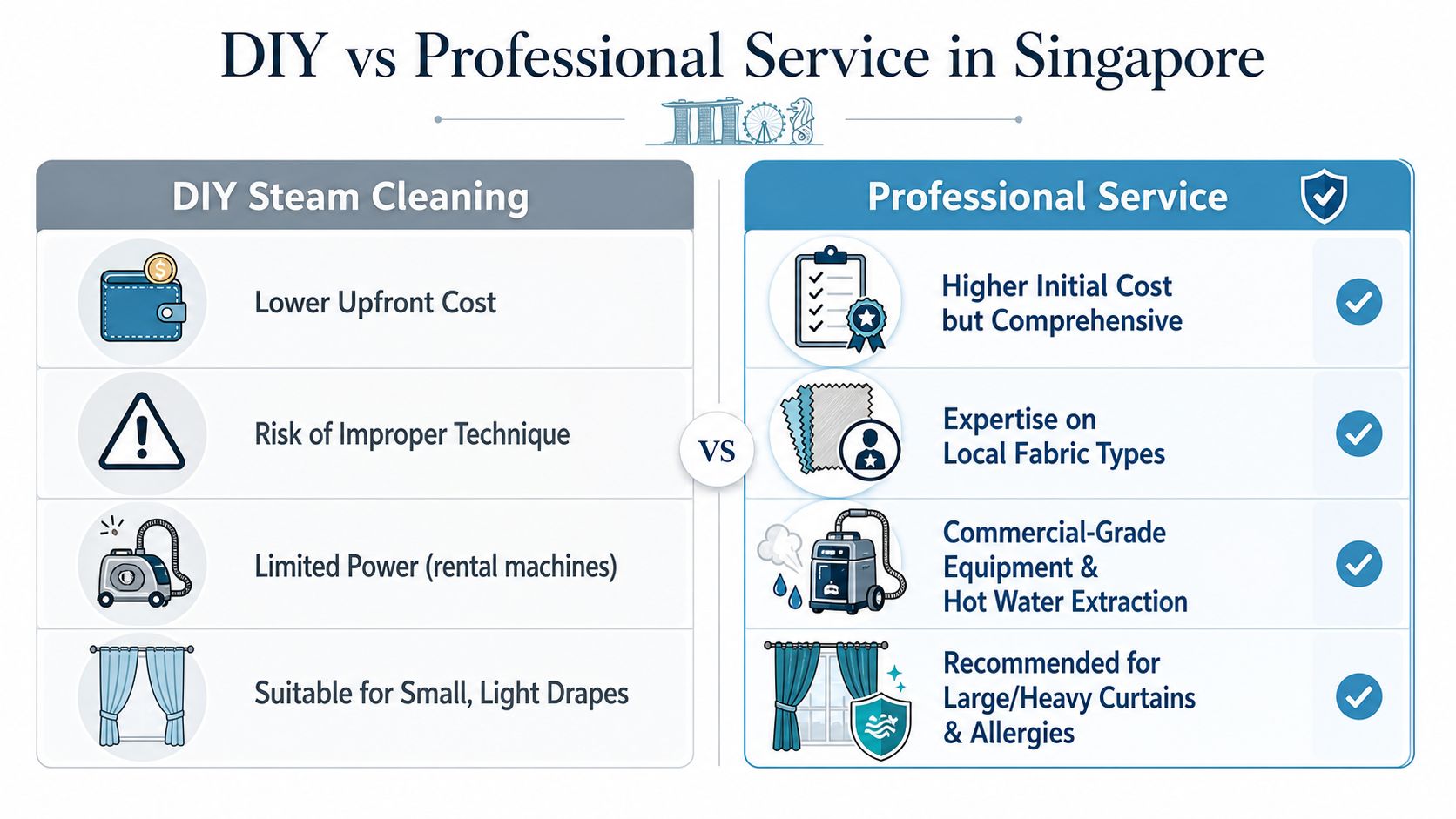
DIY makes sense when the curtain is light, the room is ventilated, and the fabric is clearly compatible. A thin single-layer sheer in a breezy living room is a very different job from a lined drape in a closed condo bedroom. The question isn't whether steam works in theory, it's whether your space gives the fabric enough room to dry safely.
Singapore's apartment layout changes the answer. In high-rise homes, curtains often hang close to painted walls, windows, or electrical outlets, and the brief specifically notes that guides warn about condensation on walls and the need to keep steam away from outlets and window areas. That's where DIY can go wrong, not because the steamer is weak, but because the room is unforgiving.
For homeowners who like portable tools, steamer tips for Australian homes can help frame the basic handling logic, but Singapore homes add a different constraint, less drying margin and more risk of moisture lingering on nearby surfaces. That's why the same tool can be fine in one setting and awkward in another.
A professional service becomes the sensible option when the curtain is heavy, lined, or needs takedown and rehanging. It also makes sense when the issue is not wrinkles but dust, odour, or a fabric that needs handling beyond what a consumer steamer can manage. The brief's market context also fits this, because Singapore's cleaning-services economy has kept serving households, offices, and property turnover, and curtain care has become part of preventive indoor-air maintenance rather than just visible stain removal.
For readers comparing service types, this curtain-cleaning guide is useful because it helps separate routine care from deeper treatment. In practice, that's the decision point, DIY for light maintenance, professional help for anything heavy, delicate, damp-prone, or logistically awkward.
For most Singapore homes, steam is best treated as a periodic refresh, not a constant fix. If the curtain only has light wrinkles or a slightly stale smell, a careful steam session can keep it presentable between deeper cleans. If the fabric keeps looking dull again quickly, that's a sign the problem is bigger than surface refresh.
The cleanest rule is simple. Use steam when the curtain needs freshening, not when it needs recovery. If the panel is lined, heavily soiled, exposed to kitchen residue, or showing signs of moisture trouble, stop treating steam as the default and move to a full wash or dry-clean cycle instead.
If the fabric still looks flat but feels stale, think maintenance. If it looks tired, smells embedded, or has visible residue, think deeper cleaning.
Tumble Laundry offers curtain cleaning with takedown and rehang support, which fits the needs of Singapore homes where logistics are often the hardest part. That kind of service is especially useful when you want the panels handled as a complete job rather than trying to steam around furniture, walls, and limited airflow.
For practical next steps, book a provider that checks fabric type first, explains the cleaning method clearly, and handles removal and rehanging without guesswork. If your curtains are light and compatible, steam can be part of routine upkeep. If they're heavy, lined, or stubbornly musty, send them for proper care instead of gambling on another pass with hot vapor.
If your curtains are due for a proper refresh, book a service that understands Singapore homes as well as the fabric itself. Tumble Laundry handles curtain cleaning with collection, cleaning, and rehang support, which makes the job simpler when steam alone isn't enough.

We make laundry days fast and easy for you. We collect, clean and deliver your laundry and dry-cleaning.
53 Ubi Ave 1 #03-43, Singapore 408934
Mon - Fri | 8:30 am–5:30 pm
Sat | 8:30 am–12:30 pm
hello@tumble.sg
+65 62554222
Whatsapp Us


