Commercial Laundry Bags: A Practical Buying and Usage Guide
This is some text inside of a div block.


Monday morning in Singapore often starts the same way. A cleaner is pushing a stack of commercial laundry bags through a loading bay, one bag has a split seam, one has a fading label, and one has mixed linen that should never have been combined in the first place. By the time that load reaches the plant, the damage has already happened, because the bag was doing more than carrying textiles, it was carrying accountability.
That is why bag choice is never a side issue. In a city built around dense housing, islandwide pickup routes, and strict hygiene expectations, the bag decides how well a load survives collection, transport, sorting, and return. Cheap bags fail at the worst moment, and that failure ripples straight into labour, contamination risk, and customer complaints.
The mistake most buyers make is treating the bag as a generic supply item, like it's just another consumable to tick off a list. In a Singapore facility, that attitude breaks down fast. A bag gets dragged across a HDB void deck, stacked into a van, opened again at the plant, and then reused on the return route. If the seam opens, the label falls off, or the contents arrive mixed, the whole workflow slows down.
That is why I treat the bag as the first and last control point in the chain. It decides whether items stay separated, whether the driver can collect quickly, and whether the back-of-house team can trust what they receive. Commercial laundry bags are not packaging. They are part of the operating system.
The density of Singapore matters here. The country had about 5.92 million residents in 2024 and roughly 2.18 million households, while HDB flats accounted for about 78.3% of all occupied resident households in 2020. Those figures matter because they create a compact, recurring pickup environment where bag handling, not bulk storage, makes the workflow possible. Cognitive Market Research's Singapore laundry bag market report ties those housing patterns to the operational reality of scheduled collection and door-to-door delivery.
Practical rule: if the bag can't survive collection, it's not a bag you can standardise.
The commercial laundry business only works when the load stays visible, traceable, and intact. That is the core reason Tumble Laundry's commercial laundry service belongs in the conversation at all. Any provider handling recurring business loads should be thinking about the bag as a chain-of-custody tool, not a cheap accessory.

A bad bag choice shows up fast in Singapore. In dense HDB collection routes, in healthcare back-of-house, and in islandwide pickup runs, the bag either keeps the workflow tight or turns every handoff into a problem. Buyers should sort the options by job first, because shape alone tells you nothing about failure rates, contamination risk, or how much time staff will waste untangling a bad process.
1. Heavy-duty woven polyester mesh.
Use this for soiled linen that still needs airflow during wash and dry stages. Industrial sacks built from high-tenacity nylon or polyester are described as handling 150 to 250 lb of soiled linen, with more than 500 lb tensile strength and 300 lb seam strength, which is why mesh sacks are common in rough commercial handling. They suit operators that need throughput and repeated abuse, not a tidy shelf display. Infortextile's commercial laundry sack case is a clear reference for that kind of construction.
2. Hydropol-soluble water-soluble bags.
These belong in infection-control or specialty linen workflows where manual contact has to drop. A soluble-bag specification lists standard sizes of 660×840 mm and 710×990 mm, with 25 μ film, and states that the material dissolves at 70°C/158°F or above. That makes the bag chemistry part of the wash program, not an afterthought. Aquapak's industrial laundry bag specification shows why these bags sit in a different category from ordinary transport sacks.
3. Coated nylon or PVC transport sacks.
Pick these for wet, heavy, or awkward loads that need to move between sites without leaking through the rest of the operation. They focus on containment during transit, not on wash-through. For teams that want a broader sorting reference, Tumble Laundry's sorting guidance is useful because it shows how load separation starts before anything reaches the machine.
4. Reusable cotton or poly-cotton pickup bags.
These fit customer-facing services where the customer fills a bag and the provider collects it. That model works well for subscription wash-and-fold or door-to-door residential collection, because the bag supports both the customer experience and the sorting system. It also keeps pickup simple for drivers moving across Singapore estates. For buyers comparing service-side handling models, the MSP Packaging sack guide is a practical parallel on heavy-duty sack use.
If you want a clean buying frame, sort every option by throughput, containment, hygiene, and customer-facing pickup. That is the decision tree that matters in Singapore facilities, where one weak bag can throw off collection timing, mix loads, and drive avoidable rewash.
Cheap bags fail in the same few places. They split under wet weight, soften under heat, or turn sorting into guesswork because the load is no longer contained properly. Singapore buyers should treat all three as live risks, because a bag that looks fine at pickup and fails in the dryer still creates downtime, rewash, and complaints.
Mesh, film, and coated fabrics behave differently in service. Polyester mesh is the safest default for breathable throughput because it lets water, detergent, and heat move through the load. The commercial spec in the brief places mesh bags made from high-tenacity nylon or polyester in the 28"×40" to 36"×48" range, and notes that some are built for very high tensile and seam strength. That suits hotel linen, service-sector loads, and mixed textile handling where abrasion is part of daily use. Infortextile's commercial laundry sack case remains the clearest reference in the brief for that construction.
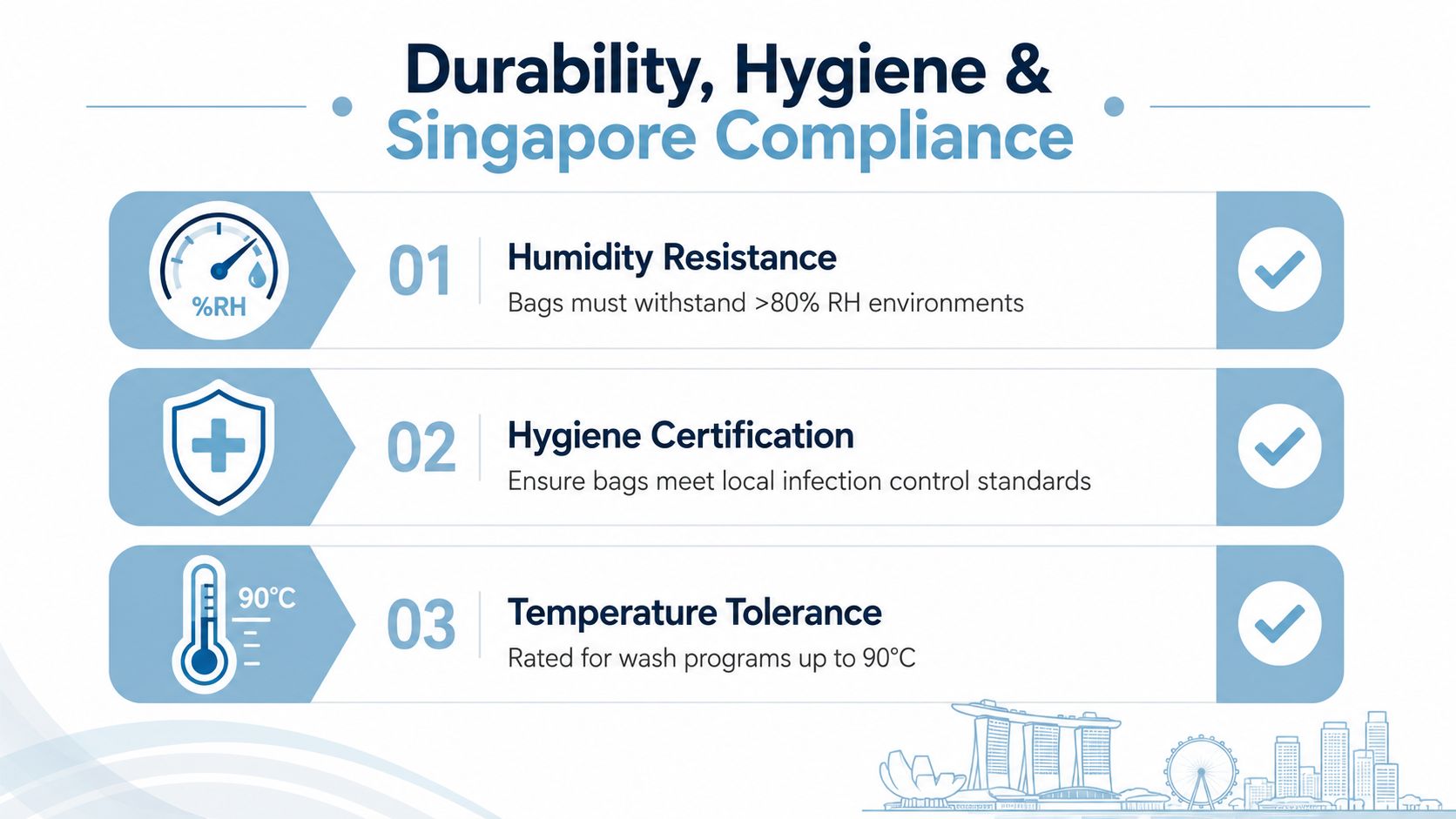
Hydropol-soluble film is the opposite trade-off. It is not built for rough transport, it is built to reduce human contact in contaminated-linen handling. The specification in the brief is direct, the film dissolves at 70°C/158°F or above. That means the bag chemistry has to match the wash program exactly. If the machine never reaches that threshold, the bag does not help you, it creates another failure point. For a plain-English comparison of wash temperatures and fabric handling, Tumble Laundry's cold-wash versus hot-wash guide fits naturally beside this decision.
Use heat to support the bag, not to punish it. If your process depends on thermal disinfection, the bag has to be specified for that environment from day one.
For buyers who want a clear reference on heavy-duty sack construction outside the laundry niche, the MSP Packaging sack guide is useful because it shows how sack strength, thickness, and use case should be matched instead of guessed.
Coated nylon or PVC transport sacks sit in the middle. They are useful when the bag has to resist moisture and survive van loading, but they are not a substitute for a breathable wash bag. Their job is logistics, not wash-through. In Singapore, that matters on pickup routes that cross estates, loading bays, and shared service corridors, because a transport sack that leaks or tears creates contamination risk long before the linen reaches the machine.
For sanitation-sensitive workflows, the bag also has to fit the detergent and wash method. BacteriaFAQ.com guide to laundry sanitizing is a useful reminder that chemical action and wash temperature need to work together, not in isolation.
The procurement mistake is comparing materials on price alone. Compare them on heat tolerance, seam behaviour, load containment, and whether the bag is meant to enter the wash or just move the load. Once you do that, the spec sheet shows what the sales pitch leaves out.
Sizing goes wrong when teams buy for appearance instead of workflow. A bag that is too small forces overpacking, while a bag that is too large creates its own problems. The load becomes awkward to lift, wash penetration gets weaker, and the bag spends more time full of dead space than moving textiles efficiently.
The brief gives a strong anchor point for industrial sizing. Mesh sacks in the 28"×40" to 36"×48" range are described as holding 150 to 250 lb of soiled linen. That gives buyers a practical reference, not a fantasy spec. It also makes the point that capacity is about more than volume, because wet textile weight changes everything.
For Singapore residential collection, medium-format bags usually make more sense than giant industrial sacks. Dense HDB living and condo-based pickup routes favour bags that one person can carry without fighting stairwells, lifts, and corridor turns. That is why customer-facing bag programmes often standardise a manageable format instead of asking households to improvise.
If you need a consumer-facing example, Tumble Laundry's Load Wash & Fold model uses a bag-based approach that makes capacity visible to the customer. That is exactly the sort of standardisation procurement teams should borrow for recurring pickup work, even if they run an in-house process.
Rule of thumb: size the bag to the heaviest practical load you expect to move repeatedly, not to the maximum load you can physically stuff inside once.
A separate question is whether the bag needs to live through the wash or only move the load. That answer changes the size decision too. Washable workflow bags should be easier to open, sort, and inspect, while transport-only sacks can be shaped around loading efficiency.
The simplest buying test is this, if staff can't lift it cleanly, sort it quickly, and return it without strain or spillage, the bag is too big. If it arrives underfilled every time, the bag is too large for the workflow and too expensive for the job.

Singapore buyers have to think about more than bag strength. They're operating in a tight urban system with contamination risk, waste-pressure concerns, and a strong expectation that outsourced services will keep records straight. That is why durability, hygiene, and traceability belong in the same buying conversation.
The waste context is not abstract. The National Environment Agency says only about 2% of waste was recycled in 2023, with the rest going to Semakau Landfill. That means flimsy bags that tear, spill, and force re-handling aren't just an inconvenience, they create avoidable disposal friction. In a market where waste handling is already tight, procurement should favour bags that hold their shape, stay labelled, and survive repeated handling. The cleaned-up procurement angle in the brief points directly to this NEA reality.
Hygiene is the other half of the equation. The Ministry of Health's Singapore healthcare IPC guidance continues to emphasise safe handling of contaminated linen as part of infection-prevention workflows, and that changes what a bag needs to do. For care, hospitality, and F&B buyers, bag closures, colour-coding, and dedicated bag assignment matter because they lower cross-contamination risk and make chain-of-custody easier to defend. The SG-relevant guidance summary in the brief is useful because it frames the bag as part of the handling process, not just the container.
That means procurement specs should ask for dedicated-per-customer bags, clear labelling, and consistent segregation by soiling level or department. It also means the cheapest bag can become the most expensive option if it tears and sends a mixed load back into the system. The more humid and high-turnover the operation, the less patience there is for weak stitching and fading identifiers.
For practical workplace standards, Tumble Laundry's laundry best practices guide aligns with the same principle, keep the workflow clean, labelled, and easy to audit.
Cheap bags look efficient on paper because the invoice is easy to read. In real operations, they usually lose because they fail mid-cycle. Once a bag tears in transit or opens in sorting, staff stop to re-bag, re-separate, and sometimes re-clean the load. That labour is the hidden line item most buyers never price in.
The right way to think about cost is simple. You are paying for purchase price, cycle life, failure rate, and handling labour. A stronger bag that costs more upfront but survives far longer is often the cheaper option per use, because it avoids repeated replacement and reduces rework. That logic is especially strong in hotel, healthcare, and subscription laundry work where the same bag gets handled over and over.
Maintenance matters too. Bags should be inspected before use, and any bag with weakened stitching, failed closures, or stretched fabric should be pulled out before it becomes a failure case. They also need to be washed on a schedule if they are part of the reusable workflow, because a dirty bag undermines the clean load it is supposed to protect.
Do not buy to the lowest unit cost. Buy to the lowest believable cost per clean cycle.
The business risk goes beyond labour. A torn bag can expose soiled linen, mix client loads, and damage trust with customers who expect clean handling. That is especially painful in Singapore, where service standards are visible and repeat business is won on consistency, not apologies.
The cleanest procurement decision is usually the boring one. Standardise a bag that matches the wash chemistry, hold a spare pool, reject weak seams early, and track failures by batch. The moment a team starts treating bags as disposable rather than managed assets, costs climb and service quality drops fast.
Start with the wash program, not the catalogue. If your operation uses hot-water or thermal disinfection steps, the bag chemistry has to match that reality. If it's a pickup-and-return service, the bag has to be easy for customers to fill, label, and hand over without confusion. That single decision rules out a lot of bad options fast.
Then check the load profile. Estimate the heaviest repeated load, not the biggest one you hope to move once. Decide whether the bag is a wash-through sack, a transport sack, or a customer-facing pickup bag. Those three categories should not be blurred just because a vendor says a product is “heavy duty”.
A vendor pilot is worth more than a polished brochure. Test closure strength, label retention, seam integrity, and how the bag behaves after repeated handling. If a supplier won't let you trial a batch, that tells you enough.
When you need outside support for recurring collection and chain-of-custody, a provider like Tumble Laundry can be a practical reference point for how scheduled pickup and delivery gets organised in Singapore. The useful question is not whether you want outsourced or in-house handling. It's whether your bag system can stand up to the route, the wash chemistry, and the people using it.
If you want a laundry workflow that doesn't fall apart at pickup, Tumble Laundry can handle recurring collection, professional cleaning, and delivery in Singapore with bag-based service options that suit homes and organisations. Visit Tumble Laundry to see how their commercial and residential laundry services fit into a tighter chain-of-custody workflow.

We make laundry days fast and easy for you. We collect, clean and deliver your laundry and dry-cleaning.
53 Ubi Ave 1 #03-43, Singapore 408934
Mon - Fri | 8:30 am–5:30 pm
Sat | 8:30 am–12:30 pm
hello@tumble.sg
+65 62554222
Whatsapp Us


