Laundry Turnaround Time in Singapore: What to Expect
This is some text inside of a div block.


It's Monday morning in Singapore, and the laundry bag by the door is already part of your day. There are work shirts for the office, a set of curtains that's been waiting too long, and a linen blazer with a mark you hoped would disappear after the weekend. The pickup rider arrives in the promised window, scans the bag, and you get the first reassuring message, processing has begun. What you really want to know now is simple, when will it come back, and what does that timing mean for your week?
Turnaround time is the promise that turns laundry from a vague errand into something you can plan around. In Singapore, that matters because people are already used to formal service benchmarks, and the national logistics system has been measured closely for speed and consistency. Singapore Customs' 2020 Time Release Study reported an average total import release time of 7 hours, 27 minutes and 55 seconds from docking to gate-out, excluding stack-yard storage, and the country's overall trade turnaround time fell to 24 minutes and 17 seconds in 2020 from 26 minutes and 9 seconds in 2018, a 7.14% reduction (Singapore Customs Time Release Study 2020). That kind of measurement mindset is exactly why laundry SLAs need to be clear, specific, and honest.
At 7:45 a.m. on a Monday, the bag is already waiting by the shoe rack in a Tampines flat. The pickup rider does the one thing that matters most to the customer, he shows up when the service said he would, and the order stops being a chore and starts being a tracked process. A Tiong Bahru family with the same bag might care about different details, but the question is identical, when does the clock start, and when does it end?
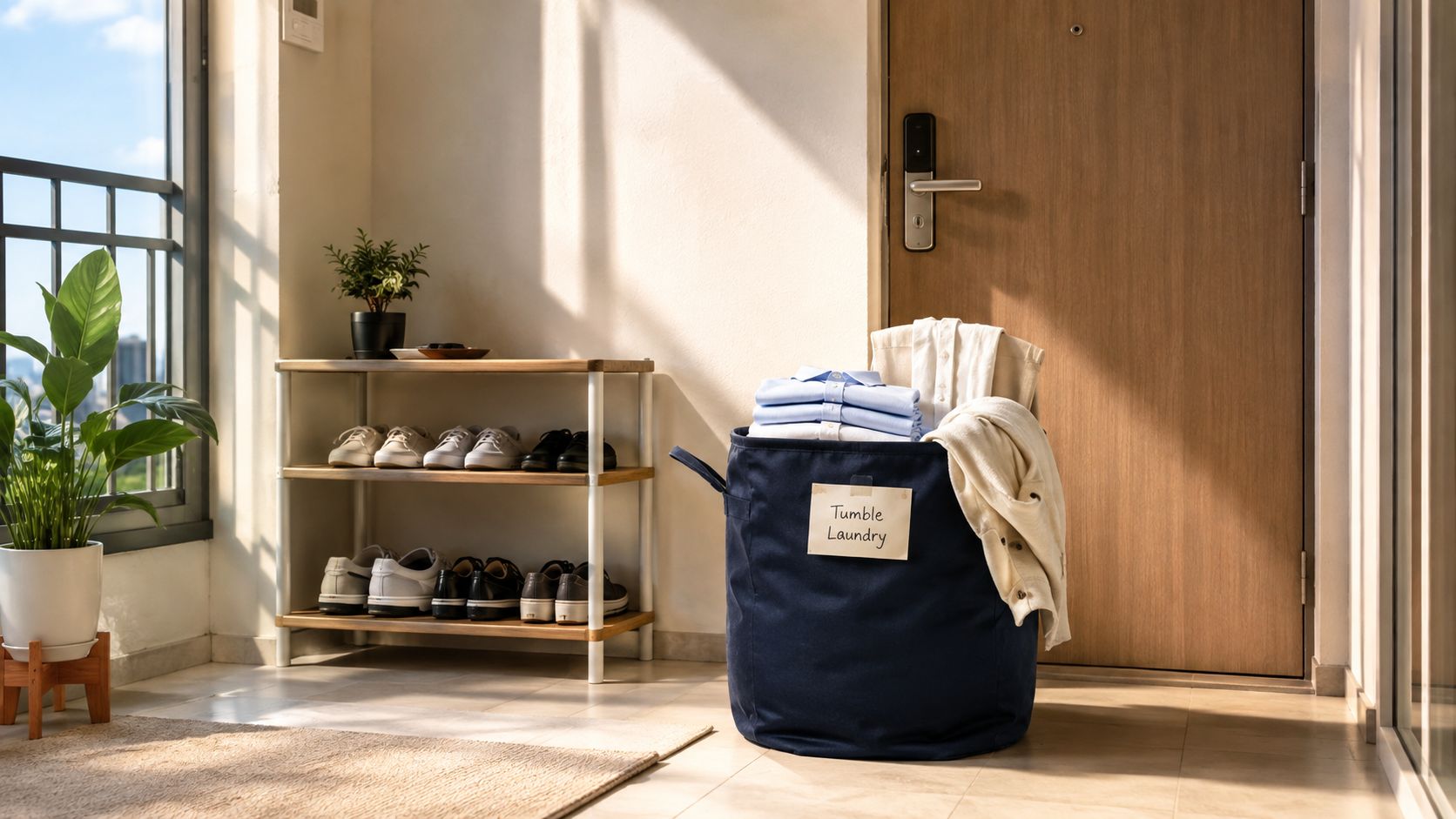
For most customers, the answer is not “when the washer starts”. It's the full service window from booking to redelivery, because the bag can still be sitting at intake, in a queue, or waiting for quality check long before it reaches the machine. That's why a clear pickup slot matters just as much as the wash itself, especially for families and office workers trying to plan clothes for the next few days.
Practical rule: if a provider only talks about washing speed, you're not hearing the whole promise.
If you want to book a pickup instead of guessing at timing, Tumble Laundry's scheduling page is the point where that promise becomes an order rather than a vague intention. The useful habit is to treat the pickup window as the start of a service chain, not the end of one. Once you read turnaround time that way, the rest of the SLA becomes much easier to evaluate.
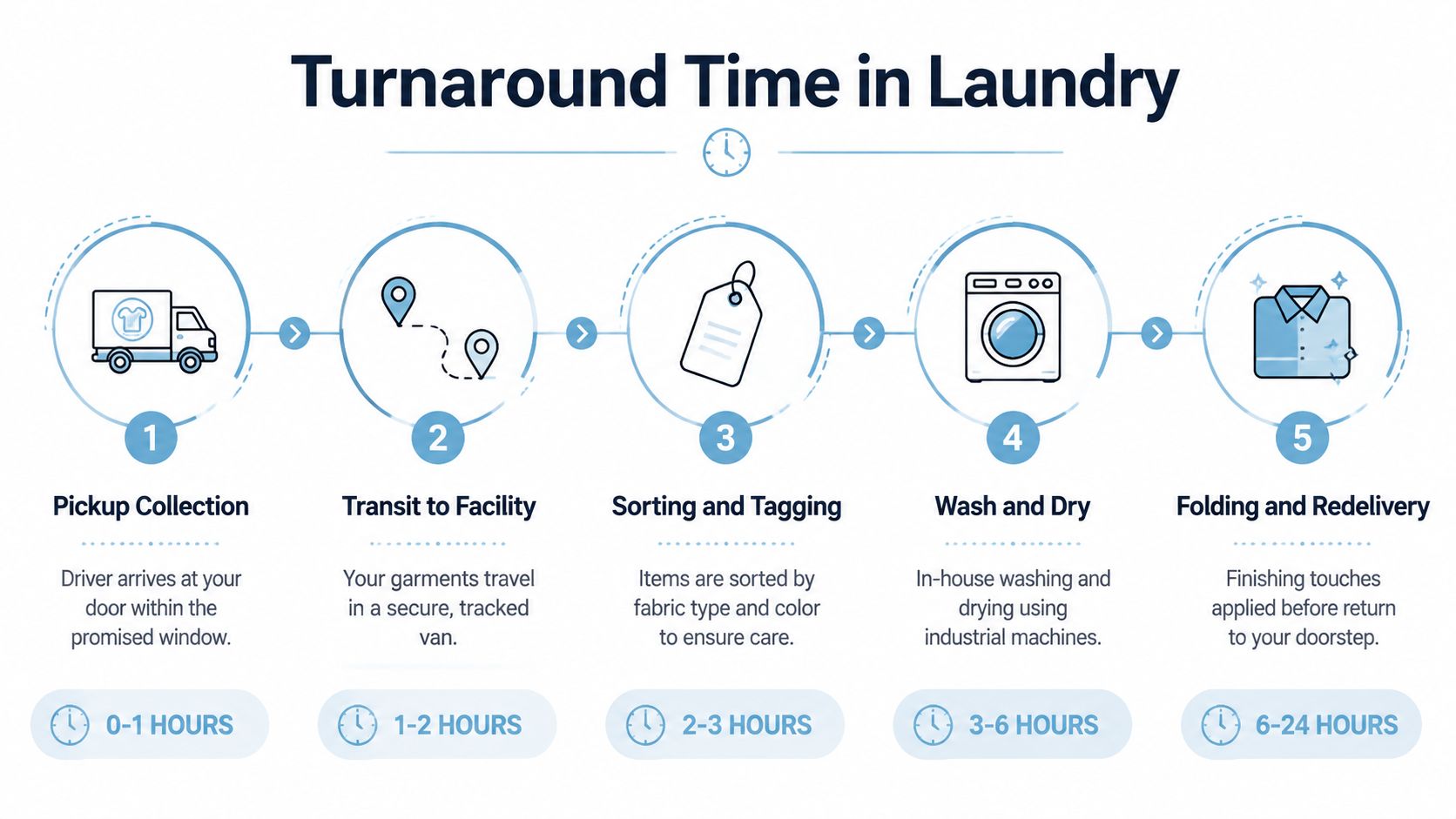
Turnaround time in laundry is the full path from confirmed booking to delivered garments, not just the hours spent washing. In practice, that path has five stages, and each one can add a little time if the operation is busy, the item is delicate, or the customer has asked for a special finish. That is why a promise that sounds short on paper can still feel longer in real life.
A sensible way to read any laundry SLA is to ask what happens at each step:
1. Pickup collection. The rider collects the bag inside the promised window.
2. Transit to the facility. The order moves to the plant, where it joins the day's workflow.
3. Sorting and tagging. Items are logged, separated, and matched to the care route they need.
4. Wash and finish. Garments are cleaned, dried, pressed, or dry-cleaned according to fabric.
5. Return delivery. The finished order is packed and brought back to your doorstep.
That breakdown is also a good reminder that “fast” and “predictable” are not the same thing. If you want to measure a cycle like this inside your own business, the workflow guide on how to measure work cycle time is a useful reference because it forces you to define the start point, the hand-offs, and the finish point clearly.
A standard 48-hour order usually looks straightforward from the outside. Morning pickup on Monday, processing through the day and overnight, quality check on Tuesday morning, and delivery later on Tuesday if the route and finishing queue stay on schedule. Public holidays, weekends, and high-volume periods such as Chinese New Year or Hari Raya can extend that window, because the calendar doesn't stop even when the laundry still has to move through each stage.
If you've ever tried to read an SLA and wondered why a “2-day” promise feels different from a “48-hour” promise, the answer is usually the calendar. A 2-day window can be counted across working hours or full days, while a 5-working-day window excludes the days when the plant is closed or operating at reduced capacity. The same rule applies when you read Tumble Laundry's dry-cleaning process, because the finish stage is what often pushes a delicate item into a longer window.
Different laundry services in Singapore don't run on the same clock, and that's the part many first-time customers miss. A wash-and-fold bag, a one-off clean-and-iron order, and a curtain job all use different production paths, so the promised window should reflect the work involved. The right question is not “which one is fastest?”, it's “which one matches the item I'm sending?”
Service TypeStandard WindowExpress OptionNotesSubscription Load Wash & Fold48 hoursSame-day collection windows are available for scheduling, depending on timing and service termsSuits recurring everyday loads, with free collection and deliveryPay-As-You-Go Wash & Fold5 daysExpress options may be offered for some loadsPriced by weight, with a minimum order and item limits for this routeClean & Iron5 working daysAdd-on express options can compress the windowDesigned for laundry or dry cleaning by piece, with ironing and hanger finishingCurtain cleaning5 working daysExpress options can compress the windowOften includes takedown or rehang support, and it is scheduled around heavier cleaning cyclesBulky household items5 days or more, depending on the serviceExpress availability depends on load typeThese jobs are handled differently because of volume and finishing time
A useful contrast sits between everyday wear and specialist items. Standard wash-and-fold is built for regular rotation, while dry-cleaning a structured blazer needs slower handling, lower-temperature processes, and a careful finish. This dry-cleaning service guide for Singapore is worth reading if you're trying to understand why some items belong in a longer queue instead of a rushed one.
The operational reason behind each window is simple. Everyday loads can move quickly because they follow a more direct wash, dry, fold path, while curtains and dry-clean-only items add inspection, fabric-specific care, and finishing time. A five-day curtain slot isn't slow by accident, it's scheduled to protect the item and keep the promise realistic.
A turnaround promise only matters if the operator can control the work. The cleanest way to do that is to keep the whole process in-house, so the order doesn't bounce between subcontractors, delayed hand-offs, and separate inventories. That's where credibility comes from, because every extra party adds uncertainty.
Tumble Laundry's setup relies on a few practical levers. Orders are scanned at pickup, again at intake, and again before bagging for return, so the team can see where each item is instead of guessing. That item-level tracking matters most on by-piece work, where a missing shirt or delayed jacket is a customer service problem long before it becomes an operations problem.
The same logic applies to machine allocation. Same-day loads go onto dedicated machines, which keeps them from waiting behind standard pay-as-you-go orders. Subscription bags are routed differently again, because their volume is forecast in advance and can be built into the schedule before the day even starts.
A separate finishing line also matters for clean-and-iron work. Pressing, hanger finishing, and final inspection can become the bottleneck in a rushed operation, so running that stage across more than one shift gives the team more room to absorb exceptions without breaking the promise. That's the difference between a marketing claim and a timetable that can survive a messy day.
A promised window is only as good as the queue behind it.
Tumble Laundry is one option in Singapore for islandwide pickup, in-house processing, and delivery, and the model only works because the facility controls the full chain from intake to return. You can see the flow in the embedded process overview below.
The easiest mistake is choosing the shortest possible window for every item. That sounds efficient, but it can backfire when the garment needs more care than a standard wash can provide. Turnaround time should follow the garment, not the customer's wish for the calendar to move faster.
Garment CategoryRecommended WindowWhy This WindowCotton shirts and workwear24 to 48 hoursThese items fit a straightforward wash-and-fold flow and usually do not need delicate finishingBedsheets and towels2 to 5 daysBulkier household linen often runs better in larger-capacity batches, especially when the load is mixedSuits, silk blouses, formal dresses3 to 5 working daysDry-clean-only items need solvent care, pressing, and inspection before releaseCurtains5 working daysCurtain care usually involves weight-based handling and more finishing timeStructured blazers and items with linings3 to 5 working daysShape, fabric, and re-pressing can add time even when the cleaning itself is efficient
The rule of thumb is simple. Everyday fabric can move through the system quickly, but delicate or structured pieces need room for inspection and rework. That extra time reduces the chance that a stain is missed, a crease is set badly, or a garment has to come back for another round.
If you're unsure whether an item belongs in wash-and-fold or dry cleaning, this explanation of laundry versus dry cleaning is the quickest way to separate the two. The useful habit is to think about risk, not just speed. A shorter window is only better if the garment still comes back in the condition you expected.
A longer turnaround window is not always a sign of slower service. In many cases, it's a sign that the operator has built in enough slack to handle the normal messiness of real work, such as a stubborn stain, a press that needs a second pass, or a rider route that changes at the last minute. That extra room is what keeps the promise believable.
A 24-hour SLA sounds attractive until the order lands on a Sunday evening, the dryer needs another cycle, or a collar comes out needing rework. A 72-hour window gives the team space to correct those problems without turning every exception into a customer apology. That's why predictability often beats raw speed.
Subscription customers usually feel this most clearly. Their pickup days are fixed, their volume is forecast, and the route can be planned before the bag reaches the door, so the return hour is often steadier than a last-minute rush order. The customer experiences fewer surprises because the operations team isn't improvising around the schedule.
Practical rule: if the item matters more than the hour, choose the window that leaves room for quality control.
Longer windows are also safer for communication. If a stain needs extra treatment or a piece has to be held back for re-pressing, the team can manage that exception without pretending the original slot still holds. In Singapore, where customers are already used to multi-day service cycles in other categories, that kind of transparency is often worth more than a promise that sounds impressive but fails in practice.
Most laundry stress comes from inconsistency, not volume. The easiest way to avoid that is to give the service a rhythm it can follow, which usually means sending the same kinds of items on the same days each week. Once you do that, turnaround time stops feeling like a deadline and starts acting like a background routine.

• Sort the night before. Check pockets, separate delicate pieces, and read care labels before pickup day.
• Book before the cut-off. Early scheduling gives the facility more time to place your order into the next processing queue.
• Keep one load per routine. Batching the same type of items together reduces handoff confusion.
• Use fixed pickup days. A recurring day makes it easier for the operations team to forecast volume.
• Leave express requests for true exceptions. Last-minute urgency works best when it's rare, not routine.
That kind of rhythm is exactly what busy households need, and it's the idea behind Tumble Laundry's guide for busy people. The point is not to obsess over laundry. It's to make the timing so regular that you stop thinking about it.
A steady schedule also reduces error. When the same family sends office wear on Tuesday and household linen on Friday, the facility can predict what's coming and prepare the right machines, finishing line, and delivery route. Consistency beats speed because it removes the kind of surprises that create delays in the first place.
Do turnaround times include weekends? Sometimes yes, sometimes no, depending on whether the service is counting calendar days or working days. Always check the stated window, because a 5-working-day promise behaves differently from a 5-day promise.
Can weather slow things down? Heavy rain can affect rider routing and pickup timing, but indoor washing and finishing still continue unless the schedule is disrupted for operational reasons. The biggest delay usually comes from transit and delivery, not from the wash itself.
What happens if an item needs extra care during a faster service? The team may hold it back for re-treatment or re-pressing rather than sending it out half-finished. That's the right call when the item's condition matters more than hitting the earliest slot.
Do subscription plans guarantee same-day slots? No plan should be read that way unless the service says so clearly. Subscription usually improves predictability and routing, but same-day availability still depends on cut-offs and capacity.
How do I request an emergency rush? Ask before pickup or at booking, because a rush request only works if the plant can route it into the right machine and finishing line. If the item type is delicate, the provider may advise a longer window even when you need it urgently.
When does the official clock start? It starts at the point the service accepts your order, not when the garment reaches the washing machine. That's the fairest way to measure the full customer wait, including pickup, intake, and delivery.
If you want a laundry service that treats turnaround time as a promise about predictability, not just speed, visit Tumble Laundry and choose the service window that fits your week. The right pickup pattern, the right garment route, and the right delivery expectation make the whole process easier to plan.

We make laundry days fast and easy for you. We collect, clean and deliver your laundry and dry-cleaning.
53 Ubi Ave 1 #03-43, Singapore 408934
Mon - Fri | 8:30 am–5:30 pm
Sat | 8:30 am–12:30 pm
hello@tumble.sg
+65 62554222
Whatsapp Us


