Sofa Washing Services in Singapore: A Practical Guide
This is some text inside of a div block.


Sofa washing services in Singapore range from about S$50 for a single seat to S$200 or more for a full three-seater, and drying typically takes 6 to 12 hours in humid conditions. The final price and downtime change with the sofa's fabric code, cleaning method, level of soiling, access, and ventilation.
You may be looking at your living-room sofa right now, wondering whether a damp cloth will solve the problem. In a typical HDB flat or condominium, the same sofa handles movie nights, meals, children's naps, visiting guests, and the occasional pet accident. The fabric can look acceptable from across the room while the armrests feel slightly sticky, the seat edges look grey, and a musty smell appears when the air-con is switched off.
That's when choosing a sofa cleaning service becomes less about finding the cheapest quote and more about avoiding the wrong treatment. Singapore's official statistics classify domestic and household cleaning services as recognised business categories, and place Cleaning Activities at about S$3.6 billion in operating receipts across roughly 2,316 establishments in 2024, up from about S$2.6 billion in 2019 (Singapore's official cleaning and laundry industry data). Upholstery care sits within that wider, increasingly organised home-care market.
A sofa usually gives you several warnings before it needs professional attention. The first is visual. Look closely at the front of the arms, the top edge of the back cushions, and the area where people rest their hands. Darkened fabric in these contact zones often comes from accumulated body oils, dust, food residue, and everyday friction rather than one dramatic spill.
The second warning is tactile. If the material feels tacky after wiping, a surface spray may have moved grime around instead of removing it. Sanitising sprays can make a room smell fresher for a short while, but they don't pull embedded soil out of the weave. A household vacuum helps with crumbs, loose dust, and pet hair, yet it won't replace a deep upholstery process.
Run through these simple observations:
• Look at high-contact areas: Compare the armrests and seat fronts with a less-used section behind a cushion.
• Check the smell: A faint mustiness can become more noticeable in a closed, air-conditioned room.
• Inspect the seams: Dust and crumbs collect along piping, joins, and under removable cushions.
• Notice the drying history: If previous spot cleaning left rings or stiff patches, the fabric may need controlled treatment rather than more water.
A home wipe-down is still useful for fresh spills when the care label permits it. Blotting is safer than rubbing, and a white cloth makes colour transfer easier to spot. For a broader home-care routine, these upholstery cleaning tips from Canes Cleaners are a useful reference, especially on pre-vacuuming and handling spills carefully.
Practical rule: A sofa that looks clean from a distance may still need deeper cleaning if the fabric feels greasy, smells stale, or has darkened where people sit.
Before you request quotes, photograph the sofa, its cushions, visible stains, and the manufacturer's care tag. Tumble Laundry's guide on how to clean upholstery can help you understand the difference between routine care and a more involved treatment. The next decision is the important one, identify what the upholstery can safely tolerate.
The small care tag underneath a sofa cushion or frame is more useful than a salesperson's broad description such as “fabric” or “microfibre”. The cleaning code tells a technician whether water, solvent, either method, or almost no home treatment is appropriate. Singapore upholstery guidance emphasises checking this code before wet cleaning because humid conditions make moisture retention, colour bleed, and mould risk more difficult to manage (Singapore sofa fabric-care guidance).
CodeMeaningSafe methodsCommon Singapore fabricsWWater-based cleaning is permittedControlled wet cleaning, foam, or extraction after patch testingMany microfibre and cotton-blend upholstery fabricsSUse solvent-based products onlyLow-moisture solvent or specialist dry-cleaning processSome silk-blend, velvet, and treated performance fabricsWSEither water or solvent may be suitableMethod selected after inspection and colour testCommon mid-range family-sofa fabricsXAvoid home wet or solvent treatmentVacuuming only at home, professional assessment for deeper careDelicate rayon or viscose-type covers
The code doesn't guarantee that every stain will disappear. It defines the boundaries of a safe process. A W-coded sofa may accept an extraction clean, but the technician should still test a hidden area first. An S-coded sofa can react badly to water through shrinkage, watermarking, pile distortion, or colour movement. WS is more flexible, although the least aggressive suitable method remains preferable. X is a warning not to experiment with household detergent.
Velvet, boucle, chenille, linen-look fabric, and microfibre can behave differently depending on their backing, dye, finish, and manufacturer treatment. A removable cover also isn't automatically machine washable. Check the actual sewn-in label, purchase documentation, or manufacturer instructions. A broader explanation of laundry symbols and care labels is helpful when the tag uses unfamiliar icons alongside the upholstery code.
For another professional perspective on fabric-specific upholstery care, consult this resource on Atticus Cleaning Services upholstery. When booking, send a clear photograph of the code and ask the provider to confirm the proposed method in writing.
The three names often used in sofa washing quotations describe different moisture levels and cleaning actions. They aren't interchangeable labels for the same service. The correct option depends first on the upholstery code, then on the type of soil, colour stability, cushion construction, and how quickly the household needs the sofa back.

Steam or hot-water extraction applies cleaning solution to the fabric and removes much of it with a vacuum system. It can work well on suitable W and WS upholstery, particularly where body oils and general soil have penetrated the weave. The trade-off is moisture. Even when extraction is thorough, the sofa can remain damp for many hours in Singapore.
Steam cleaning isn't a universal answer. It shouldn't be used on an S-coded fabric just because the sofa looks dirty, and an X-coded sofa requires a much more cautious professional assessment.
Low-moisture dry cleaning uses a solvent, foam, or dry compound that captures soil before removal. It suits S-coded fabrics and situations where the household has limited tolerance for downtime. The sofa may feel usable sooner than after wet extraction, but dry cleaning may not remove embedded contamination as effectively as a suitable wet process.
Shampoo extraction works foaming detergent into the surface, often with a rotary brush, then removes the loosened soil with wet vacuuming. It can be useful for heavily soiled, durable upholstery and persistent odours, but it introduces more moisture and mechanical agitation. That increases drying demands and can raise the risk of colour bleeding or pile disturbance on sensitive fabrics.
Don't choose by method name alone. Ask what the technician will do if the hidden-area colour test fails.
For households comparing a service with home equipment, protecting custom upholstered furniture is a useful reminder that fabric construction and finishing matter as much as visible dirt. Tumble Laundry's explanation of the dry-cleaning process also gives useful context for why low-moisture treatment differs from washing.
A properly managed appointment starts before the machine is switched on. The technician should inspect the sofa, confirm the upholstery code, ask about previous cleaning, and identify stains that may require separate treatment. If the material, backing, or condition doesn't match the booking details, the technician should explain the risk before proceeding.
The next control is a hidden-area colour-fastness test. A small amount of the proposed solution is applied to an inconspicuous location, then checked for colour transfer, texture change, or watermarking. This isn't a guarantee against every problem, but it helps prevent an obvious mismatch between product and fabric.
1. Fabric check: The crew confirms the code, fibre appearance, construction, and existing damage.
2. Dry vacuuming: A vacuum removes loose grit, crumbs, dust, and pet hair before moisture can turn them into mud.
3. Pre-treatment: Suitable products target marks such as food residue, oils, and odours. Strong stains may need realistic expectations rather than a promise of complete removal.
4. Main cleaning: The crew uses extraction, dry compound agitation, or rotary shampoo according to the approved method.
5. Grooming and inspection: Seams, cushion edges, and undersides are checked, the pile is set in a consistent direction, and the result is reviewed with the customer.
Cushions may be removed where practical so the technician can reach the platform, joins, and rear surfaces. Ask whether moving the sofa, lifting cushions, or treating both sides is included, because these details can change the quote.
Before arrival, clear toys, throws, loose items, and small furniture around the sofa. In an HDB block, confirm lift access, loading instructions, and a suitable parking or unloading arrangement. Arrival windows vary by provider and traffic, so a time range is more realistic than expecting an exact minute.
Here is a visual walkthrough of the main stages:
A single-seat job can start at about S$50, while a full three-seater can cost S$200 or more, but those figures are starting points rather than a universal tariff. Singapore's wider cleaning market grew from S$1,574.4 million in 2014 to about S$2,064.8 million in 2019, representing a 5.6% CAGR, while industry materials projected personalised cleaning services to reach S$708.8 million by 2024 (Singapore carpet-cleaner market research). Upholstery cleaning fits the personalised model because the technician prices the item, fabric, access, and treatment rather than processing a standard load.
The first question is whether the quote is per seat or per sofa. Per-seat pricing may be clearer for a single armchair, modular sofa, or partial treatment. Per-sofa pricing can be better value for a complete three-seater when every cushion and the frame are included. Ask whether “seat” means the seat cushion only or the cushion, backrest, arms, base, and sides.
For example, a three-seater fabric sofa with light staining may receive a straightforward quote. The same sofa with embedded odours, pet hair, or biological staining may require more preparation and a different expectation about the result. Don't compare those quotations as though they describe identical work.
If a provider offers stain treatment, ask whether the price covers inspection, pre-treatment, extraction, drying advice, and final inspection. Tumble Laundry's guide to removing stains from clothes isn't a sofa-pricing guide, but it illustrates why stain type and treatment method matter. A credible quote should state inclusions rather than hide them behind a low headline figure.
Drying is the part of professional sofa cleaning that causes the most household frustration. In Singapore, extraction or steam cleaning can take 6 to 12 hours or more in humid weather, while another upholstery FAQ gives a shorter 2 to 3 hour estimate depending on ventilation (Singapore sofa-cleaning guidance on drying). Those figures aren't necessarily contradictory. They describe different fabrics, moisture levels, room conditions, and service methods.
A sofa can feel dry on the surface while the foam-facing fabric or seams remain damp. That's why touch-dry doesn't always mean ready for normal use. Sitting too early compresses the damp areas, slows airflow, and can encourage a stale smell.
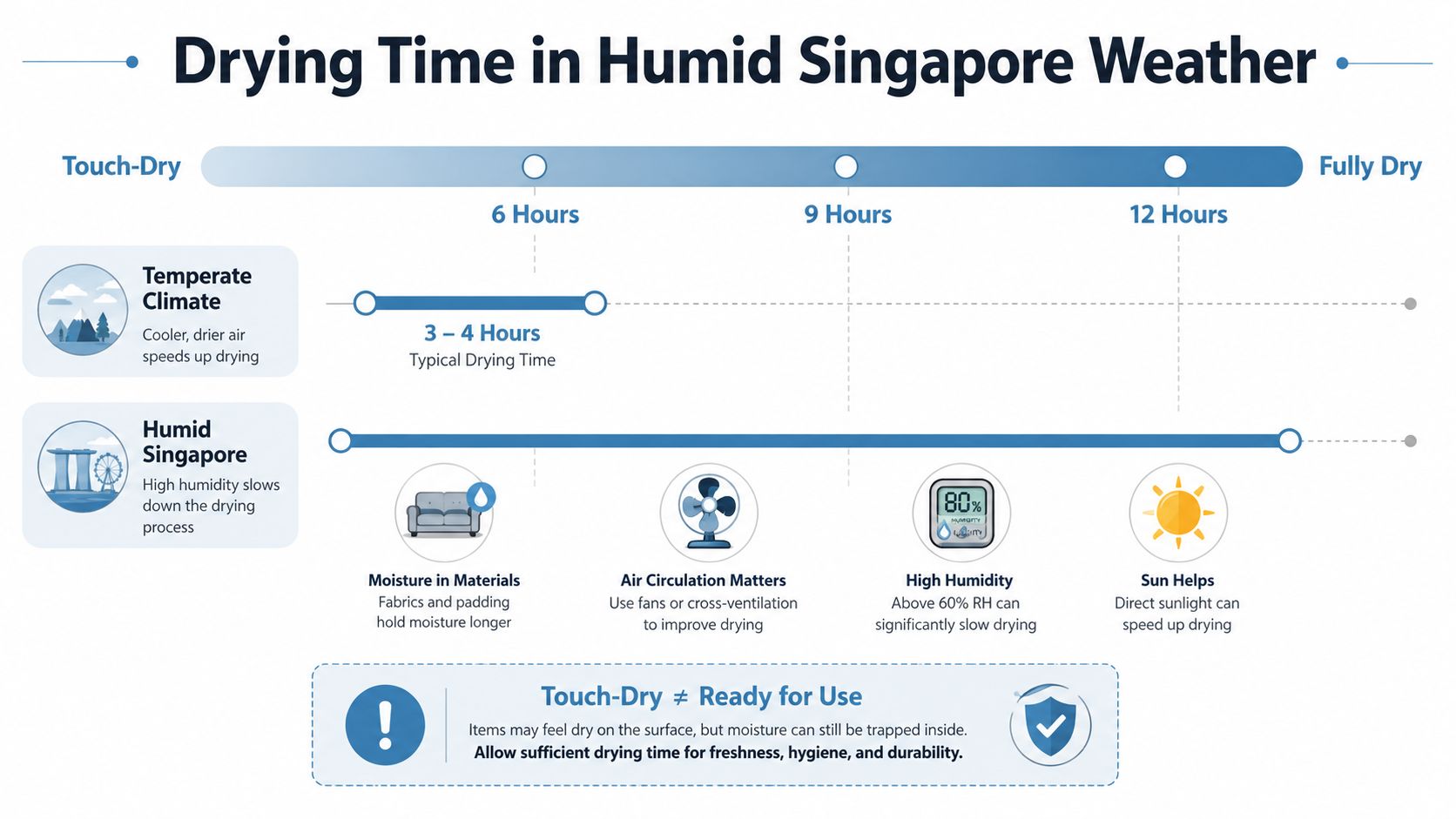
• Fabric and cushion density: Thick upholstery and dense foam hold moisture longer than thin, open weaves.
• Cleaning method: Dry compound or low-moisture cleaning generally leaves less water than steam extraction.
• Ventilation: Cross-breezes, open windows, and a fan can help. A closed room slows the process.
• Air-conditioning: Dry mode can reduce moisture in the room, but avoid creating conditions that leave the fabric cold and damp without circulation.
• Cushion placement: Separate removable cushions and expose their edges so trapped moisture can escape.
Run a pedestal fan across the sofa rather than directly into one small patch. Keep people and pets off until the technician's stated drying period has passed. Avoid placing the sofa in strong afternoon sun, since heat and direct light can shrink some fabrics or fade dyes.
For related fabric-care planning, Tumble Laundry's guide to curtain steam cleaning provides useful context on moisture, airflow, and why treatment conditions affect the final result. Ask your cleaner for a drying estimate based on your room, method, and fabric, not a generic promise.
“Once a year” is easy advice, but it ignores how Singapore households use sofas. A better schedule considers fabric colour, occupants, pets, food habits, ventilation, and the sofa's location. A pale sofa used daily by a family with children and a dog will show soil sooner than a darker sofa in a lightly used sitting room.
The hygiene issue also starts before visible stains. Body oils and food residue can bind to fibres while the sofa still looks presentable. Regular vacuuming and prompt blotting help, but they don't remove every layer of accumulated grime.
• Heavy daily use: Families with pets, frequent eating on the sofa, or children's naps may need professional attention sooner than a lightly used home.
• Light occupancy: A single-occupier flat with careful use can often wait longer, provided the fabric is vacuumed and spills are handled promptly.
• Sensitive appearance: Light colours, textured fabrics, and velvet-like piles reveal marks quickly and need gentler maintenance.
• Special environments: Post-renovation dust, homes near busy roads, newborn households, and short-stay rental turnovers call for an inspection rather than an automatic calendar rule.
Leather follows a different care pattern from fabric. It needs cleaning products suited to leather and periodic conditioning, while water extraction is generally not the default approach. The material, not the phrase “deep clean”, should determine the service.
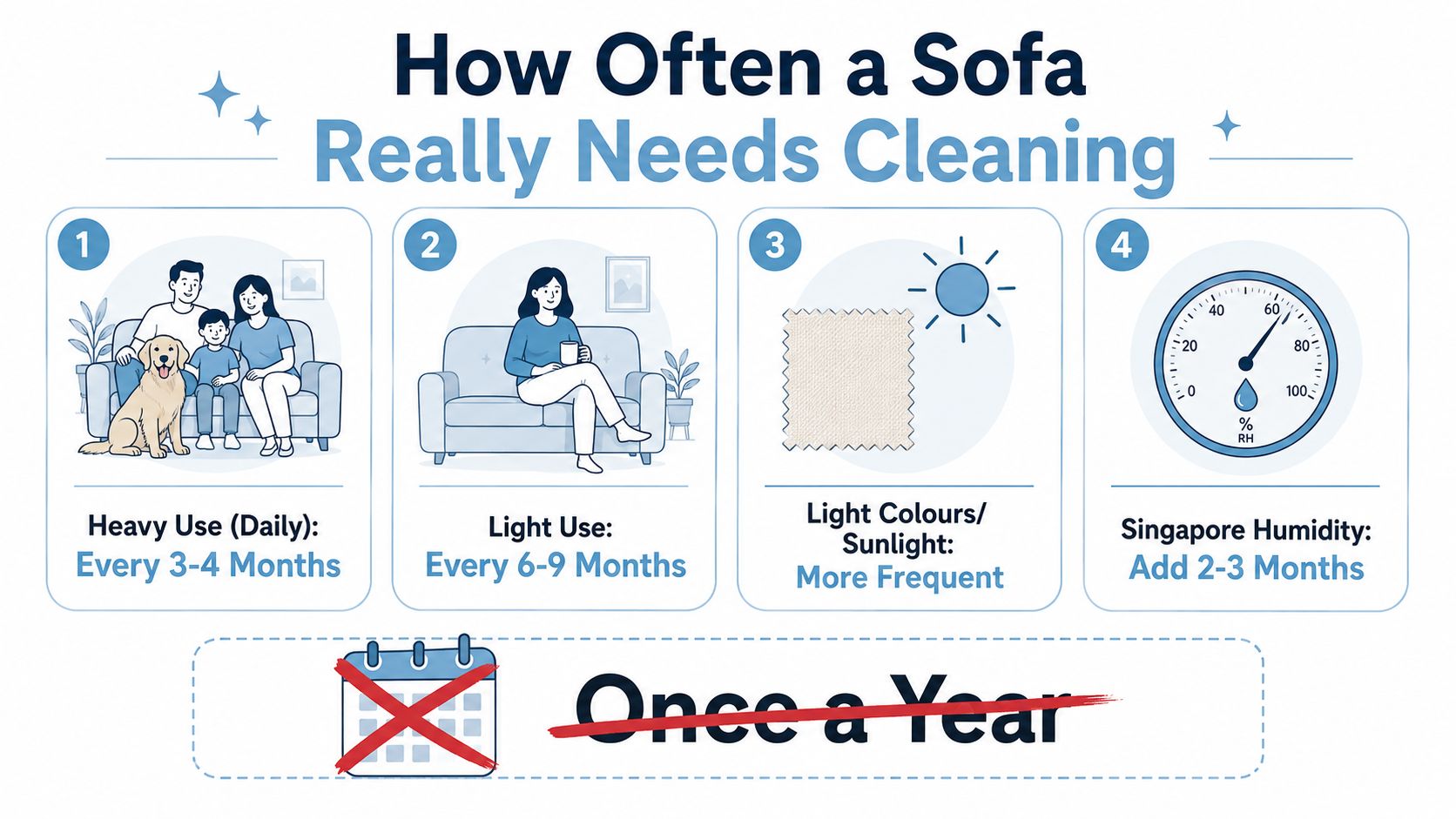
Keep a simple record of the last professional clean, major spills, renovation work, and changes in household use. If the sofa begins to smell musty, feels greasy, or develops recurring marks after spot cleaning, book an assessment instead of waiting for a fixed annual date.
A sensible booking follows four checks. First, find the manufacturer's upholstery code. Second, ask the provider to match the method to that code and confirm whether a hidden-area test will be performed. Third, request a quote that clearly separates per-seat and per-sofa pricing. Fourth, ask how long the sofa is expected to remain out of use in your current room conditions.
A three-seater microfibre sofa in a Bukit Merah HDB might receive a steam-cleaning quote of roughly S$160 to S$220, with an estimated 6 to 10 hour drying window and normal use returning the next day. Those figures are an example of how a quote can be presented, not a fixed market price. The actual amount depends on the provider's scope, the sofa's condition, access, and whether the fabric responds safely to water.
• Photograph the label: Send the W, S, WS, or X code before the appointment.
• Describe the soil: Mention food spills, pet hair, urine, smoke, renovation dust, or old cleaning attempts.
• Ask what is included: Confirm cushions, frame, sides, seams, stain treatment, deodorising, and furniture movement.
• Plan the room: Arrange airflow, keep children and pets away, and avoid booking just before an important gathering.
• Read the final quote: Check minimum charges, access fees, peak-slot premiums, and cancellation terms.
Tumble Laundry handles sofa-cover cleaning alongside its broader laundry and dry-cleaning services, so customers who want removable covers treated should confirm the item scope, care label, collection arrangement, and turnaround before booking. For fixed upholstery, an on-site specialist may be more suitable because the frame and cushions need inspection together.
Choose the method that protects the fabric, not the one with the most impressive-sounding label. A clear quote, realistic drying plan, and confirmed care code will tell you far more about the service than a generic “deep clean” promise.
If your sofa covers need professional care, visit Tumble Laundry to check its sofa-cover cleaning options, pickup arrangements, and related laundry services. Share the care label and item details when requesting a quote so the team can advise on the appropriate handling and turnaround.

We make laundry days fast and easy for you. We collect, clean and deliver your laundry and dry-cleaning.
53 Ubi Ave 1 #03-43, Singapore 408934
Mon - Fri | 8:30 am–5:30 pm
Sat | 8:30 am–12:30 pm
hello@tumble.sg
+65 62554222
Whatsapp Us


