Understanding Minimum Order for Laundry Pickup Services
This is some text inside of a div block.

Tumble Laundry's pay-as-you-go Wash & Fold has a S$50 minimum order. Load Wash & Fold subscription bags and Clean & Iron by piece are not bound by that minimum, so the rule mainly affects occasional one-off pickup orders.
That matters the moment you open your laundry basket and see a small pile that feels too light to send out. If you live in an HDB or condo, the question isn't just “what does the service cost?”, it's also whether the basket is large enough to make a pickup sensible.
A minimum order is the smallest basket value a pickup service will accept in one run. For a first-time customer, that usually shows up as a checkout message when the cart is still below the required amount, and it can feel like a hard stop even when the laundry itself is ready.
For Tumble Laundry, the threshold for pay-as-you-go Wash & Fold is S$50. Once the cart clears that line, the minimum no longer changes the per-kg pricing, it only decides whether the order is accepted for pickup.
That's the simplest way to think about it. The service is not saying your laundry is too small to wash, it's saying the basket has to reach a level that works for a pickup route.
Practical rule: If your order is below the minimum, you are not looking at a quality issue. You're looking at a routing rule.
The easiest way to avoid confusion is to treat the minimum as a gate, not a fee layered on top of everything else. That distinction matters when you compare it with subscription bags or by-piece cleaning, because those options are structured differently and don't use the same threshold.
For a deeper look at how minimums work in other product categories, the logic behind calculate packaging order minimums follows the same basic idea, even though the industry is different. If you want to see how this looks in practice across Tumble Laundry's own services, the home bundle preview is a useful reference point.
Laundry pickup has route costs attached to it. A rider has to travel, collect, hand off, and then the laundry still has to move through washing, folding, and delivery, so each stop needs enough value to justify the trip.
That is the same reason many Singapore services use basket thresholds. In food delivery, groceries, and other doorstep services, small orders can be accepted only when the order value covers the work of dispatch and last-mile delivery. Laundry is different mainly because the cost is built into the order, rather than split into a separate delivery line item.
A minimum order does more than cover the rider's time. It also protects the workflow behind the scenes, because a washer who sets up a tiny batch uses nearly the same preparation time as one who handles a fuller load.
That is why a single t-shirt is never just a single t-shirt in operations terms. It is a pickup slot, a wash cycle, a fold, a bag, and a second delivery round if the order is spread too thin.
Singapore's route economics make this even more obvious, because HDB blocks, condominiums, and special locations all create different delivery patterns. Public service examples in Singapore show that thresholds are often tied to geography, not just price, which is why minimums are a practical operations tool rather than an arbitrary rule.
For anyone comparing minimums across categories, the key question is simple. Does the order contribute enough to cover the work of going there, collecting it, and bringing it back?
Tumble Laundry uses three different service structures, and only one of them is tied to the S$50 minimum order.
Pay-as-you-go Wash & Fold is priced per kilogram, and the minimum applies here. At S$3.50/kg, the break-even point is 14.3kg, because that is the point where the basket reaches S$50. Anything lighter is still a valid laundry basket, but it does not clear the pickup threshold on its own.
Load Wash & Fold subscription bags are a separate structure. The 5kg bag is S$17.50 and the 10kg bag is S$30, and these are not governed by the same minimum because each bag is a self-contained unit.
Clean & Iron by piece is also separate from the threshold. It starts at about S$3.80 per garment, which makes it a better fit for shirts, workwear, and items that need pressing rather than bulk washing.
ServicePricing ModelS$50 Minimum Applies?Best ForPay-as-you-go Wash & FoldPer kgYesMixed household laundry, fuller basketsLoad Wash & Fold subscription bagsPer bagNoPredictable weekly volumesClean & Iron by piecePer garmentNoShirts, uniforms, delicate items
Household items sit on top of the basket value, not inside it. That means items such as bedsheets or curtains can help you move toward the threshold faster, instead of being treated as a separate cap on the order.
If you want to compare the service paths directly, the services page lays out the main options in one place.
A number on a pricing page feels abstract until you do the basket math. The easiest way to understand the threshold is to run your own laundry through the same calculation a checkout page would use.
A young professional has 6kg of mixed casual laundry at S$2.40/kg, which comes to S$14.40. That is well below the S$50 minimum order, so the basket would not clear on its own.
If that customer adds a second bundle of bedsheets at 4kg for S$9.60, the subtotal rises to S$24. Add curtains at S$12, and the basket reaches S$36, which is still short.
At that point, the cleanest fix is to top up with another kilogram of wash-and-fold or add a by-piece item from another service path. Once the basket clears the threshold, the order can proceed as one pickup.
A family of four books a weekly Clean & Iron order with five shirts at S$3.50, two pants at S$4.50, and a bedsheet set at S$8. The total comes to S$41.50, which is below the pay-as-you-go minimum, but that does not block the order because Clean & Iron by piece has no minimum.
That is where people often get mixed up. They see a total below S$50 and assume the basket is invalid, but the threshold only applies to the specific service path that uses it.
A basket can be “under minimum” for one service and still be fully acceptable for another.
If you want to sanity-check a mixed order before booking, the wash-and-fold page is the best place to compare weight-based pricing with the pieces you already have in hand.
The right question is not whether S$50 feels high. It is whether the pickup saves more hassle than doing the same laundry at home in a high-rise.
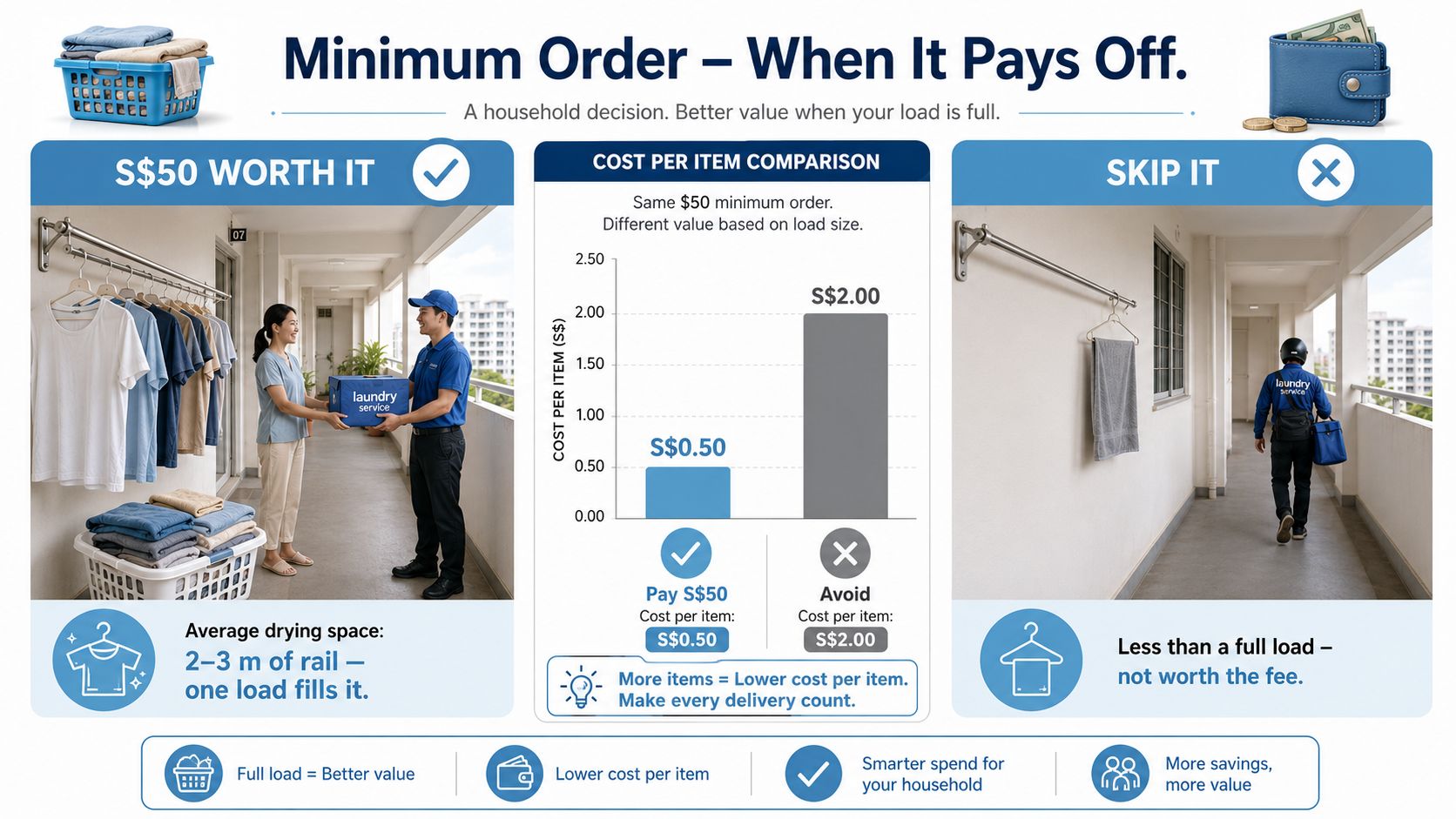
In Singapore homes, drying space is often limited by design and by building rules. HDB and condo households also have to work around restrictions on hanging wet or dripping laundry in certain places, which means the home cost is not just the machine cycle, it's also the space and time needed to dry properly.
That is why a pickup can make sense even when the basket is not huge. If the laundry sits on a rack for long enough to become a household nuisance, the service is no longer competing only on price, it's competing on convenience and compliance.
The home calculation usually includes detergent, water, electricity, folding time, and the space taken up by drying. For many households, those small costs add up faster than they first appear, especially when laundry has to be managed across several loads and then put away.
The decision tends to look different by household type:
• Single professional: often benefits when workwear and casual items pile up together, because one pickup can clear the week.
• Couple: usually gets the most value from bundling shared loads and adding household items that would otherwise need separate home handling.
• Family of four: often sees the strongest case for pickup, because weekly sorting, drying, and folding quickly become a routine chore.
• Shared flat: can use the threshold as a group basket, which spreads the decision across more garments and more people.
If your laundry routine is taking over a weekend evening, the minimum is probably not the real problem. The problem is that home drying and folding are consuming space you don't have.
For customers who want scheduled collection instead of a one-off decision, the schedule page is the natural next stop.
The easiest way to handle a minimum order is to decide whether you want to clear it efficiently or avoid it entirely. Both are reasonable, and the right move depends on how often you wash, what you own, and how much space you have at home.
• Bundle a small pile: Hold back lighter items until the next week so the basket becomes worth sending.
• Add bulky household pieces: Bedsheets and curtains can make sense if they would otherwise need their own home wash cycle.
• Share with a flatmate: One pickup can cover more than one person if you are already sending laundry to the same address.
• Use a by-piece item to top up: A shirt or two can move a basket over the line without changing the whole order structure.
• Switch to a subscription bag: If your volume is predictable, a bag-based plan can remove the minimum-order question altogether.
That last point matters most for people who wash on a steady cadence. When the weekly volume is known, a subscription is often easier to plan around than a one-off cart total.
The operational detail people miss is timing. If you line up your pickup with an existing delivery day, and you keep detergent preferences standard, you avoid unnecessary extras that can make a small basket feel inefficient.

If your laundry pattern is regular, the subscription page is worth checking before you keep paying attention to the cart total every week.
Yes, the minimum applies to the pickup order you place, not to some abstract weekly total. If you send one small basket today and another tomorrow, each booking still has to make sense on its own.
You can usually top it up with another item, wait and combine it with the next load, or switch that basket to a service that does not use the same minimum. The cleanest choice depends on whether you need the laundry back quickly or whether the rest of the week's washing can wait.
Surcharges sit alongside the base order, so they do not usually replace the minimum. That means it helps to check the order summary carefully, especially if you have special handling needs or delivery preferences.
Wash & Fold, Clean & Iron, and subscription bags all run on different service timelines, so the right choice depends on how urgently you need the clothes back. If the laundry is time-sensitive, choose the service path first, then check the order value.
Check the pockets before pickup whenever you can. Forgotten items create avoidable delays and can be a nuisance later, especially if the garment has already entered a cleaning workflow.
Customers ask about this often when they compare laundry providers. The useful habit is to compare the full order structure, not just the headline price, because the minimum, the service type, and the turnaround all affect the final value.
If you want laundry that fits Singapore homes without making you guess how the cart rules work, Tumble Laundry has pay-as-you-go Wash & Fold, subscription bags, Clean & Iron, and curtain care in one place. If you're comparing a one-off pickup against your weekly routine, visit Tumble Laundry and check which service path matches the basket you have.

We make laundry days fast and easy for you. We collect, clean and deliver your laundry and dry-cleaning.
53 Ubi Ave 1 #03-43, Singapore 408934
Mon - Fri | 8:30 am–5:30 pm
Sat | 8:30 am–12:30 pm
hello@tumble.sg
+65 62554222
Whatsapp Us


