How to Wash Curtains at Home: A Complete Care Guide 2026
This is some text inside of a div block.


You've got curtains that look a bit tired, trap cooking smell near the kitchen, or shed dust every time you shake them. In a Singapore apartment, the main problem isn't just getting them clean, it's getting them dry again without turning the room into a damp corner. The smart move is to match the fabric, the fit, and the drying space to the method before you touch water.
Curtains live in a difficult spot in Singapore homes. They're large, awkward to dry, and easy to damage if you guess wrong, so the care label has to come first. If you want a dependable result, treat the label as the fabric's instruction manual, not a suggestion, especially when the panel has a lining or finish that isn't obvious from the front.
A sheer voile behaves very differently from a lined blackout curtain or a heavy velvet panel. Singapore guidance from local providers points to a clear split, washable curtains can go on a gentle cycle with mild detergent, while non-machine-washable fabrics need hand washing or dry cleaning, which matters a lot for linen, silk, and blended sheers in apartment settings Helpling Singapore's curtain care guidance. For a practical reference on label symbols, keep Tumble Laundry's guide to laundry symbols and care labels open while you work through the tag.
Practical rule: if the front fabric looks simple but the back feels coated, stiff, or layered, assume the real care limit is set by the backing, not the outer cloth.
That's why blackout curtains need extra caution. South Mountain Window Cleaning's blackout window tips are useful here because they reinforce a point many homeowners miss, the visible fabric isn't always the washable part, and window dressings with special light-blocking construction need a more careful approach than ordinary drapes South Mountain Window Cleaning's tips.
Sheers and voiles are the easiest starting point for home washing, provided the tag allows it and there's no fragile trim. Cotton blends often tolerate machine washing better than structured fabrics, but you still need to check for pleats, bonded layers, or decorative finishes.
By contrast, silk, velvet, wool, thermal curtains, lined panels, pleated drapes, and many blackout styles are much less forgiving at home. Those fabrics are more likely to lose shape, separate at the lining, or react badly to water and agitation. If the label is vague, the safest assumption is that the curtain needs gentler treatment than a normal laundry load.
The decision is simple. If the panel is lightweight, removable, and clearly machine-safe, home washing may work. If it's structured, layered, or expensive to replace, stop and read the tag twice before you commit.
Curtain removal looks quick until a hook snags, a ring falls behind the radiator, or you pull a seam at the header. The safest way to take panels down is to slow the process, keep the hardware organised, and deal with loose soil before any water touches the fabric. That saves time later, because once a dirty panel goes into the wash, embedded grit turns into extra friction.

Start by opening the curtain fully so the folds aren't compressed while you work. Remove hooks, rings, clips, and weights one by one, and place them in a small container so you don't lose the matching set. If you're dealing with a rail that's awkward to reach, support the fabric with one hand while you unfasten the last points of attachment.
Dust comes off more cleanly if you shake each panel outdoors or over a protected floor before washing. That matters in apartments where curtains often collect cooking residue, window dust, and the fine grime that settles near tracks and sills. If the surrounding window area also needs attention, clean window sills and tracks before you put the curtain back, because dirty tracks make fresh fabric look tired again almost immediately.
Not every mark needs the same approach. Dust-bonded grey patches usually respond to a light vacuum pass and a mild pre-soak, while kitchen grease often needs a small amount of diluted detergent worked gently into the spot before washing. Pet marks are better handled with a careful blotting approach, and water staining from leaks should be treated conservatively so you don't spread the ring wider.
Don't scrub a curtain stain like a countertop stain. The weave is the first thing to suffer, not the mark.
For deeper stain logic, Tumble Laundry's curtain stain guide is a useful companion when you're deciding whether a spot can be lifted safely at home.
Use only as much moisture as the fabric can handle. A pre-treatment should loosen soil, not soak the panel, because excess wetting makes drying slower and increases the chance of a ring forming around the spot.
The right wash method depends on how the curtain is built, not just what it looks like from across the room. In Singapore homes, the safest decision map is usually this, machine washing for removable, low-risk panels, hand washing for delicate washable fabrics, and professional care for anything structured, coated, or heavily lined. That's a better filter than trying to force every curtain through the same routine.
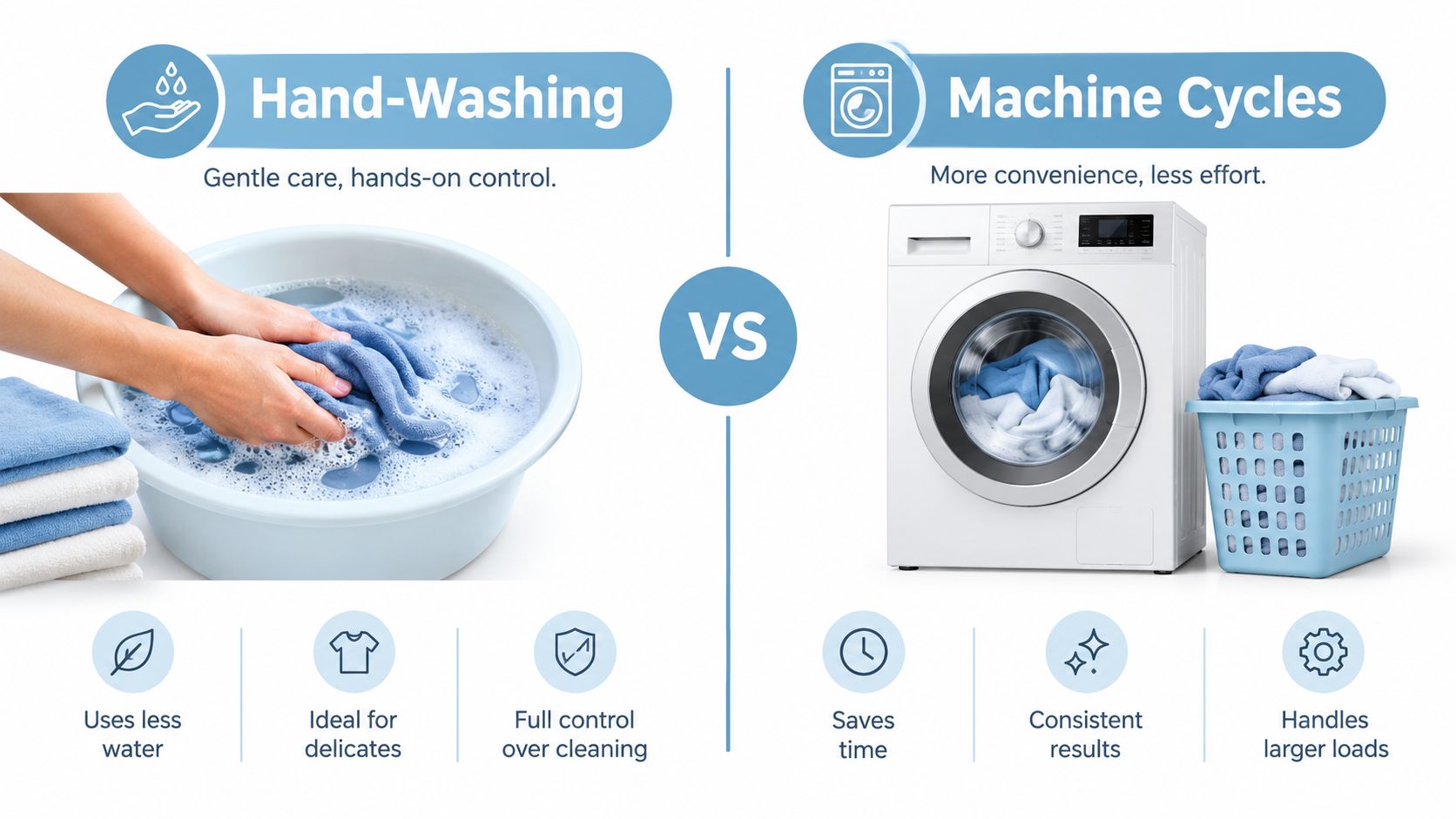
For sheers, voiles, and other unlined synthetics, machine washing is usually the least stressful option if the care label permits it. Remove hooks or rings, shake out dust, place the panels in a mesh bag, and use a cold, gentle cycle with mild liquid detergent. Keep the spin very low, then rehang while the fabric is still slightly damp so the curtain's own weight helps flatten creases.
That approach works because the fabric moves with less friction. It's a low-mechanical-load wash, which matters for light panels that can snag easily but don't usually need aggressive cleaning.
Lined, pleated, blackout, silk, velvet, wool, and thermal curtains are poor candidates for home machine washing. Shape distortion is the main risk with pleats and structured headers, while lining damage and coating failure are the bigger problems for blackout and thermal styles. Even when the face fabric looks ordinary, the hidden construction can make the curtain far less tolerant of agitation.
If your washer or dryer is part of the plan, it pays to know where appliance care starts and ends. The practical angle is simple, if the machine is likely to be stressed by oversized, water-heavy panels, washer and dryer repair becomes part of the conversation, not just the curtain itself.
Hand washing makes sense when the panel is washable but too delicate for a drum. Fill a tub or large basin with cool water, add mild detergent, and move the fabric gently through the water without twisting it. Press excess water out carefully, never wring the panel, because stretching is usually more damaging than dirt.
Practical rule: if you're tempted to scrub or twist, the curtain probably shouldn't be hand-washed any harder than a soft soak and a slow rinse.
For temperature choice, Tumble Laundry's cold wash versus hot wash guide reinforces the safer direction for fragile fabric care, especially when shrinkage or coating damage would be expensive to fix later.
Singapore humidity makes drying the deciding step in curtain care. Washing can be careful, but if the panel stays damp, mould and mildew can settle into the folds fast. The practical answer is simple, get the curtain moving air as soon as it comes out of the wash, because a cramped apartment gives moisture fewer places to go.

Hang the panel in a ventilated spot once the wash is done. A basket, chair, or piled-up floor space traps moisture in the folds and gives odour a head start. In an apartment, that usually means a rack near an open window, a fan, or any area with better cross-breeze than the bedroom.
Same-day drying is the target. Curtains hold water in hems, linings, and pleats longer than everyday clothes, so a panel that feels almost dry can still carry enough dampness to cause trouble overnight.
Rehang the curtain while it is still a little damp. Gravity helps the fabric settle, the folds relax, and you avoid forcing heat into material that may not tolerate it well. For pleated headers, put the panel back on the rod in the same order so the shape stays consistent as it finishes drying.
If the care label allows smoothing, keep it gentle. Light steaming or low heat is safer than pressing hard, especially on fabrics that flatten or mark easily. Tumble Laundry's guide to drying clothes indoors without musty smells points to the same practical rule, airflow first, patience second.
Singapore guidance recommends periodic cleaning every 3 to 6 months, or every 3 to 4 months in more moisture-prone settings, with weekly vacuuming to lift dust before it settles into the weave Presto Dry Cleaners Singapore's curtain drying guidance. That schedule works because curtains stay easier to dry, and easier to keep fresh, when dust and humidity are not left to build up between washes.
A curtain that looks washable can still be a poor candidate for home care in a Singapore apartment. The decision comes down to fabric, weight, drying space, and how much handling risk you can accept. If the panel is delicate, lined, oversized, or awkward to take down and put back, professional cleaning is usually the safer choice.
Day-night sets, long lined drapes, and curtains on hard-to-reach tracks can turn a quick wash into a drawn-out job. In dense housing, the main constraint is often not the wash itself, but where the curtain will dry and how you will reinstall it without creasing or damaging the fabric. If airflow is limited, time is tight, or the curtain is expensive to replace, a service clean is the lower-risk option.
Price matters because it changes the threshold. Some providers charge about S$15 to S$40 per piece, and minimum orders such as S$150 can apply if you only have one or two panels Helpling Singapore's curtain pricing overview. For method-specific pricing, Big Mama's curtain cleaning pricing puts steam cleaning at about S$25 to S$35 per panel, while workshop-style dry cleaning is about S$10 to S$18 per foot. Those figures make the method choice just as important as the cleaning job itself.
Lined, blackout, thermal, and heavily pleated curtains deserve caution. The same goes for fabrics you do not want to test with a guess at home. A professional clean keeps the shape more predictable than repeated washing and drying in a cramped flat.
Singapore services also point to steam or dry cleaning for day-night curtains because dismantling, drying, and reinstallation are harder in apartment layouts. Tumble Laundry's curtain steam cleaning guide is useful if you want a refresh without a full do-it-yourself cycle. Tumble Laundry also offers curtain cleaning with optional takedown and rehang support, which helps when the hard part is the removal and reset, not the wash itself.
Choose home washing when the curtain is light, clearly washable, and easy to dry. Choose professional cleaning when the fabric is delicate, the backing is risky, or the apartment setup works against proper drying.

We make laundry days fast and easy for you. We collect, clean and deliver your laundry and dry-cleaning.
53 Ubi Ave 1 #03-43, Singapore 408934
Mon - Fri | 8:30 am–5:30 pm
Sat | 8:30 am–12:30 pm
hello@tumble.sg
+65 62554222
Whatsapp Us


