Hotel Linen Laundry in Singapore: A Practical Guide
This is some text inside of a div block.

At 11 p.m., the guest doesn't care why the room isn't ready. They don't care that the laundry truck came late, that the towels were still damp, or that housekeeping had to strip one floor to release another. They see one thing. The hotel looks disorganised.
That's why hotel linen laundry is never just a cleaning task. In Singapore, it sits inside an organised B2B operating model with providers offering scheduled delivery, industrial laundering, and hospitality-specific linen programmes for hotels, restaurants, and related venues, as shown by Alsco Singapore's linen solutions. If you treat linen as a side issue for housekeeping, you'll keep solving symptoms instead of fixing the system.
The usual mistake is simple. A hotel treats linen as a purchase plus a wash service. Then the team wonders why room release slips, banquet setup gets messy, and the front office starts chasing towels at night.
The root cause is almost always upstream. Pickup windows were too tight. Return volumes were signed off without proper verification. The laundry accepted more load than it could process properly. None of that is “cleaning”. It's operations design.
If you're reviewing hotel linen laundry, start with three blunt questions:
1. Will rooms stay stocked at check-in
2. Will the textiles survive industrial handling
3. Will a bad batch become visible to the guest
Those questions cut through most sales talk. A provider can promise clean linen all day. What matters is whether your property gets the right stock, in the right condition, at the right hour.
Practical rule: Put linen on the daily ops stand-up agenda, not just the housekeeping checklist.
A good linen programme feeds more than guestrooms. It also supports F&B, kitchens, spa operations, and poolside service. If one stream breaks, another department usually feels it first. Banquet napkins go missing. Kitchen cloths get mixed into towel loads. Someone raids room stock to patch a service gap.
Keep these decisions at operations level:
• Pickup cadence: Daily, alternate-day, or event-based pickup has to match actual turnover, not what looked cheap on the quote.
• Verification method: If your dock team can't reconcile outgoing and incoming loads cleanly, disputes will pile up.
• Failure response: Late truck, rejected batch, stain issue, shortage event. The response path must already exist before the first problem.
If your current setup still feels reactive, review your workflow against practical laundry best practices in Singapore. The strongest hotels don't “manage laundry” in the abstract. They design a system that keeps linen invisible to guests.
A lot of hoteliers sign weak contracts because they never define the scope properly. “Linen laundry” sounds obvious until the first billing dispute lands on your desk.
Hotel linen laundry isn't one stream. It's several textile categories moving on different wear patterns, different stain profiles, and different presentation standards.
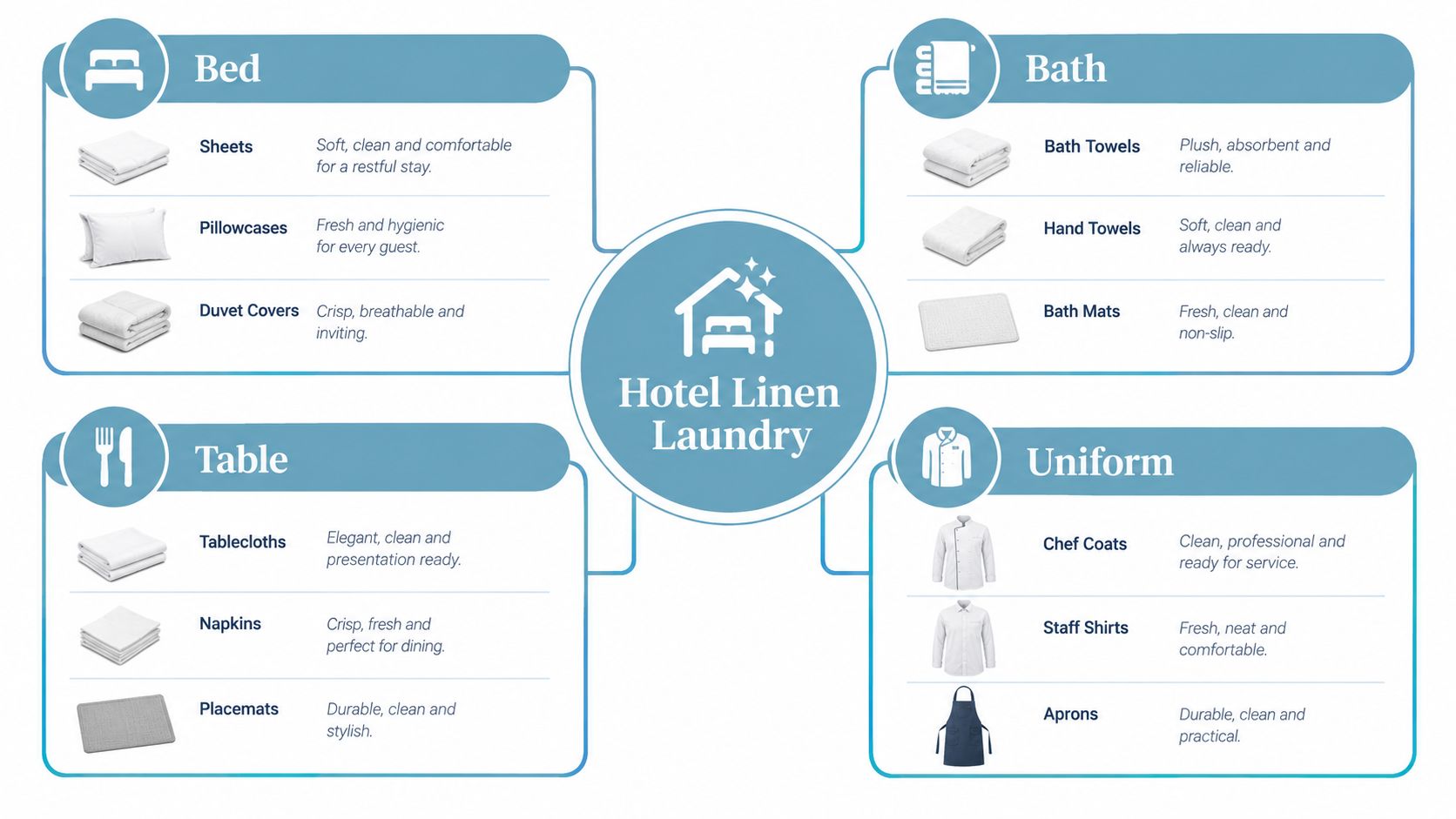
Most properties are really managing four parallel mini-programmes:
• Bed linen: Sheets, pillowcases, duvet covers, mattress protectors, bolster covers.
• Bath linen: Bath towels, hand towels, face towels, bath mats, robes.
• Table linen: Napkins, tablecloths, runners, banquet skirting.
• Back-of-house textiles: Kitchen cloths, chef wear, spa linen, pool towels, staff uniforms where included.
Each stream needs its own handling logic. Towels shed lint. Table linen carries food and beverage stains. Bed linen gets body oil, cosmetics, and occasional biological soiling. Kitchen textiles are a category of their own and shouldn't be casually bundled into a generic rate.
A useful contract doesn't just say “laundry included”. It names the operating components:
• Supply model: Rental stock or hotel-owned stock
• Collection and delivery: Fixed windows, receiving process, escalation path
• Finishing standard: Pressed, folded, stacked, hanger-packed, cage-packed
• Repair and replacement: Minor mending, condemn criteria, replacement trigger
• Identification: Tagging, hotel marking, SKU control, cage labelling
That last point matters more than people think. If bath mats or spa sheets aren't named clearly, they often show up later as “special items” and get billed separately.
For guest-facing bed presentation, your housekeeping trainers may still benefit from simple visual references like this SouthShore Fine Linens bed making tutorial. It's not a laundry guide, but it's useful for aligning linen finish with what the guest sees on the bed.
A one-line quote for “all hotel linen” usually means the vendor is averaging across unlike items. That's convenient for them, not for you.
Spell out whether protective covers, duvet inserts, mattress covers, and pillow protectors sit inside standard service or are treated as exception items. Hotels miss this constantly. If you need a practical reference for bedding components and care categories, this guide on cleaning pillowcases, duvets, and mattress covers is a helpful reminder of how different these pieces are in real handling terms.
One soiled sheet tells you almost everything about a laundry operation if you follow it properly. The weak points always show up in the handoffs.
Here's the visual workflow most hotels should expect from a competent provider:
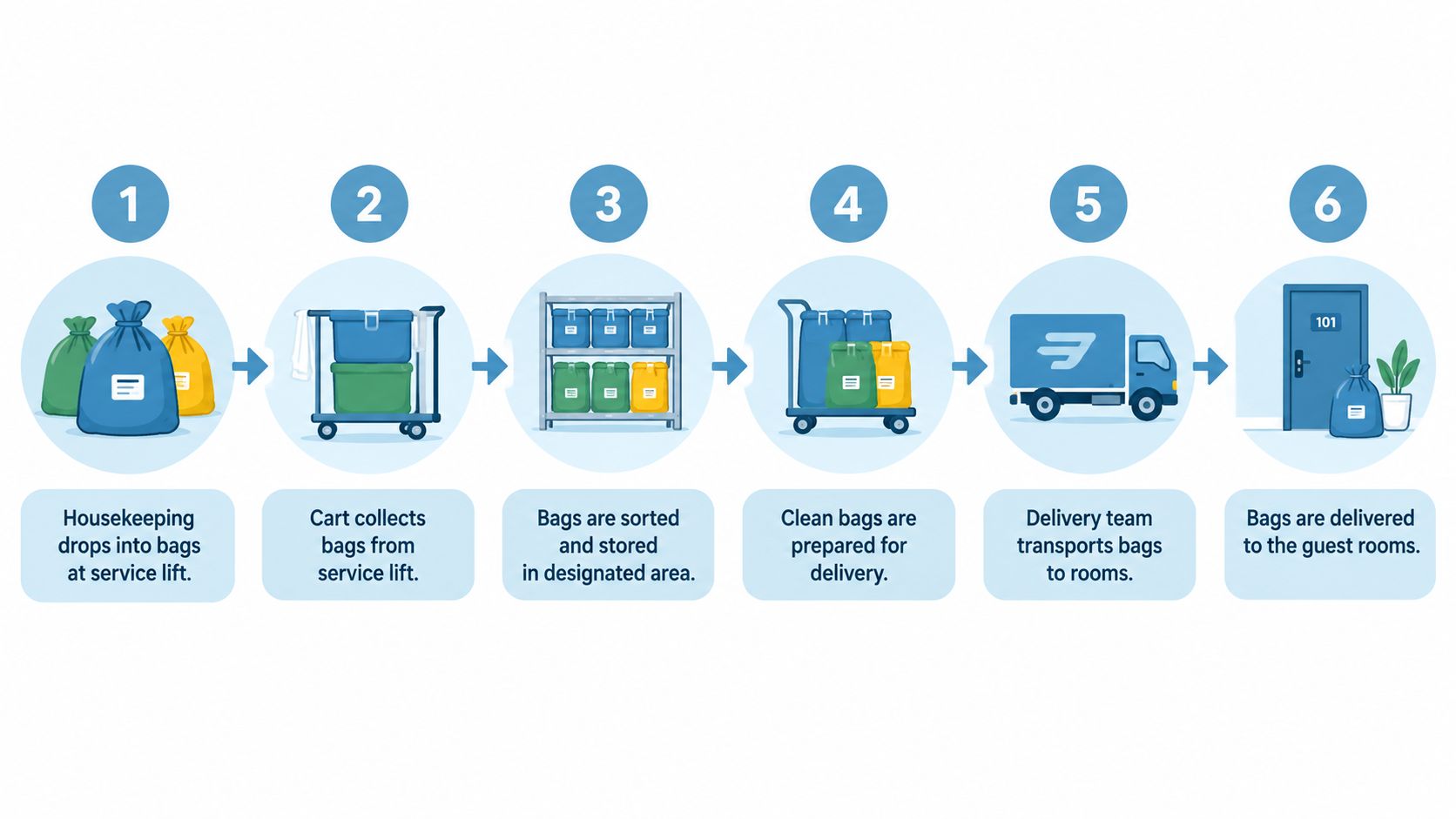
Housekeeping should bag soiled items at the service point, ideally in segregated streams rather than one mixed heap. Corridor piling is lazy and creates contamination risk, smell issues, and counting mistakes.
At pickup, the hotel and laundry must agree on what is leaving the property. That can be by weight, by piece count, or by a mixed control method depending on item type. What matters is that both sides sign the same reality.
If your property still uses flimsy, inconsistent packing for collection, fix that first. Standardised containment affects count accuracy, handling speed, and contamination control. This guide to commercial laundry bags is worth a look if your team needs a cleaner bagging setup.
Once loads hit the plant, proper sorting decides whether quality stays stable. Sheets should not be casually processed with lint-heavy towels. Heavily stained F&B stock shouldn't disappear into the same chemistry and cycle logic as routine room linen.
A decent workflow usually includes:
1. Sort and classify by textile type, soil type, and urgency.
2. Pre-spot obvious stains before full wash.
3. Check foreign objects like cutlery wraps, pens, guest items, or kitchen debris.
4. Run the assigned wash programme with controlled chemistry and machine loading.
5. Dry and finish according to fabric type.
6. Inspect and reconcile before packing for return.
The biggest quality failures are usually process failures in disguise. Greying, lint transfer, torn hems, and sour smell rarely come from “bad linen” alone.
A short operations video can help align your team on what an industrial flow should look like in practice:
If you only audit three things, audit these:
• Weigh or count point: Know exactly where custody changes.
• Wash record: Ask whether the laundry can produce process logs for disputed loads.
• Return reconciliation: Returned cages, bundles, or packs must map to the dispatch record.
When hotels say “the laundry lost control”, they usually mean nobody defined the handoff properly.
Hygiene isn't a feeling. It's a process outcome.
A Singapore hospitality-laundry training source states that washing hotel linen at 70°C for about 25 minutes achieves thermal disinfection against most bacteria, and it also warns that under-loading or overloading harms wash results and can damage linen, as set out in the ASEAN housekeeping training material on laundering linen and guest clothes. That's the part many buyers miss. Temperature alone doesn't save a bad load.
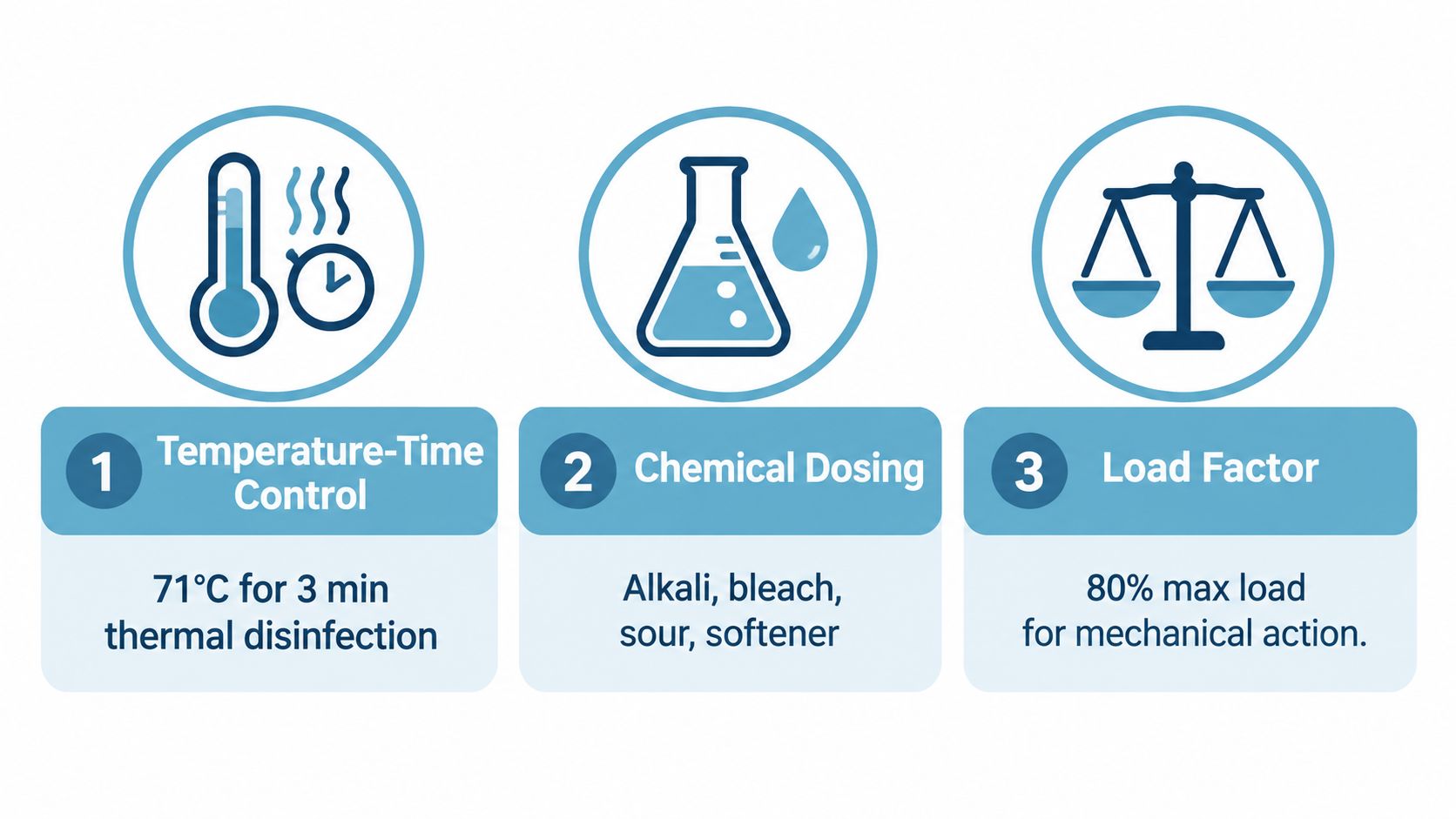
Don't accept vague lines like “hospitality-grade washing” or “sanitised finish”. Ask for the operating controls behind the claim.
Check these points:
• Temperature-time record: The plant should be able to show that the programmed cycle reached and held the required condition.
• Load factor discipline: If drums are packed badly, linen at the core may not wash or rinse properly.
• Chemical programme: You want a controlled sequence, not random “stronger” dosing when stains get difficult.
• Stain classification before wash: Blood, oil, cosmetics, food, and beverage marks don't all respond to the same treatment.
A laundry can talk endlessly about chemical quality. That's not enough. If the machine is overloaded, chemistry can't compensate for poor mechanical action or poor heat penetration through the load.
That's why I push hotels to ask a very simple question during site visits: how does the plant decide machine loading by category? If the answer sounds improvised, walk away.
For teams that need a broader view of professional garment treatment logic, the dry cleaning process explained is useful background because it shows the same principle in another form. Process control matters more than marketing language.
Overprocessing solves one problem by creating another. If a laundry keeps hitting everything with aggressive bleaching or rough handling, terry loses hand feel and sheeting starts yellowing or thinning sooner than it should.
Good hotel linen laundry balances disinfection with fabric survival. Bad laundry treats every problem as a chemistry problem.
If your linen life keeps collapsing, don't blame procurement first. Audit the wash process.
Most Singapore hotels end up choosing among three models. None is perfect. The right one depends on how much control you want, how much operational risk you can absorb, and whether you're ready to manage textile inventory like a real asset.
Full hire or rental means the provider owns the linen pool and launders it. You pay for access to a managed supply. This reduces replacement headaches, but it also means you're using their fabric standard, their stock logic, and their replenishment discipline.
Wash-and-return outsource means the hotel owns the linen and the laundry processes it. This gives stronger control over quality, branding, and room feel. It also means loss, damage, and replacement disputes need sharper contract language.
In-house laundry gives the property the most direct control. It also gives the property the staffing problem, the utility burden, equipment maintenance exposure, and the pain of downtime when a machine or team fails.
DimensionFull Hire / RentalWash-and-Return OutsourceIn-House LaundryOwnership of linenProvider owns stockHotel owns stockHotel owns stock and plantUpfront capital burdenLowerModerateHighestControl over fabric specificationLowerHigherHighestReplacement riskMostly sits with provider, subject to contractSits with hotel, subject to damage termsFully sits with hotelDaily operational workloadLower on propertyModerateHighestFlexibility during service issuesDepends on provider's spare poolDepends on your reserve stockDepends on your own team and backup planBrand consistencyLimited to provider rangeStrongerStrongest if managed wellScaling with occupancy swingsEasier if contract is well structuredUsually manageableHarder without excess internal capacity
Smaller or leaner properties usually benefit from full hire if they care more about predictability than fabric customisation.
Mid-sized hotels often land on wash-and-return outsource because it keeps guest-facing control with the hotel while shifting labour and plant complexity outside.
In-house works best when the hotel has the volume, the engineering support, the space, and the discipline to run laundry as a production unit. If you're romantic about “having control” but weak on maintenance and workforce planning, in-house becomes expensive very quickly.
If you want a non-hotel but still useful framework for comparing cost risk and control trade-offs, this cost risk KPI analysis on insourcing vs outsourcing is a helpful thinking tool. For a local commercial context, it also helps to review how commercial laundry services in Singapore are typically structured before committing to a model.
Most hotel sustainability talk around linen is too soft. Guests hear “please reuse your towel”. Operators need a harder question. Which part of the linen loop moves the property's water performance?
PUB's sector benchmark gives a better starting point. It lists median hotel water use at 0.53 m³ per guestnight for 4-star hotels with water-cooled cooling towers and 0.76 m³ per guestnight for 5-star hotels, in the sectoral water efficiency benchmark. Laundry sits inside that wider system, but not every litre is equally controllable through guest messaging.
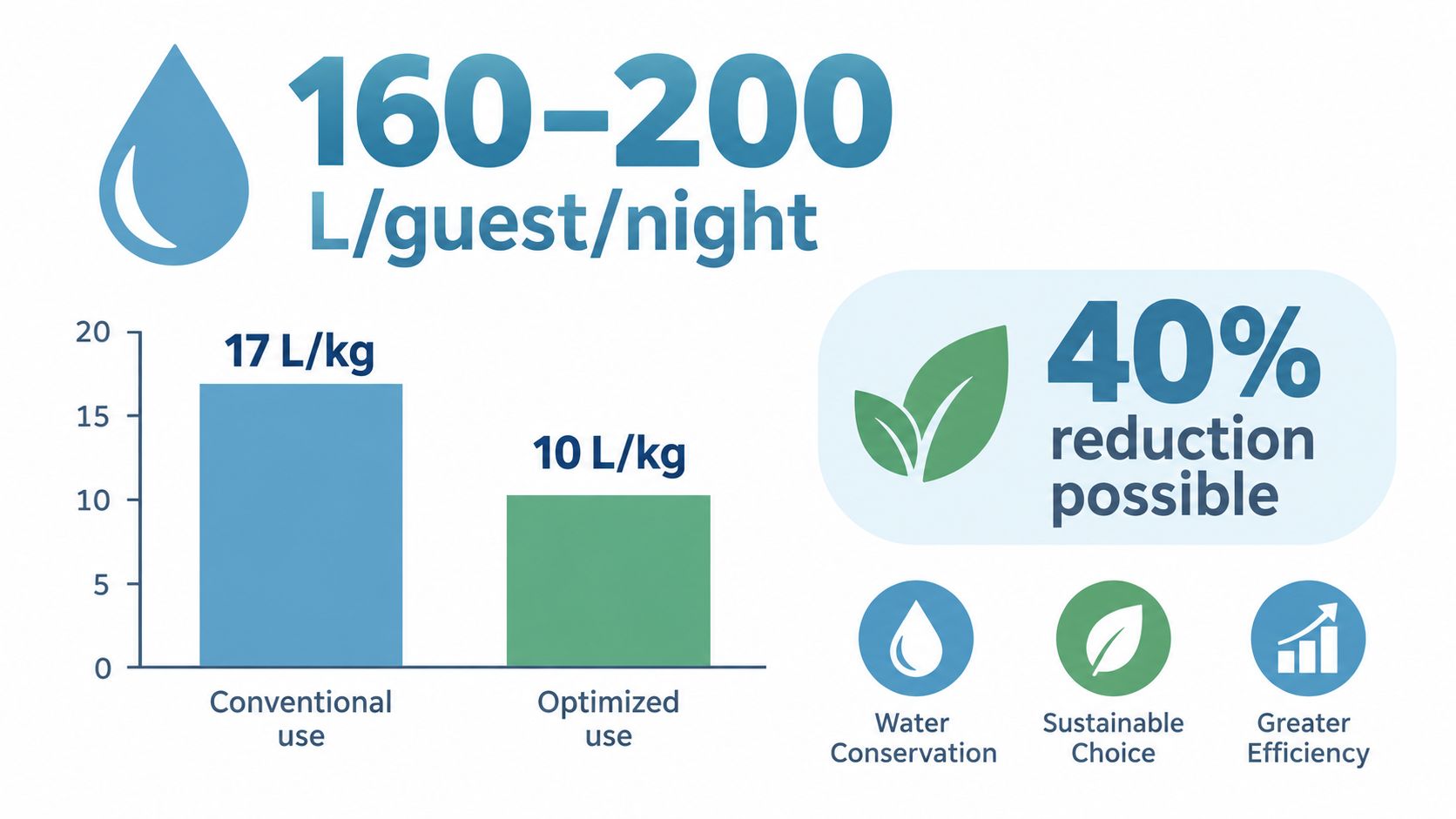
These are different levers.
Guest-side action includes linen and towel reuse programmes. They can reduce wash demand, especially where room habits support the policy and housekeeping follows it consistently.
Process-side action sits in the laundry system itself. That's where operators should focus first. Machine loading, rinse design, reuse systems, sorting discipline, and wash-programme control usually matter more than poster campaigns in the bathroom.
Ask your provider this: where in your process do you reuse water, and is that treatment matched to the actual end use?
PUB notes that commercial laundries can reuse treated water without needing NEWater-grade quality for every use, and that simple filtration can be sufficient for certain operations, according to PUB's water efficiency guide for the commercial laundry sector. That's the right mindset. Don't over-treat every stream if the process doesn't require it.
Fix the plant before you market the programme. A weak laundry process will waste water even if every guest hangs up their towel.
A cheap linen quote can wreck a hotel. It won't show up in month one. It shows up when stock goes missing, rewash rates rise, banquet linen returns late, and nobody agrees on who pays.
The common charging approaches are straightforward, but each shifts risk in a different way.
DimensionCommon OptionsTrade-off for HotelsPricing basisPer-piece rateEasy to budget for stable items, but can punish higher-turn categoriesPer-kilogram rateFlexible for mixed loads, but harder to audit if sorting is weakFlat bag or subscription-style rateSimple administration, but only works if bag definition and accepted contents are clearTurnaroundSame-dayUseful for urgent recovery, but usually costs more and leaves less room for quality recoveryNext-dayCommon balance between service level and process stabilityLonger turnaroundCan work for lower-priority streams, but raises stock dependencyPickup cadenceDailyLowers shortage risk, increases service costFixed multi-day scheduleCheaper on paper, riskier during occupancy swings or event periodsDamage treatmentRepair, replace, or rejectMust be defined by item class and condition thresholdLoss handlingProvider liability, shared liability, or proof-based reviewWeak wording usually hurts the hotelStain policyRewash, special treatment, or condemnIf this isn't defined, you'll argue about “permanent stains” foreverHygiene failure responseReprocess, urgent redelivery, credit, or root-cause reviewThis is where real service quality shows upMissed pickup or deliveryService credit, emergency collection, or no remedyNo penalty usually means missed windows become “best effort”
Push hard on these points before signature:
• Pickup and delivery windows: Not just “daily service”. Specify time bands and what happens when the truck misses them.
• Reconciliation method: State whether disputes are settled by dock count, dispatch sheet, cage count, or verified weight.
• Damage liability: Define what counts as fair wear versus process damage.
• Loss replacement rule: Set out how missing stock is investigated and replaced.
• Rewash policy: Clarify which stains trigger rewash and who decides when an item is beyond recovery.
• Contingency response: Demand a documented backup plan for plant breakdown, vehicle failure, or rejected batch.
• Exit terms: If service degrades, you need a practical path out without chaos.
I'd reject any agreement that uses soft language like “subject to operational conditions” without defining service recovery. I'd also reject broad loss waivers and vague wording around “normal shrinkage” or “industrial wear” unless the categories are clearly described.
If the contract doesn't say what happens on the bad day, the contract is unfinished.
One more point. Turnaround commitments only mean something if they line up with your room-release pattern. Same-day sounds attractive, but if the operation keeps returning unstable quality, next-day with stronger controls may serve the hotel better.
Most vendor meetings sound fine. The slides are clean, the trucks look decent, and everyone says they understand hospitality. That's not enough. You need a checklist that forces operational proof.
Start with plant capability. Ask what categories they process, how they separate hospitality streams, and how they handle peaks. Look for signs of discipline rather than polished sales language.
Use this shortlist:
• Equipment fit: Can the plant handle sheets, terry, table linen, and back-of-house items without collapsing them into one generic process?
• Process control: Can they show wash logs, loading discipline, and clear stain handling rules?
• Stock logic: If they offer rental, how do they maintain supply continuity when a batch is condemned or delayed?
If you're weighing ownership versus outsourced processing more broadly, this piece on evaluating total cost of ownership for laundry is useful because it forces the right questions around equipment, labour, and operational burden.
Don't stop at the plant tour. Reliability lives in routine execution.
Ask directly:
• What happens when a truck misses the slot
• What backup capacity exists if the main plant has an issue
• How are urgent shortfalls handled on weekends or after hours
• Who signs off disputed counts and by when
A provider that can't answer those cleanly is telling you something important.
The best laundry partner is boring in the best way. Loads arrive when expected, discrepancies are documented, and nobody in the hotel has to improvise.
The contract should match what the operation claims. If sales promises flexibility but the agreement limits every remedy, believe the contract.
Review these clauses line by line:
1. Pricing clarity: No mixed-item ambiguity, no hidden surcharges for routine hospitality categories.
2. Service levels: Pickup windows, return windows, escalation contacts, and remedies.
3. Failure handling: Rewash timing, shortage events, hygiene complaints, and temporary substitutions.
4. Liability framework: Loss, damage, and replacement process.
5. Exit mechanics: Notice period, stock return, final reconciliation, and handover support.
I'd always run a 30-day pilot before locking into a longer term deal. Use the pilot to inspect count accuracy, finish quality, stain handling, packaging consistency, and whether the delivery pattern matches your operation in real life.
That month will tell you more than any presentation deck.
Tumble Laundry provides Singapore-based commercial laundry support with in-house processing, scheduled collection and delivery, and recurring service for business clients that need consistency rather than excuses. If you're reviewing your current linen workflow, service model, or pickup discipline, visit Tumble Laundry to see how a professionally managed laundry operation can fit into a tighter hospitality process.

We make laundry days fast and easy for you. We collect, clean and deliver your laundry and dry-cleaning.
53 Ubi Ave 1 #03-43, Singapore 408934
Mon - Fri | 8:30 am–5:30 pm
Sat | 8:30 am–12:30 pm
hello@tumble.sg
+65 62554222
Whatsapp Us


