Cheap Dry Cleaning Singapore: How to Find Affordable Service
This is some text inside of a div block.


You're standing in front of a laundry pile that looks harmless until you start counting the pieces. Two office shirts, one suit for a meeting, a cheongsam or saree for dinner, and those curtains you've ignored for months. In Singapore, that mix is exactly where dry cleaning Singapore cheap gets tricky, because the bill isn't driven by one neat price, it's driven by garment type, minimum order rules, and how much convenience you're paying for.
The fast mistake is to compare one shop's shirt price against another shop's shirt price and call it a day. That misses the actual question, which is whether the service is cheap once you include pickup, turnaround, stain treatment, and the fact that a single blazer can cost more than an entire wash-and-fold bag. If you want a grounded local reference point on pricing strategy, the breakdown in local SEO pricing for agencies is a useful reminder that buyers usually weigh total service value, not sticker price alone.
A typical weekday in Singapore starts with a rushed wardrobe decision. You grab a shirt for the office, notice a suit hanging behind the door, and remember a family event this weekend where a traditional outfit needs careful handling. By the time you've added curtains to the list, the “cheap” question is no longer about one item, it's about keeping a whole household presentable without wasting time or space.
That's the reality for dry cleaning Singapore cheap. Dry cleaning in Singapore is usually sold as a premium convenience service, not a commodity wash, and the local market reflects that. Published rate cards commonly place shirts or blouses at S$3 to S$6, suits at S$12 to S$18, dresses at S$10 to S$20, and jackets or coats at S$12 to S$25, while specialty items can reach S$20 to S$50+ or higher depending on fabric and finishing requirements, as shown in Singapore pricing coverage from Pressto Asia.
If you only send one item at a time, the maths gets ugly fast. A working professional who needs office wear refreshed every week, plus the occasional formal outfit, isn't comparing dry cleaning against another dry cleaning quote. They're comparing it against whether a wash-and-fold bag, a home machine, or a pickup service makes more sense for the month.
Practical rule: if your laundry mix is mostly everyday cotton, dry cleaning is usually a bad habit, not a smart spend.
Singapore's housing setup makes that decision sharper. Limited drying space, long work hours, and event wear all push people towards door-to-door service, but that doesn't mean every garment deserves the same treatment. The internal guide on dry cleaning service in Singapore is worth reading if you want a straightforward local overview of what service types usually exist and how they're framed in the market.
Dry cleaning is priced per garment for a reason. The cost depends on fabric sensitivity, structure, lining, stain work, and finishing, not just how heavy the item is. That's why a shirt, a suit, and a saree do not sit in the same price band, even if they all end up on the same receipt.
These Singapore figures come from published local comparisons that show a broad household-facing range, not a single fixed rate. A 2025 Singapore comparison also found wash-and-fold around S$3/kg to S$8/kg, with several providers clustering near S$5/kg to S$6/kg, which is why many budget-minded customers judge dry cleaning against a much cheaper load-based alternative instead of another item-based quote (Pressto Asia).
A suit costs more than a shirt because it demands more than a quick wash and hang. It needs inspection, stain removal, solvent cleaning, pressing, and often more careful finishing to keep lapels, seams, and shape intact. Traditional attire and evening wear push the price higher because a mistake is more expensive to fix than the cleaning itself.
Singapore rate cards also make the minimum-spend trap obvious. Some service models expect S$30 to S$50 or more before the order makes sense, especially if collection and delivery are folded into the offer, as seen in Singapore laundry pricing coverage from MoneySmart. That means a single shirt may look cheap on paper, but the checkout total can stop feeling cheap very quickly.
The Tumble walkthrough on dry cleaning process helps frame why the per-piece model exists in the first place. The short version is simple, garment care is priced by complexity, not by weight.

The machine isn't doing a normal wash. Dry cleaning uses non-aqueous solvent circulation instead of water immersion, and the garment load is usually kept to about one-third of the machine chamber capacity so the fabric isn't crushed or overworked. The solvent is filtered through lint traps, cartridge filters with activated clays or charcoal, and polishing filters before being recirculated, which is part of why the process is more controlled than home washing (Dry cleaning).
1. Tagging
Every piece gets labelled, because item tracking matters when garments are processed one by one.
2. Solvent-based cleaning
The machine uses a solvent, not a soaking wash, which is how delicate fabrics avoid the same water exposure that can distort shape.
3. Filtration
Lint traps and cartridge filters remove impurities, so the solvent can be reused without dragging dirt back into the fabric.
4. Pressing and steaming
Industrial pressing restores shape. Structured items get their clean finish.
5. Quality check and packaging
Someone still has to inspect the garment, spot remaining marks, and package it properly.
Warm air drying in dry-cleaning machines typically happens around 60 to 63°C, which is hot enough to evaporate residual solvent without blasting the fabric the way a rough home cycle can (Dry cleaning). That controlled setup is exactly why curtains, suits, and workwear can be cleaned with less shrinkage risk than conventional washing.
Practical rule: if a quote looks far below the rest of the market, ask which steps are missing, because the cheap version usually cuts labour somewhere.
The part Singapore customers feel most is not the machine, it's the human work around it. Stain treatment, solvent recovery, pressing, and final checks all take time. A low sticker price still has to cover those steps, which is why cheap providers often stay cheap only on uncomplicated items.
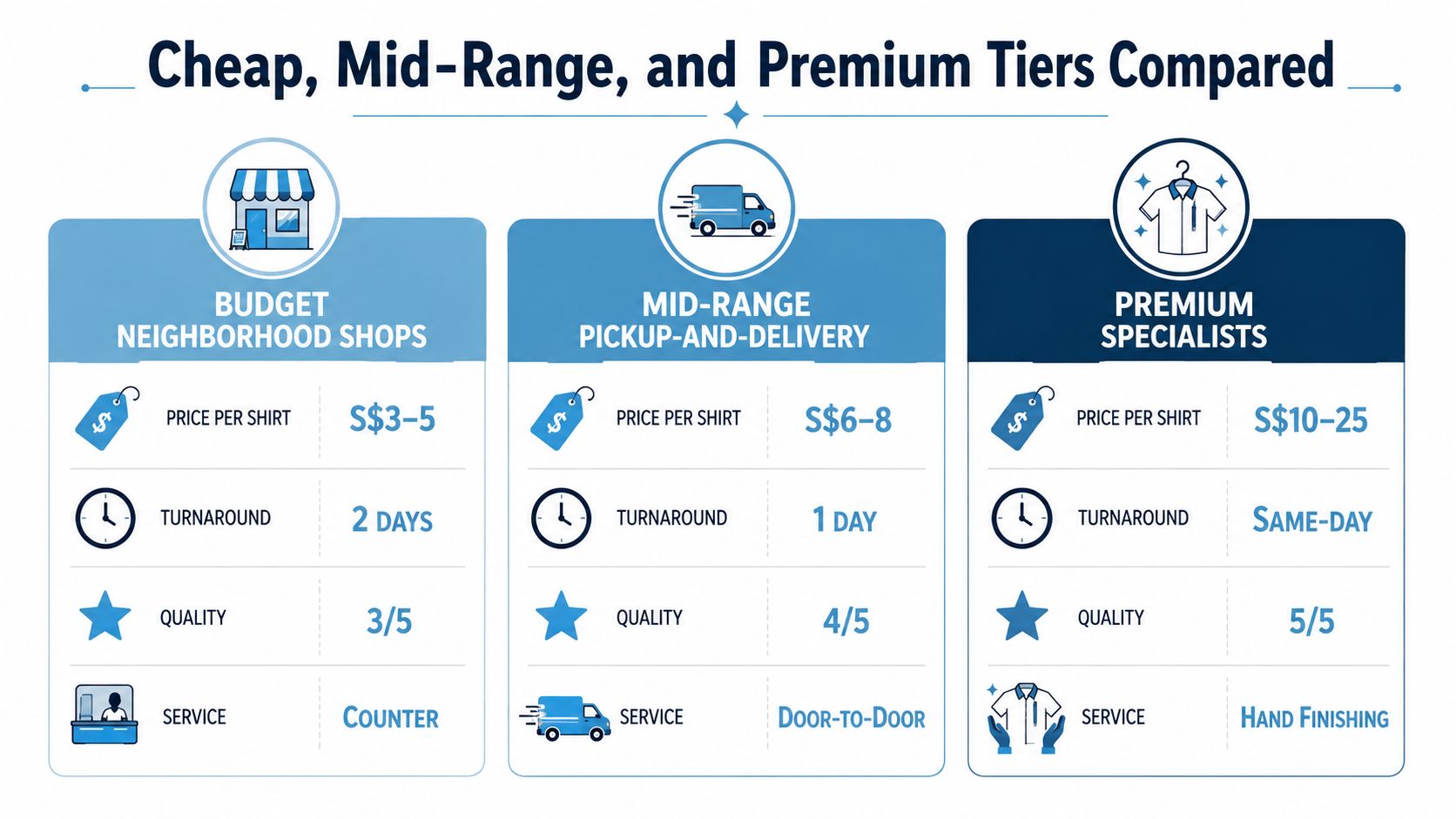
Singapore's dry cleaning market splits cleanly into three tiers. The cheapest shop is not always the smartest buy, because a lower counter price can come with slower correction if something goes wrong. Mid-range pickup services often charge a bit more, but the order tracking and delivery convenience can make the actual cost lower for busy households. Premium specialists charge the most because they're selling speed, hand finishing, and tighter control.
The practical mistake is assuming a S$4 shirt is always cheaper than a S$7 shirt. If the budget shop needs a second trip, misses a stain, or returns the item wrinkled enough that you have to re-press it at home, the lower price has already lost its advantage. That's why itemised tracking and clear turnaround commitments matter more than people admit.
If you want a local service example with pickup and itemised care options, the offer page at Tumble Laundry dry cleaning offer shows how a service can package convenience alongside garment care without hiding the workflow. That doesn't make it the only choice, but it does show how the market now sells more than just cleaning.
• Pick budget shops when the garment is ordinary, the stain is light, and you can live with slower handoff.
• Pick mid-range pickup when your time is tight and you want predictable delivery without managing a counter visit.
• Pick premium specialists when the item is delicate, structured, or expensive enough that fixing a mistake would cost more than the service itself.
The market's middle tier often wins for households with mixed wardrobes. It is not the cheapest on paper, but it can be the cheapest way to avoid wasted time and a second cleaning cycle.
Cheap dry cleaning in Singapore is about order design, not just finding a lower rate card. If you send in one item at a time, you keep paying the most inconvenient version of the service. If you group garments properly, ask the right questions, and stop defaulting to urgent turnaround, the bill drops without turning the clothes into a risk.
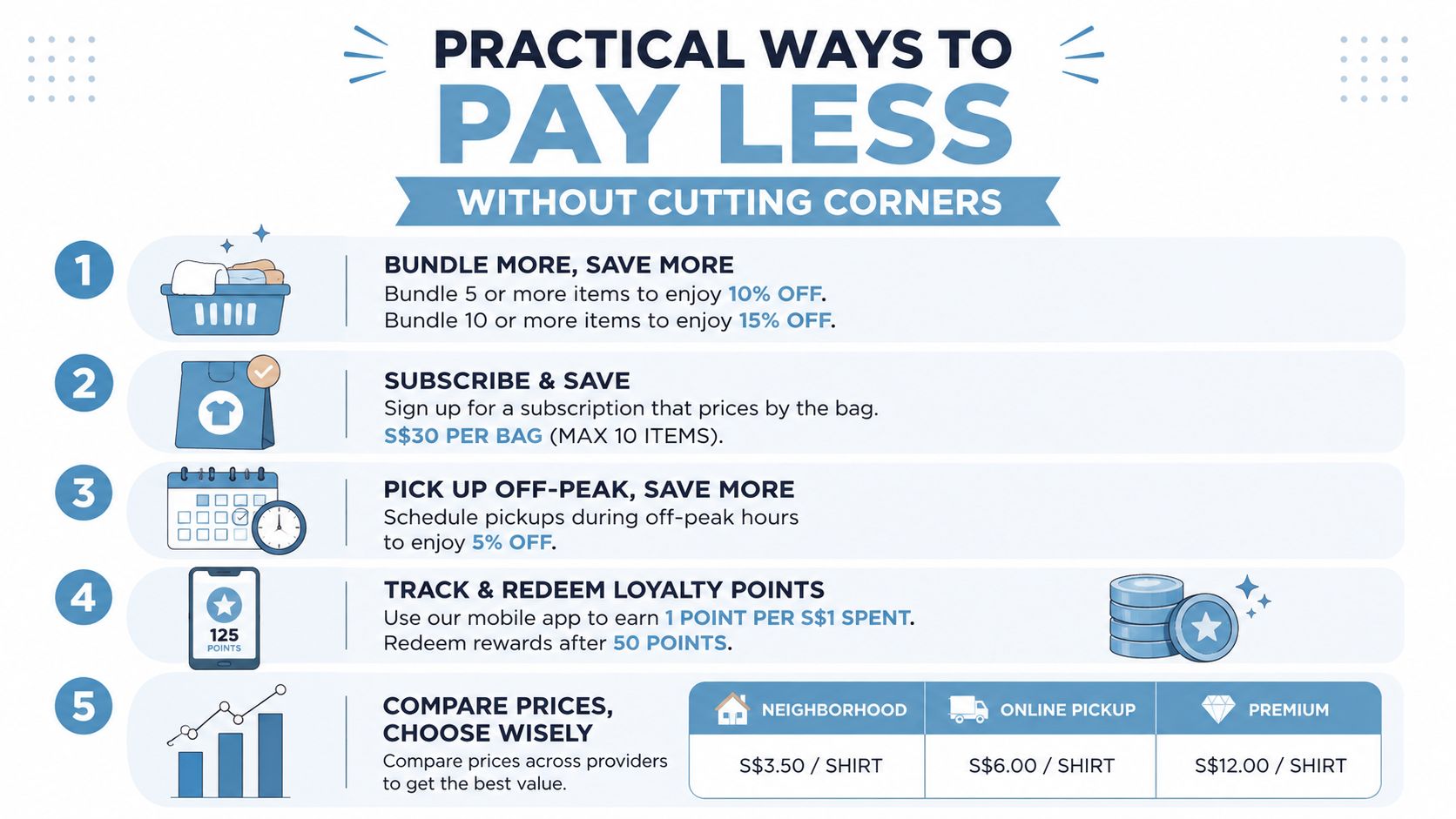
The best savings usually come from batching. If your provider offers bundles or bag-based plans, use them for a week's worth of office wear instead of sending in a lone shirt. The subscription model on Tumble Laundry's subscription page is one example of how bag pricing can make recurring laundry more predictable for households that hate piecemeal spending.
• Ask about minimum spend: If the order has a floor, send enough garments to clear it in one shot.
• Ask about turnaround: Same-day is useful for emergencies, not as a default habit.
• Ask about fabric-specific handling: Not every item needs the most expensive treatment.
• Ask about stain assessment: A proper check before cleaning is better than paying for guesswork.
• Ask about tracking: Itemised lists reduce mistakes when you're sending multiple pieces.
The hidden bill-killer is convenience inflation. Delivery is useful, but if you're paying for it on tiny orders, the “cheap” part disappears. That's why consolidating pickups matters more than shaving a dollar off the per-shirt figure.
Cold-water cycles and hypoallergenic detergent requests should be used when the garment needs them, not as a reflex. A good provider will follow care labels and recommend the least aggressive method that still gets the piece clean. That protects both the fabric and your budget.
Practical rule: send clothes in clusters, not as emergency singles, unless the item is truly urgent or high-value.
For busy households, a service with in-house processing and clear itemised handling can be easier to manage than a no-frills shop that gives you a lower sticker price but no visibility. That's the difference between cheap on paper and cheap in real life.
A lot of people in Singapore use dry cleaning for garments that don't need it. Gym wear, casual cotton shirts, kids' clothes, and everyday basics usually belong in a wash-and-fold bag or at home, especially when a load-based service is already priced around S$3/kg to S$8/kg in Singapore comparisons (Pressto Asia). If the item doesn't need structure preservation, dry cleaning is often the more expensive habit.
That's where wash-and-fold wins. Singapore laundry comparisons show wash-and-fold can start far below many item-based dry cleaning prices, while dry-cleaning comparisons often land around S$4.90 per shirt and beyond, with minimum-order thresholds commonly around S$30 to S$50 and delivery tied to those thresholds (MoneySmart). If your basket is mostly cotton basics, the cheaper answer is obvious.
• Structured blazers and suits because shape matters and home washing can ruin the fit.
• Silk and delicate fabrics because the risk of damage is too costly to gamble on.
• Traditional wear because finishing and handling matter as much as cleanliness.
• Curtains and heavy home textiles because the bulk and handling are awkward at home.
The cheapest option is not always the lowest service price. If a garment shrinks, loses shape, or gets damaged, replacement cost wipes out any savings instantly. That's the point many overlook when they search for dry cleaning Singapore cheap and assume the answer must be a lower per-piece quote.
For a direct comparison of service types, the Tumble explainer on laundry vs dry cleaning is a useful local reference. It lines up with the practical truth in Singapore, which is that the right service depends on fabric and workload, not marketing.
Sort your clothes into three piles. Always dry clean includes suits, blazers, delicate formalwear, and traditional garments that need shape protection. Sometimes dry clean covers the pieces you only send out when stain risk or finishing matters. Never dry clean is your daily cotton, gym wear, and easy-care basics.
The cheapest decision is the one that matches the garment to the right workflow. If your week is mostly office shirts, a bag-based wash-and-fold plan is often the smarter baseline. If your wardrobe has frequent formal wear or you need curtains handled properly, a dry-cleaning service with clear itemised tracking and transparent per-piece pricing makes more sense.
Before you commit, check four things. In-house processing matters because it gives the provider control over quality. Itemised tracking matters if you're sending more than one garment. Transparent per-piece pricing matters because it stops checkout surprises. Clear turnaround commitments matter because “cheap” is useless if your clothes come back late.
If you want dry cleaning that fits a Singapore routine without making you babysit every order, use Tumble Laundry as a reference point for how pickup, delivery, wash-and-fold, and dry cleaning can be organised around a busy household. The win is not paying the absolute lowest number, it's paying the right number for the right garment and getting it back ready to wear.

We make laundry days fast and easy for you. We collect, clean and deliver your laundry and dry-cleaning.
53 Ubi Ave 1 #03-43, Singapore 408934
Mon - Fri | 8:30 am–5:30 pm
Sat | 8:30 am–12:30 pm
hello@tumble.sg
+65 62554222
Whatsapp Us


