Curtain Cleaning Equipment Guide for Homes and Businesses
This is some text inside of a div block.


You don't usually notice curtain cleaning equipment until the job gets awkward. The drapes are tall, the lining is heavy, the fabric traps dust, and the only place to dry them is a narrow corridor or a spare bedroom with nowhere to hang them properly. In a Singapore apartment, that's the moment you realise curtain care isn't really a laundry task, it's a logistics task.
Property managers run into the same problem with more urgency. A unit has to be handed over, the curtains need to come down, cleaned, dried, and rehung, and the schedule rarely leaves room for trial and error. If the wrong process stretches a blackout panel, leaves a damp smell in the room, or damages the lining, the equipment choice has already failed.
Singapore's household appliance profile helps explain why this topic matters. The Singapore Department of Statistics says 96.4% of resident households owned a washing machine in 2023, while dryer ownership reached 27.8% and vacuum cleaner ownership stood at 80.2% official consumer durables data. That means most homes already have some fabric-care tools, but not every home has the drying capacity or specialist process needed for bulky curtains.
Curtains look simple from across the room. Once they're off the rail, they turn into oversized, awkward textiles with hooks, pleats, linings, and fabric behaviour that changes the cleaning method entirely. I've seen homeowners assume a normal wash cycle will do the trick, only to end up with twisted hems, water-heavy blackout panels, or curtains that take too long to dry and start smelling stale before they're rehung.
That's why curtain cleaning equipment can't be chosen like a standard domestic appliance. The key question isn't whether a machine can get fabric wet. It's whether the process fits the curtain's construction, the room's drying space, and the time available before the curtains have to go back up.

Singapore households have modernised around appliance-based fabric care for decades. The same official dataset shows washing-machine ownership rising from 46.8% in 1983 to 73.5% in 1988 and 90.6% in 1998 the same consumer durables record. That historical shift matters because curtain care now sits inside a mature laundry culture, not a manual one. People already expect powered cleaning, but curtains force the process to be more selective.
Practical rule: if a curtain is lined, heavy, or hard to dry, the equipment decision starts with moisture control, not with cleaning power.
For busy homes, the mistake is usually trying to treat curtains like bedsheets. For landlords, the mistake is the opposite, using a one-size-fits-all process because the handover deadline is tight. Both errors come from ignoring the same thing, curtains are installed textiles, and the takedown and return journey is part of the cleaning job.
If you're comparing home care advice with a more hands-on workflow, the practical steps in this curtain cleaning guide from Tumble show how much of the job happens before the machine even starts.
Curtain cleaning setups fall into a few practical categories, and each one solves a different problem. The right choice depends on whether the fabric can be immersed, whether it needs low moisture, and whether the curtains can be removed at all without disrupting the property.
Wet-cleaning machines suit unlined polyester sheers and some cotton voiles because those fabrics can tolerate a gentle, cold process. The key is low agitation, not aggressive tumbling. A soft cycle helps remove dust and light soil without crushing the weave or distorting the hem.
That said, wet cleaning stops being useful the moment the fabric construction gets complicated. Lined drapes and blackout panels trap moisture, and once water gets into layered curtains, the primary challenge becomes drying, not washing. That's where many DIY attempts go wrong.
Portable steamers and industrial steam equipment are useful when the curtain can stay hung. They're best for quick refreshes, loosening surface dirt, and reducing the visual effect of creases without a full immersion wash. Steam can be a practical option for apartments where takedown is difficult or where the owner wants minimal interruption.
Still, steam is not a universal answer. It's better for maintenance than for a deep clean, and it's not the right choice for every fabric. For a useful comparison of how steam fits into curtain care workflows, Tumble's curtain steam cleaning guide is a helpful reference point.
Hot-water extraction and dry-cleaning systems
Hot-water extraction can work well for heavier drapery when a full soak isn't appropriate, because it targets embedded soil while limiting how long the fabric stays saturated. Dry-cleaning setups are the safer route for sensitive materials that should not be routinely washed in water at all. In Singapore, that distinction matters because a curtain that looks similar at the window may still need a completely different process once it's off the rail.
For blinds and related soft window treatments, a more specialised equipment overview from Professional Window Cleaning's expert blinds cleaning solutions is useful because the same logic, fabric, moisture, and finish, often applies.
The most overlooked “equipment” is the handling gear. Curtain rails, clips, hooks, ladders, hoisting tools, and mobile scaffolding all affect how safely the job moves from window to wash area and back again. A good cleaning system fails if the takedown is rushed and the hooks get mixed up, because reinstallation then becomes a separate repair job.
If you're also comparing process choices for exterior textiles, Pine Country Window Cleaning's equipment guide is a useful way to think about how handling tools and cleaning systems have to work together.
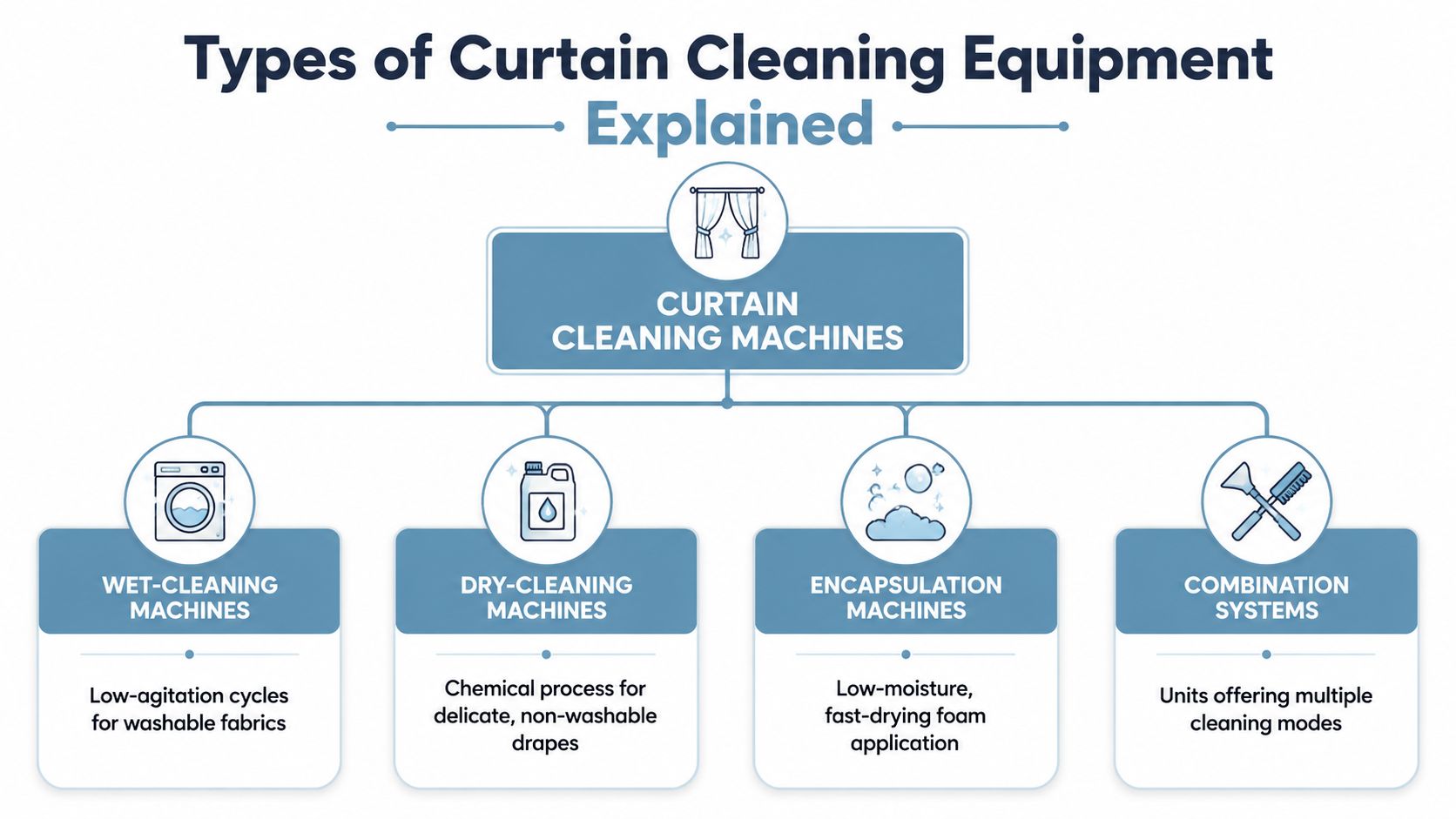
A curtain can look straightforward from the outside and still demand a very different process once it reaches the wash area. The better question is which method keeps the fabric's shape and finish intact under Singapore's humidity, limited drying space, and the mix of curtain types seen in homes and managed properties. Fabric safety, shrinkage risk, drying speed, and moisture control matter more than machine size.
Buying decisions often get skewed by price alone. In practice, the method has to match the curtain, because a process that works on washable sheers can damage lined drapes, velvet, or silk-blend panels. A cheaper machine may look attractive on paper, but it becomes costly if it distorts the fabric or leaves the room short of drying space.
Cleaning MethodBest ForShrinkage RiskDrying TimeHumidity PerformanceWet CleaningWashable sheers, some cotton voilesModerate if the cycle is too harshLongerWeak if drying space is limitedSteam CleaningHung curtains, light refreshes, crease removalLow when used correctlyShortBetter for quick turnaround, not deep saturationHot-Water ExtractionHeavier fabrics that need deep soil removal without full immersionModerate, depending on fabric and moisture loadMedium to longMore manageable than full soak if extraction is strongDry CleaningSilk, velvet, wool-blends, blackout and lined drapes that shouldn't be washed routinelyLow when handled correctlyShort to mediumStrong, because it avoids saturation
Construction changes the risk profile fast. A lined curtain may look simple, but if the lining traps moisture or the face fabric reacts badly to heat, a standard wet process becomes a liability. The method has to suit the curtain, not the cheapest available machine.
Drying space is part of the cleaning method. If you don't have room or airflow, even a technically correct wash can become a bad outcome.
For fabric-heavy homes and managed properties, process choice matters more than equipment branding. A machine that only handles one cleaning path may be fine for a single curtain type, but it leaves you stuck when blackout panels sit beside sheers, or when some sets need non-water treatment. For a practical view of why non-water workflows still matter for drapery, Tumble's dry cleaning process article is a useful reference.
Curtain cleaning volume changes the equipment question completely. A homeowner usually handles one or two sets of curtains at a time, often only when the rooms start looking dull or dusty. A property manager, school, or serviced apartment operator can't work that way, because the workflow depends on repeated takedown, cleaning, drying, and reinstallation with predictable turnaround.
For home use, capacity is really about whether the curtains can be processed without overloading the washer or filling every available drying surface in the flat. Once the load gets too bulky, the home stops being a cleaning site and becomes a storage problem. That's why so many apartment-based jobs stall at the drying stage, not the wash stage.
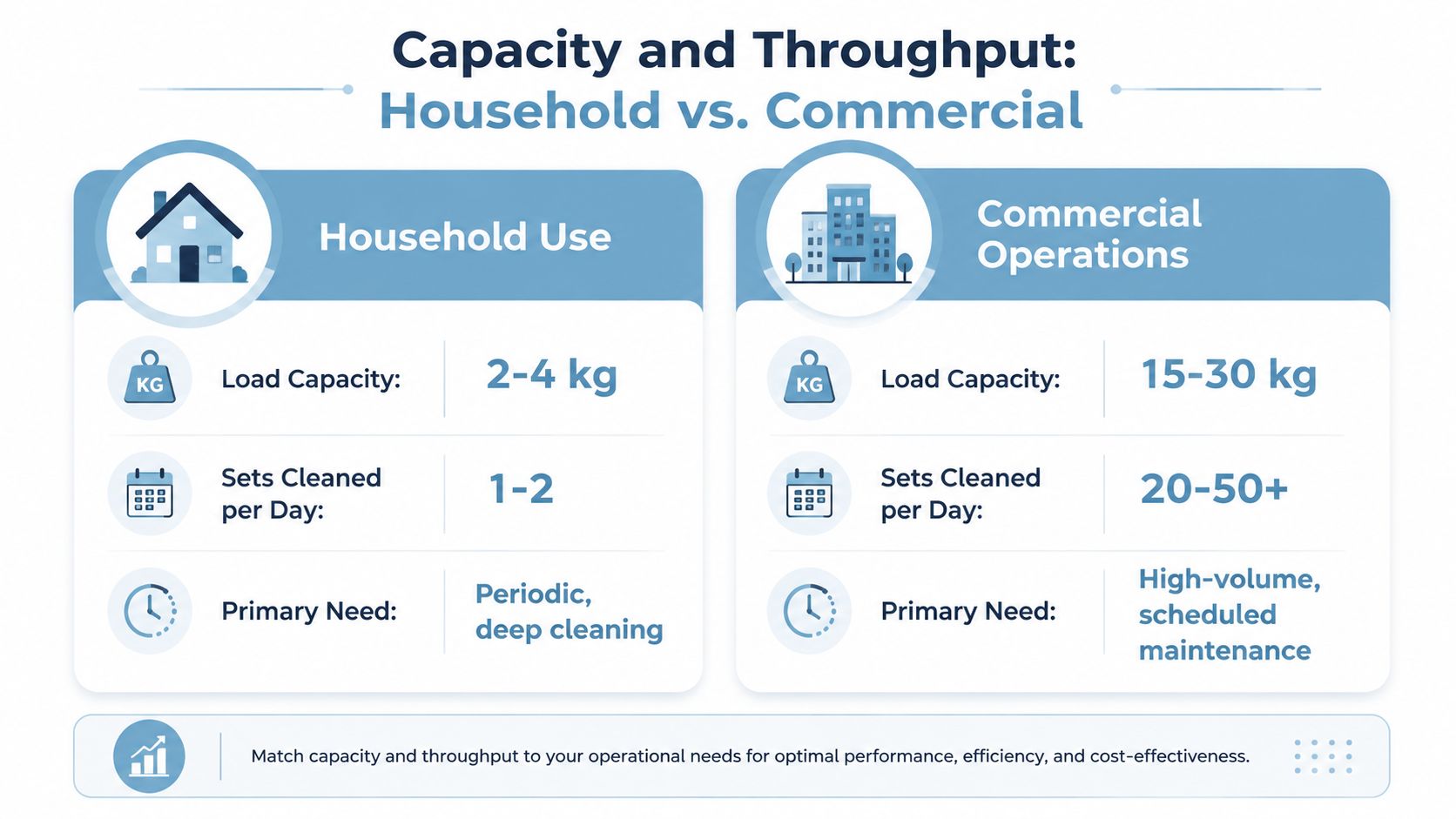
Commercial operations need a different mindset. Throughput is the point, not just cleaning quality. If multiple units need curtains turned around for move-in, the bottleneck usually isn't the washer alone, it's whether staff can coordinate removal, track hardware, clean in batches, and reinstall on time without losing pieces or delaying occupancy.
Singapore's commercial equipment market reflects that shift. Independent market coverage says commercial laundry equipment demand is expanding, and one forecast projects the Singapore commercial-laundry-machines market at USD 19.91 million in 2024 rising to USD 36.23 million by 2033 at a 6.84% CAGR commercial laundry machines forecast. Another market note points to continued growth in commercial laundry equipment through 2031. The practical takeaway is simple, institutions are investing in recurring-service infrastructure, not one-off household appliances.
For a business, that means the right equipment conversation includes labour, staging area, and rehang logistics. If the team can't move curtains cleanly through each step, a larger machine just hides the bottleneck for a while.
The internal comparison at Tumble's commercial laundry page is relevant here because commercial curtain care lives in the same operational world as recurring laundry service, consistent collection, and controlled turnaround.
Curtain fabric decides everything. A sheers-only workflow can be simple, but once blackout linings, silk face fabrics, velvet, or wool-blend drapes enter the room, the cleaning path has to become much more cautious. The wrong equipment won't just clean badly, it can change the curtain's shape, feel, and hang.
A care label should always be the first check. If the curtain is washable, you still need to see how the piece is built, because the face fabric and the lining may not behave the same way. Heavy or lined curtains often need controlled steam or dry-cleaning style handling rather than routine machine washing.
Soft-brush vacuuming should come before any wet process. Dust removal matters because it stops loose soil from turning into muddy residue once moisture is introduced. It also reduces how much mechanical action the fabric needs later.
Unlined synthetic sheers can usually handle a gentler wet path. Blackout panels and lined drapes are different, because the lining can hold onto moisture long after the visible face looks dry. That's where mildew risk goes up in Singapore's humid conditions, especially if the curtain is rehung before the inside layers are properly dry.
For a simple safe-handling reference on another fabric category, South Mountain Window Cleaning's cushion guide is useful because it reinforces the same principle, different materials need different moisture control.
Practical rule: never judge dryness by touch on the outer layer alone. Lined curtains can feel fine outside and still stay wet inside.
A few actions keep the risk down:
• Identify the fabric first. Treat silk, velvet, wool-blends, and blackout constructions as specialist jobs unless the care label clearly says otherwise.
• Remove dust before washing. A soft brush attachment or careful vacuuming is safer than forcing dirt through a wet cycle.
• Control heat and agitation. Gentle handling protects the weave and helps avoid distortion.
• Dry fully before rehanging. Moisture trapped in layers is one of the fastest ways to create odour and mildew problems.
For stain-specific work, Tumble's curtain stain removal guide is a practical companion because spot treatment needs the same fabric discipline as full cleaning.
For most Singapore households, outsourcing makes more sense than buying specialist curtain cleaning equipment. The reason isn't just cost, it's the full burden of storage, training, takedown, rehang, and drying space. A machine can be purchased once, but the learning curve for fabric-specific handling keeps showing up on every job.
The middle ground is often smarter. A homeowner or small property team can keep basic takedown tools, labelled hook trays, garment bags, and a proper steamer on hand, then outsource the actual deep cleaning. That approach keeps the handling under control without forcing the property to host a full cleaning setup.
Commercial users should ask a different question. If curtains are processed frequently enough to justify in-house work, then throughput, staging space, and staff discipline matter more than the sticker price of the machine. Once recurring jobs start involving multiple fabrics, the hidden cost becomes coordination, not equipment alone.
Tumble Laundry is one option in that outsourcing category, since it offers curtain cleaning with takedown and rehang support, alongside islandwide pickup and delivery. That kind of service matters when a home or business wants the fabric handled without turning the property into a worksite.
For many small operators, the best compromise is to own the handling process and outsource the wash process. That keeps the curtain hardware organised, reduces damage during removal, and avoids the need to install large washers, dryers, or extraction systems that may sit idle between jobs. It also makes turnaround more predictable, which is what really matters during tenancy handovers.
Start with the curtain, not the machine. Identify the fabric, check the lining, and decide whether the piece can tolerate wet cleaning, needs steam, or belongs in a dry-cleaning workflow. Then look at the actual constraint in the room, because in Singapore that's often drying space, not washing power.
After that, match volume to logistics. A single home with two sets of washable sheers needs a very different setup from a landlord managing several units on a turnover schedule. If you don't have time, airflow, or handling help, buying more equipment usually adds complexity instead of removing it.
Ask any service provider the same three things. What fabric paths do they use, how do they manage takedown and rehang, and how long does the curtain stay out of service? Those answers matter more than a glossy machine list.
The best curtain care strategy is simple in principle and demanding in practice, use the right process for the right fabric, then make sure the logistics around it are just as controlled.
If your curtains need more than a quick refresh, Tumble Laundry can handle collection, cleaning, and delivery with a process built around fabric care and turnaround. Visit Tumble Laundry to arrange curtain cleaning, takedown, or a broader laundry service that fits your home or business schedule.

We make laundry days fast and easy for you. We collect, clean and deliver your laundry and dry-cleaning.
53 Ubi Ave 1 #03-43, Singapore 408934
Mon - Fri | 8:30 am–5:30 pm
Sat | 8:30 am–12:30 pm
hello@tumble.sg
+65 62554222
Whatsapp Us


