Commercial Laundry Process: A Practical Walkthrough
This is some text inside of a div block.

At 6:30 a.m., a procurement manager at a Singapore loading dock may see linen carts coming off a van and assume the hard work starts inside the washroom. In reality, the outcome was already being shaped by the collection route, the condition of the bags, the sorting decisions, and the records attached to each load.
A commercial laundry process is closer to a controlled production line than a larger version of domestic washing. Textiles must be identified, separated, treated, cleaned, dried, finished, inspected, packed, and returned within an agreed service window. In Singapore, that workflow also operates under PUB water-efficiency requirements and trade-effluent controls, so the cheapest price per kilogram doesn't necessarily represent the lowest operating cost or the lowest service risk.
The van reverses into the bay. One cart contains hotel sheets, another carries kitchen cloths, and a third holds uniforms from a food-and-beverage team. The operator checks the collection paperwork before anything moves. A missing bag, incorrect count, or unclear customer label can create trouble several stages later.
That's the defining feature of the commercial laundry process. It isn't washing textiles in bulk. It's a managed sequence that connects pickup, identification, production planning, cleaning, quality control, packaging, and delivery. Each handoff needs a record, and each decision affects the next one.
Domestic laundry usually starts with a household member choosing a mixed load. A commercial plant starts with service specifications. The operator needs to know whether the load contains white flat linen, coloured garments, heavily soiled kitchen items, delicate uniforms, or textiles requiring a separate hygiene protocol. Sorting determines the chemistry, temperature, mechanical action, and finishing route.
Practical rule: A laundry vendor should be able to explain what happens to your items between collection and return, not just describe the detergent used.
Singapore adds several constraints that buyers shouldn't overlook. The local laundry services market generated USD 455.1 million in 2022 and is projected to reach USD 873.1 million by 2030, implying an 8.5% CAGR from 2023 to 2030, according to Singapore laundry services market data. The same dataset identifies commercial laundry as the fastest-growing application segment, although residential laundry remained the largest segment in 2022.
That growth matters operationally because recurring linen, uniform, and garment-care work requires dependable throughput. Singapore's dense urban layout also makes loading-bay access, route timing, drying space, labour planning, and return windows part of the production system. A buyer evaluating a vendor should therefore ask how the provider controls the full chain, rather than comparing only the advertised rate.
The workflow has nine connected stages:
1. Pickup, where the provider collects identified bags or carts from the customer.
2. Sorting, where items are separated by client, colour, fabric, category, and soil level.
3. Pre-treatment, where visible stains receive appropriate treatment before the main wash.
4. Washing, where the operator selects the programme, temperature, chemistry, and mechanical action.
5. Drying, where moisture is removed without overdrying or damaging the textile.
6. Ironing, where flatwork or garments receive heat and pressure to restore appearance.
7. Finishing, which includes folding, pressing, hanging, or other presentation work.
8. Quality control, where staff inspect, count, and route failed items for rework.
9. Delivery, where finished items are packed, documented, and returned.
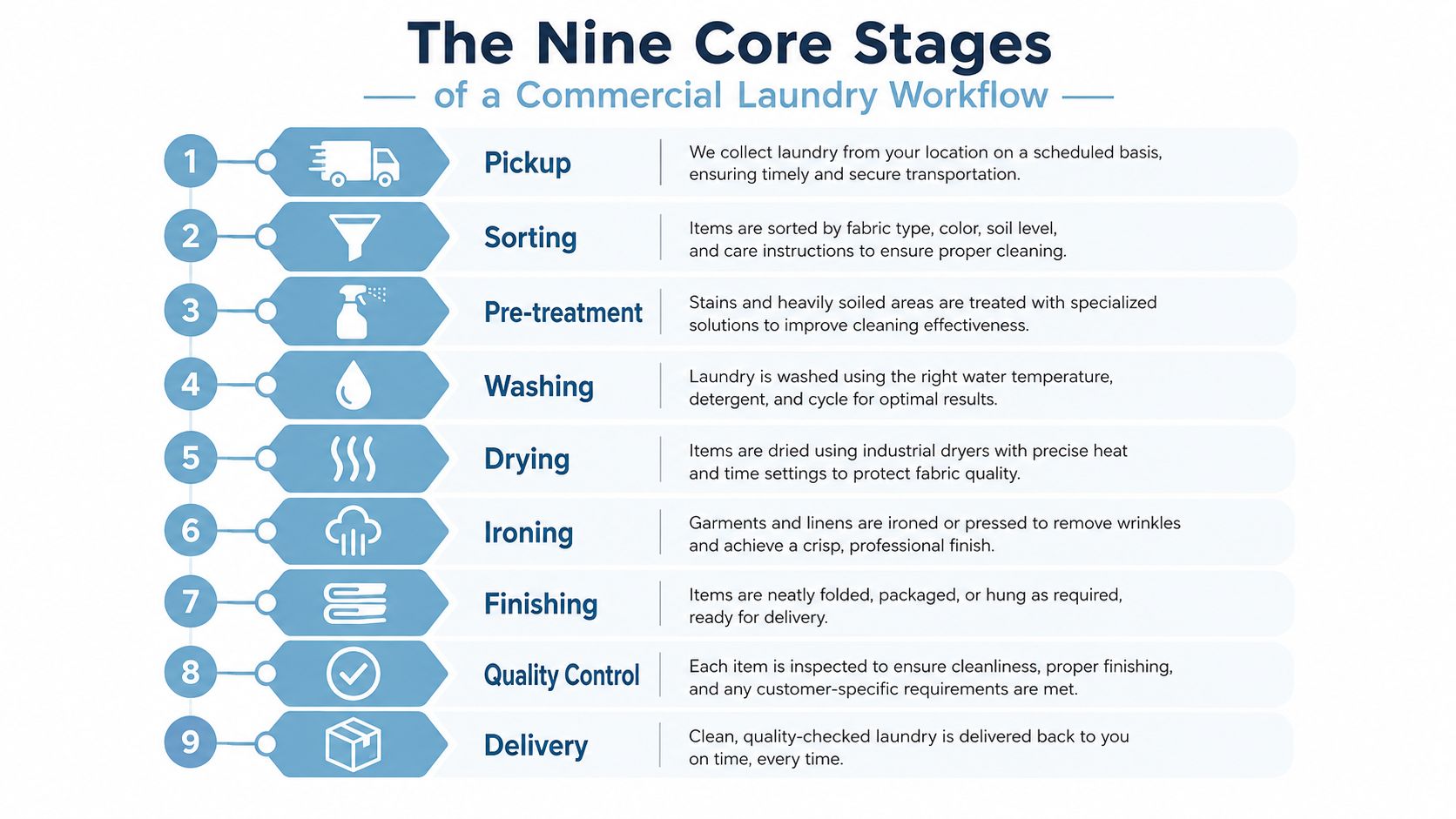
The order matters. If pickup records are incomplete, sorting staff may assign items to the wrong customer. If sorting is careless, the wash formula may be unsuitable. If stain treatment is rushed, the plant may need a rewash. If drying leaves inconsistent moisture, ironing and folding become slower and quality control catches more defects.
A plant can combine equipment functions, but it shouldn't eliminate accountability between stages. For example, the person loading a washer shouldn't be the only person deciding whether the finished order passes inspection. Separating production from quality control gives the buyer a clearer audit trail.
The process also responds to Singapore-specific requirements. PUB's water benchmark encourages operators to measure usage against tonnes processed, while trade-effluent rules influence chemical selection, rinse planning, and wastewater treatment. Route density determines collection windows, and hotel, restaurant, healthcare, and uniform accounts may each require a different service rhythm.
The first production decision may happen before the van reaches the plant. A route planner must coordinate hotel loading bays, commercial buildings, restaurant clusters, industrial estates, and customer access restrictions. In Singapore, a collection schedule can fail because a driver can't use a lift at the planned time, a loading bay is occupied, or bags weren't ready when the route arrived.
Dedicated runs give a customer more control over timing and segregation. Shared routes can be efficient when several nearby customers have compatible pickup windows, but the provider needs reliable labelling and scanning to prevent mix-ups. Ask how the vendor records bag identity, weight, customer, collection time, and exceptions.
Sorting is the plant's first major control point. Staff commonly separate by:
• Client: Prevents one organisation's textiles from entering another organisation's order.
• Colour: Reduces colour transfer and protects light-coloured items.
• Fabric weight: Helps prevent lightweight garments from being processed with heavy linen under unsuitable mechanical action.
• Textile category: Keeps sheets, towels, uniforms, mats, and kitchen cloths on appropriate routes.
• Soil level: Stops lightly soiled work from sharing a formula designed for grease-heavy or visibly contaminated items.
Sort CategoryTypical ClientDownstream ImplicationWhite flat linenHotels and serviced accommodationSupports flatwork finishing and controlled whitening chemistryTowels and heavier terry itemsHotels, gyms, and spasRequires drying and folding plans suited to higher bulkKitchen cloths and apronsRestaurants and F&B operatorsMay need stronger degreasing and closer stain inspectionStaff uniformsHospitality, offices, and facilitiesRequires garment-specific care and count reconciliationClinical or care textilesHealthcare and care settingsNeeds documented segregation and an agreed hygiene workflow
Stain treatment is controlled pre-wash work, not an improvised spray before loading. Operators classify the mark, select a suitable reagent, allow the required dwell time, and check whether the treatment is safe for the fabric and colour. Protein, tannin, oil, and dye stains behave differently, so a single universal treatment can damage textiles or fail.
For a practical explanation of stain categories and removal methods, buyers can review this guide to stain removal. The procurement question is simple: does the vendor log repeat stains and rewash causes, or does the plant treat every failed item as an isolated nuisance?
Once sorting and pre-treatment are complete, the plant builds a wash batch. The operator chooses a programme based on fabric class, soil level, colour, and the customer's care requirements. A programme may control water levels, temperature, prewash, main wash, rinses, extraction, and chemical injection.
Commercial chemistry often includes detergents, builders, oxidising agents, neutralisers, and softeners. Automatic dosing helps the operator repeat a formula accurately, but automation doesn't replace calibration. If the dosing pump is inaccurate, the load may leave with residue, poor soil removal, colour change, or an unstable wastewater profile.
A washer-extractor gives the plant flexibility. It suits varied loads because operators can batch items by customer or textile type and select a specific programme for each load. A tunnel system can provide continuous-batch throughput for a more standardised stream, but it demands consistent sorting, loading, and downstream handling.
Singapore's equipment rules are central to that decision. PUB states that commercial washer-extractors must meet a minimum water-efficiency requirement of no more than 8.0 L/kg, as described in its water-efficiency guidance for buildings. The same guidance also points operators towards full-load washing, private metering, rinse-water reuse, steam isolation, and leak maintenance.
Water quality affects chemistry and equipment performance, too. A procurement team comparing plants in another market may find a useful technical reference in this resource on Los Angeles County water softener service, particularly when assessing how water treatment supports detergent performance. The Singapore decision remains governed by the local plant's water data and PUB requirements.
Extraction removes a substantial amount of water before thermal drying begins. The operator then selects a tumble-drying or flatwork route according to the textile. Excess heat can shorten fabric life, while insufficient drying leaves dampness that affects folding, storage, odour, and delivery.
Flat linen may pass through a heated ironer. Garments may go to a press or be finished on hangers. Towels and volume items typically require controlled folding so the final bundle is consistent and easy for the customer to count.
For a separate explanation of solvent-based garment care and its workflow, see this overview of the dry-cleaning process.
Quality control should include visual inspection, lint removal, spot checking, count reconciliation, and rework routing. Staff compare the finished quantity against the inbound tally and investigate missing or damaged items rather than adjusting the invoice.
Item Category24-Hour Express2-Day Standard5-Day EconomyHospitality linenAvailable where route and plant capacity allowCommon planned service windowSuitable for lower urgencyF&B uniformsSuitable for urgent roster needsCommon recurring arrangementUseful for reserve stockHealthcare textilesRequires an agreed validated workflowUsed where inventory permitsAppropriate only where the customer can hold more stockIndustrial workwearLimited to compatible loadsPossible for regular programmesOften suitable for planned replenishment
These are planning bands, not universal promises. A vendor should explain the cutoff, collection day, exception process, and rework impact behind each SLA.
Water efficiency isn't a side project for a Singapore laundry. PUB identifies commercial laundries as a high water-use sector and gives the sector a benchmark of 13.1 m³ per tonne of laundry processed in its commercial-laundry water-efficiency guide. That measure is more useful than looking only at litres per machine load because it lets an operator compare different load sizes and production volumes.
A partially filled washer can consume much of the same cycle water while processing less textile. Full-load planning, accurate weighing, load balancing, and programme selection therefore affect both resource use and unit economics. The plant should track consumption against processed weight and investigate unusual changes rather than relying on a monthly utility bill.
Laundry wastewater is trade effluent. Singapore's framework sends used water from commercial premises to Water Reclamation Plants, and operators with discharge questions are directed to PUB's formal channels. The PUB commercial-laundry guide recommends wastewater recycling with treatment trains that can include multimedia filtration, advanced oxidation, ultrafiltration, nanofiltration, and reverse osmosis.
The treatment choice depends on the wastewater profile and the intended reuse. Screening and equalisation can stabilise the feed, while biological and membrane processes address different contaminant risks. Detergent selection, soil loading, oil, suspended solids, and chemical carryover all influence whether reuse water remains stable or fouls downstream equipment.
Singapore-specific reuse guidance identifies treated-water design targets including COD at or below 50 mg/L, BOD₅ at or below 10 mg/L, suspended solids at or below 10 mg/L, pH from 6.5 to 9.0, and E. coli at or below 2000 MPN/L, as summarised in the commercial laundry wastewater reference. Buyers should ask whether a vendor measures these parameters, how often testing occurs, and what happens when results move outside the design range.
A useful procurement checklist includes:
• Water data: Request the plant's water use per kilogram or tonne and the measurement method.
• Equipment compliance: Confirm that washer-extractors meet the PUB requirement and ask for supporting documentation.
• Effluent controls: Ask for discharge approvals, monitoring records, and escalation procedures.
• Reuse engineering: Check whether recycling includes adequate pretreatment and membrane protection.
• Maintenance evidence: Review leak checks, meter readings, dosing calibration, and equipment service records.
For operational context on local laundry practices, buyers can also consult laundry best practices in Singapore, while treating the plant's own compliance records as the decisive evidence.
A buyer usually chooses among three models. Fully outsourced processing transfers plant operations, staffing, equipment maintenance, water compliance, and delivery planning to a specialist. In-house processing keeps control close to the hotel, facility, or organisation, but it also leaves that organisation responsible for capital investment, trained operators, utilities, breakdowns, and wastewater management.
A hybrid model splits the work. Staff may handle urgent, low-volume, or sensitive items on site, while a commercial provider processes bulk linen, uniforms, or recurring loads. This can preserve some immediate control without requiring the customer to build capacity for every demand pattern.
CriterionFully OutsourcedIn-HouseHybridControlStrong contractual control, less direct plant controlDirect control over daily decisionsControl over selected items and vendor-managed bulkCapital exposureLower plant investmentHighest equipment and infrastructure exposureModerate, depending on the retained scopeLabourVendor carries most production staffingCustomer recruits and trains operatorsShared responsibilitySurge handlingDepends on vendor reserve capacityLimited by installed plant and staffingFlexible if the vendor can absorb overflowCompliance workloadVendor supplies evidence, customer still needs oversightCustomer owns the operational burdenResponsibilities must be written clearly
Price differences often reflect service architecture rather than cleaning chemistry. Ask whether loads are dedicated or shared, how the provider tracks individual items, and whether replacement-loss cover applies. A low rate may not include sorting by department, emergency reprocessing, garment repair, or detailed reconciliation.
Other differentiators include route coverage across the CBD and industrial estates, RFID or barcode capability, dashboard reporting, ESG documentation, and integration with hotel or healthcare linen systems. A vendor that can show rejected-item reasons, rewash history, delivered weight, and missed-pickup records gives procurement a stronger basis for managing performance.
The right comparison is not “What's your rate per kilogram?” It's “What controls are included in that rate, and how will you prove they worked?”
The finished bundle still needs protection and identification. Common packaging choices include polyethylene bags for folded loads, mesh bags for selected textile streams, and individual protective sleeves for premium or pressed garments. The correct option depends on hygiene requirements, storage conditions, presentation standards, and the customer's handling process.
Barcodes or RFID tags can connect the finished items to the original weight-in ticket and order record. That link helps a procurement team compare what was collected, processed, packed, and returned. It also gives the provider a way to investigate missing bags instead of treating every discrepancy as a billing adjustment.
Singapore's dense delivery network favours consolidated van routes, but consolidation only works when pickup windows are realistic. A hotel may need a quick return for uniforms, while healthcare or industrial workwear may fit a longer planned cycle. The service tier should specify collection days, cutoff times, return windows, missed-bag treatment, and proof of delivery.
Service TierPickup WindowReturn WindowTypical SegmentsExpressScheduled collection within the agreed operating route24-hour return where confirmedUrgent hospitality and F&B uniformsStandardPlanned Mon to Sat collection2-day return for compatible loadsRecurring hospitality and business laundryEconomyConsolidated collection5-day returnHealthcare and industrial workwear with sufficient stock
A tracking platform can add value when it shows status changes, exceptions, driver notes, and proof of delivery. This overview of OnRoute door to door tracking is relevant for buyers assessing how delivery visibility can support customer communication and reconciliation.
Packaging specifications should appear in the contract, not remain a verbal promise. The same applies to commercial laundry bags, especially where different customers or departments require separate bagging.
Shortlist vendors by asking for evidence, not broad assurances. A plant tour should follow the load from receipt to dispatch, and the vendor should be able to explain where responsibility changes hands.
Use these checks:
• PUB compliance: Request documentation for washer-extractor water efficiency and trade-effluent controls.
• Water measurement: Ask for consumption data tied to processed weight, not just a general sustainability statement.
• Equipment disclosure: Record machine type, capacity, maintenance condition, and contingency arrangements.
• Quality records: Check whether the vendor logs counts, stains, rewashes, damage, missing items, and corrective action.
• Segregation policy: Confirm whether your loads are dedicated, shared, or separated only at selected stages.
• Route coverage: Verify collection capability for your postal districts, loading-bay restrictions, and required pickup windows.
• Contractual accountability: Include return times, missed-collection procedures, incident response, loss cover, and any service remedies.
• Pilot testing: Run representative sheets, towels, uniforms, stains, and packaging through the proposed workflow before committing the full volume.
The pilot matters because a vendor can look efficient on a clean sample and struggle with your actual soil mix, fabric range, access schedule, or count requirements. Score the process control, communication, rework handling, and delivered condition alongside the quoted price.

For buyers ready to compare service scope and recurring commercial support, Tumble Laundry's services provide one example of how pickup, processing, garment care, and delivery can be packaged for different customer needs.
Tumble Laundry offers Singapore businesses scheduled pickup and delivery, in-house processing, dedicated loads, stain inspection, and itemised tracking for by-piece orders. If you're evaluating a commercial laundry process, visit Tumble Laundry to discuss your service requirements and arrange a practical workflow review.

We make laundry days fast and easy for you. We collect, clean and deliver your laundry and dry-cleaning.
53 Ubi Ave 1 #03-43, Singapore 408934
Mon - Fri | 8:30 am–5:30 pm
Sat | 8:30 am–12:30 pm
hello@tumble.sg
+65 62554222
Whatsapp Us


