Commercial Laundry Cart on Wheels: Top Picks for 2026
This is some text inside of a div block.


You're probably standing in a linen room, a service corridor, or a cramped back-of-house corner, looking at carts that drag badly, clip door frames, or make too much noise on polished floors. That is not a minor annoyance. In Singapore, where laundry moves through hotels, clinics, schools, and outsourced plants inside tight buildings, the commercial laundry cart on wheels is a workflow decision, not a storage purchase.
The wrong cart burns time every day. The right one keeps linen moving cleanly between sort, wash, dry, and dispatch without staff fighting the equipment. In this market, the key question is not which cart holds the most. It's which cart rolls properly, turns tightly, and survives the facility you operate.
Practical rule: if the cart can't clear the lift, the corridor turn, and the linen-room doorway without a struggle, its headline capacity doesn't matter.
A hotel linen room in Singapore does not fail because someone bought the wrong shelf. It fails when staff spend their day wrestling carts through narrow doors, tight turns, lift lobbies, and service corridors. The commercial laundry cart on wheels is a workflow tool, and in this market it decides whether linen keeps moving or piles up at the worst point in the route.
Singapore's demand pattern makes that plain. The Accommodation and Food Services sector employed about 267,000 workers in 2023, and hotels were projected to record 9.0 million guest arrivals in 2024, so linen keeps cycling through the same back-of-house routes again and again. In that setting, the cart is part of material handling, not a convenience item.
The built environment adds pressure. Singapore had 6.04 million residents in 2024, concentrated in high-rise housing and compact commercial premises, which pushes laundry work into centralised back-of-house systems instead of roomy, low-density layouts. That means more movement through shared corridors, lift lobbies, and service ramps, where wheel class and footprint matter far more than product photos suggest.
Start with capacity, but do not stop there. A cart that is too small forces extra trips. A cart that is too large slows every turn and raises collision risk in narrow spaces.
Wheel class comes next. Caster diameter changes how the cart handles thresholds, lift lips, and uneven service routes, and that is where weak carts start to fail. For Singapore facilities, turning radius matters as much as load rating because many back-of-house routes punish oversized, stiff, or noisy equipment.
Then check hygiene and footprint. The cart has to separate soiled and clean loads properly, wipe down fast, and fit into rooms that were never designed around oversized handling gear. The operational order is simple, turning behaviour first, capacity second, hygiene third, footprint fourth.
For teams that already standardise laundry handling, Tumble Laundry's best-practice guidance for Singapore points in the same direction, choose equipment that fits the building and keeps staff from fighting the route.
Most product pages bury the specs that matter and highlight the ones that sell. That is backwards. In Singapore facilities, the key differences come from load rating, wheel class, footprint, cart weight, and frame build, because those traits decide whether one person can move the cart cleanly or whether two staff have to fight it around every corner.
A practical way to judge a cart is by whether it behaves like a site mover or a bulk hauler. The product data for a 400 L cart shows 440 lb capacity at about 35.4 × 25.6 × 31.9 in with 4-inch quiet casters and an 18.9 lb cart weight, while smaller stainless carts such as 2.5-bushel and 4.5-bushel units sit at 26.5 × 22 × 27 in and 33.75 × 21.5 × 30.5 in respectively. That is the difference between dense internal handling and lighter in-facility movement.
If you are comparing products, treat caster size as a performance spec, not an accessory. A cart with the wrong wheels becomes a labour problem quickly.
The same logic shows up in adjacent material-handling gear. Products like roller skates for container moving make the point clearly, wheel class and load behaviour decide manoeuvrability. The principle is identical, the load path and floor conditions decide the right hardware.

Material choice changes how the cart sounds, cleans, and survives humidity. In Singapore, that's not academic. Back-of-house areas stay busy, damp, and tight, so the wrong surface type causes more handling friction than most buyers expect.
Stainless steel is the conservative pick, and in healthcare or wet zones, that caution is justified. It handles aggressive cleaning better than softer materials, but it's heavier and will take dents if staff keep ramming tight corners. In humid Singapore conditions, that weight also matters when crews have to push carts repeatedly through service lanes.
Polymer is the better everyday option for most hospitality floors. It's easier to move, quieter on hard flooring, and it won't corrode the way lower-grade metal can in damp service areas. The caution is loading-bay exposure, where sunlight and heat can age the material faster than indoor use would.
Canvas and reinforced fabric basket trucks suit transport, not premium hygiene staging. They're useful when the goal is moving large volumes quickly, but don't use the same cart as a mixed soiled-clean staging surface. For commercial operators who need bag-based workflow support, commercial laundry bags pair more naturally with that transport model than rigid staging carts do.
The procurement error is predictable. Buyers fixate on capacity, then discover the cart is too bulky for the building and too slow for the crew. In Singapore, that mistake shows up fast in narrow linen rooms, service lifts, and corridors that leave no room for sloppy handling.
A larger cart only helps if staff can move it cleanly through the route it has to take. As noted earlier, a 400 L cart with 440 lb max load sits at about 35.4 × 25.6 × 31.9 in, while a compact stainless option at 2.5 bushels measures 26.5 × 22 × 27 in. If the route is tight, the smaller cart often wins because it turns more easily and needs less correction at every corner.
Start with the tightest point, not the biggest room. Measure the lift door, the narrowest bend, and the linen-room entrance, then compare those figures with cart width and the turning clearance it needs when loaded.
Good rule: choose the cart that your staff can steer with one person, one hand, and no shoulder contact with walls.
That rule matters even more in buildings with polished shared areas, where noise and overcorrection create complaints. A narrower cart with the right wheel class is usually the better choice than a larger bin that scrubs walls and forces staff to slow down. For operators who want a consumer-facing example of controlled movement over bulk, Tumble Laundry's wash and fold service follows the same logic, the workflow is built around compact handling rather than brute volume.
Different operations need different defaults. A hotel housekeeping cart, a hospital linen cart, and an outsourced plant truck are not the same tool, and treating them as interchangeable leads to avoidable damage, noise, and hygiene problems.
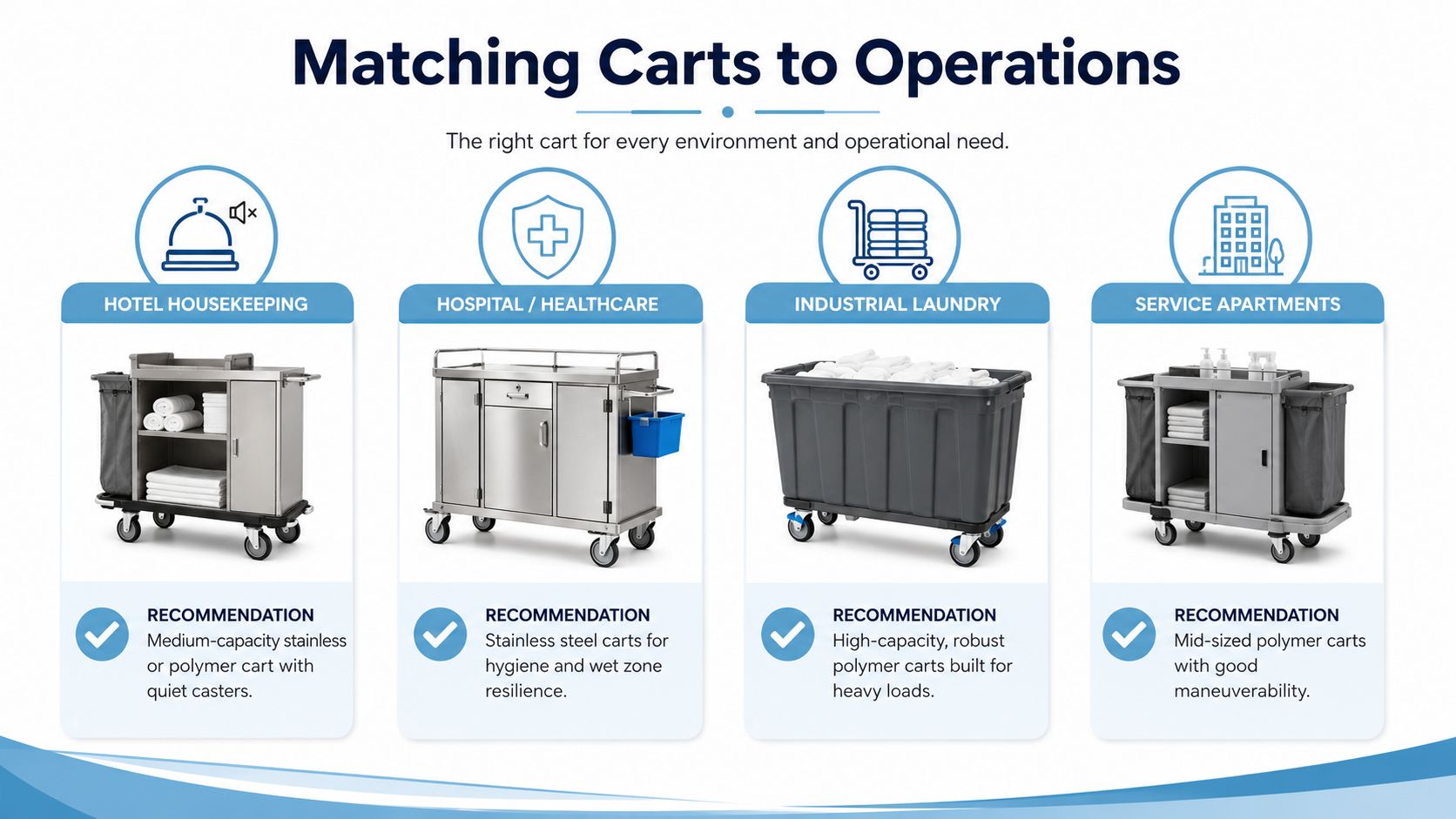
• Hotel housekeeping: Use a medium-capacity stainless or polymer cart with quiet casters. Hotels need a cart that rolls cleanly past guest doors and doesn't sound rough on hard floors.
• Hospital and clinic linen: Use stainless steel with sealed, easy-clean hardware. Hygiene and wet-zone resilience matter more than aesthetics or low purchase weight.
• Outsourced laundry plants: Use heavy-duty basket trucks with 6-inch casters. These carts are built for high cycle counts, heavier linen movement, and threshold stability.
• Schools and uniform operations: Use mid-sized polymer carts. They balance durability, manoeuvrability, and cost without bringing hospital-grade weight into a lighter workflow.
For a Singapore operator, the building itself also shapes the choice. Shared corridors, service lifts, and back-of-house ramps make wheel class a bigger factor than the brochure usually admits. That's why I'd rather see a slightly smaller cart that moves well than a larger one that staff avoid using.
The same operational discipline shows up in compliance-heavy trades. If a team needs to align cart movement with wet-area handling, a commercial plumbing compliance guide is useful as a reminder that building constraints and service rules affect equipment selection, even when the equipment isn't plumbing-related.
For Singapore businesses that need recurring laundry support as well as handling discipline, Tumble Laundry's commercial laundry service is one practical example of how cart-based operations connect to a larger outsourced workflow.
Buying the cart is the easy part. Keeping it clean, quiet, and safe is where most fleets fail. In Singapore's humid environment, casters, bearings, and hardware wear faster when carts are moved constantly through damp service zones, so maintenance has to be routine, not occasional.
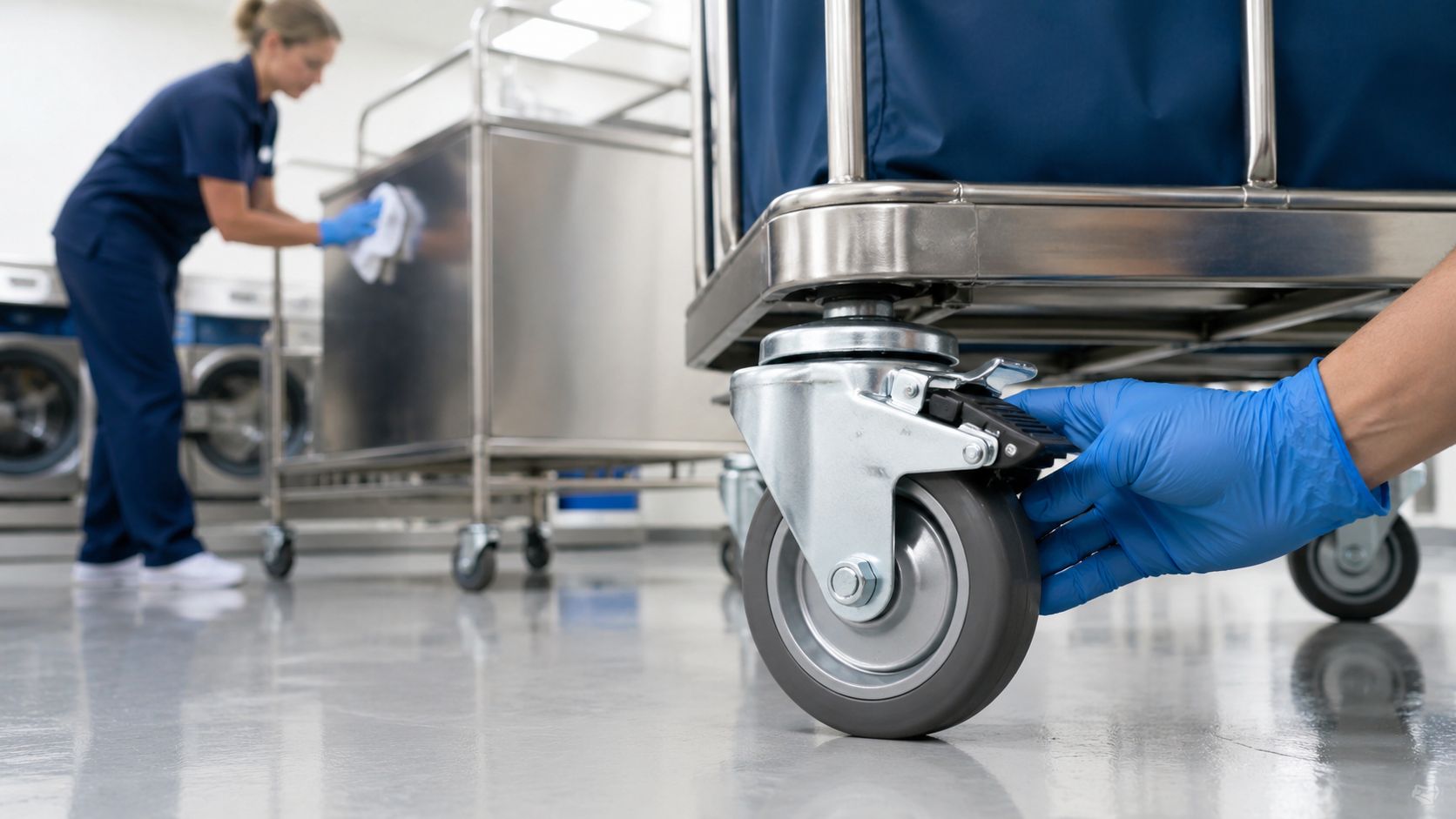
• Wipe down frames daily: Do this for stainless and polymer carts, especially after soiled-load handling.
• Inspect casters weekly: Check swivel movement, wheel wear, and brake action.
• Separate clean and soiled loads: Never mix them in the same cart unless the cart is fully sanitised between loads.
• Check fasteners and mounts: Loose hardware turns into steering drift and noise very quickly.
• Watch the floors: Grit, hair, and lint build-up make even good casters feel rough.
Polymer and stainless carts both benefit from fast wipe-downs, but the hygiene rule is essential. A cart that has carried soiled linen should not go straight into clean-linen staging. That creates avoidable contamination risk and forces staff to second-guess every movement.
The same logic applies to lifecycle planning. Constant use in SG back-of-house areas shortens bearing life, so replacement has to be based on handling condition, not just visible damage. If the cart starts pulling to one side, fighting turns, or leaving marks, it's already affecting labour output.
For teams that already standardise washing and cleaning routines, how to clean a laundry washing machine is a useful reminder that equipment hygiene only works when the maintenance habit is consistent across the whole laundry chain, not just the machine room.
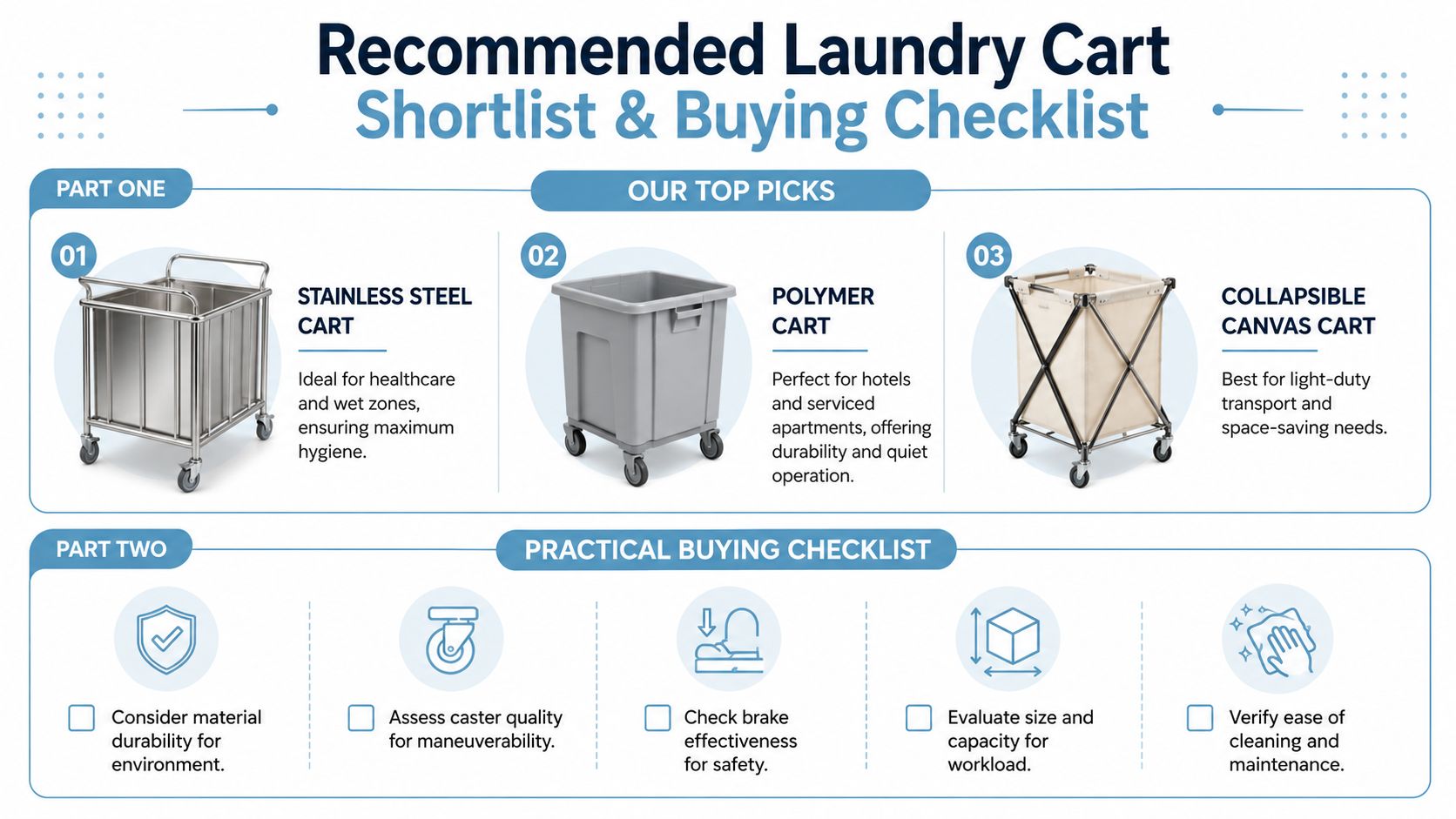
Buy the cart for the facility you run, not the one in the brochure. My shortlist is blunt: choose stainless steel for healthcare and wet zones, polymer for hotels and serviced apartments, and a heavy-duty basket truck for outsourced plants and other high-cycle environments.
A canvas cart only makes sense where transport flexibility matters more than clean staging. That's fine for bulk movement, but it's not the default answer for Singapore facilities that care about hygiene separation and corridor control. If you're still comparing options, the deciding factor is usually not capacity, it's whether the cart can move cleanly through your actual floor plan.
• Material durability for environment
• Caster quality and diameter
• Brake effectiveness
• Footprint for lifts and corridors
• Load rating for wet and dry loads
• Ease of cleaning and wipe-down
• Noise on polished flooring
• Hygiene separation between clean and soiled items
• Warranty and spare parts availability
If you're standardising across multiple sites, the buying form should force the same questions every time. That keeps procurement honest and stops teams from overbuying capacity they can't use.
How do I size a cart for a lift door? Measure the door clear opening, then subtract enough room for steering clearance. If staff have to twist the cart to enter, the cart is too wide.
Are non-marking casters worth it in Singapore corridors? Yes, if your facility has polished floors, guest floors, or shared common areas. They reduce marks and friction with building management rules.
How do I separate soiled and clean linen without buying double the fleet? Use a strict cart assignment rule, then sanitise carts before they switch roles. That's slower than having dedicated carts, but it's workable if the operation is controlled.
Are polymer carts quieter than steel carts? Usually, yes. In residential-facing buildings and hotel corridors, that difference matters because staff noise becomes part of the guest experience.
If you want equipment advice tied to an actual Singapore laundry workflow, Tumble Laundry handles commercial laundry for organisations alongside its household services, so their team works with the same space and handling constraints discussed here. Visit Tumble Laundry if you want to compare service support against your current cart setup and see how a real operating laundry in Singapore organises collection, processing, and delivery.

We make laundry days fast and easy for you. We collect, clean and deliver your laundry and dry-cleaning.
53 Ubi Ave 1 #03-43, Singapore 408934
Mon - Fri | 8:30 am–5:30 pm
Sat | 8:30 am–12:30 pm
hello@tumble.sg
+65 62554222
Whatsapp Us


