Cloth Alteration Near Me: Top Singapore Tailors in 2026
This is some text inside of a div block.


You're standing in front of a pile of clothes that should've been easy wins, but aren't. The trousers you ordered online drag on the floor, the blazer swallows your shoulders, and the dress that looked fine on the product page sits awkwardly at the waist. That's usually when Singaporeans start searching cloth alteration near me, because they don't need couture, they need someone nearby who can fix the fit without making a mess of the garment.
That search is more practical than many admit. Singapore has alteration shops spread across major retail corridors and neighbourhoods, from Orchard and the west to Bedok and Jurong, which tells you the service is built around convenience and local access, not one prestige address (AsiaOne). A good complete hemming guide is useful for understanding the basics, but in real life the bigger question is whether a piece is worth altering at all, and which shop will handle it properly on the first try.
A Hougang resident with three cardboard boxes of online orders is a very Singapore problem. One pair of trousers is two inches too long, a blazer drowns her frame, and a cocktail dress only looks right until she sits down. None of these pieces are broken, they are just mismatched to a real body, a real schedule, and a real budget.
That is why cloth alteration near me is a repair decision, a convenience decision, and sometimes a damage-control decision after an overseas purchase that was not worth the return hassle. Singapore's alteration market is spread across Orchard, the central districts, and the west, with some shops open daily and others keeping long weekday hours (Visit Jurong).
Practical rule: if the garment already hangs in your wardrobe and the fit is the only problem, alteration usually beats replacing it.
A complete hemming guide helps with the basics, but the essential question is simpler: does this piece deserve a second life, and which shop will get it right without wasting your time? That is the decision tree most guides skip.
Independent roundups show the market is mature, with local shops handling everything from shortened trousers to reshaped dresses and jacket fixes, often with a strong focus on everyday wear rather than bespoke work (AsiaOne). That matters because the best nearby option is rarely the fanciest one. It is the one that can pin clearly, quote fairly, and tell you straight if the garment is worth altering at all.
Most readers need practical fixes, not custom fashion theatre. If that sounds like you, start by judging the garment first, then the shop, then whether it makes sense to bundle the job with dry cleaning or laundry pickup.
Start with Google Maps, but don't stop there. Search by your estate or MRT station, then sort by distance first and rating second. A shop five minutes from your block is more useful than a “top rated” tailor across the island if you need a fitting done before the weekend.
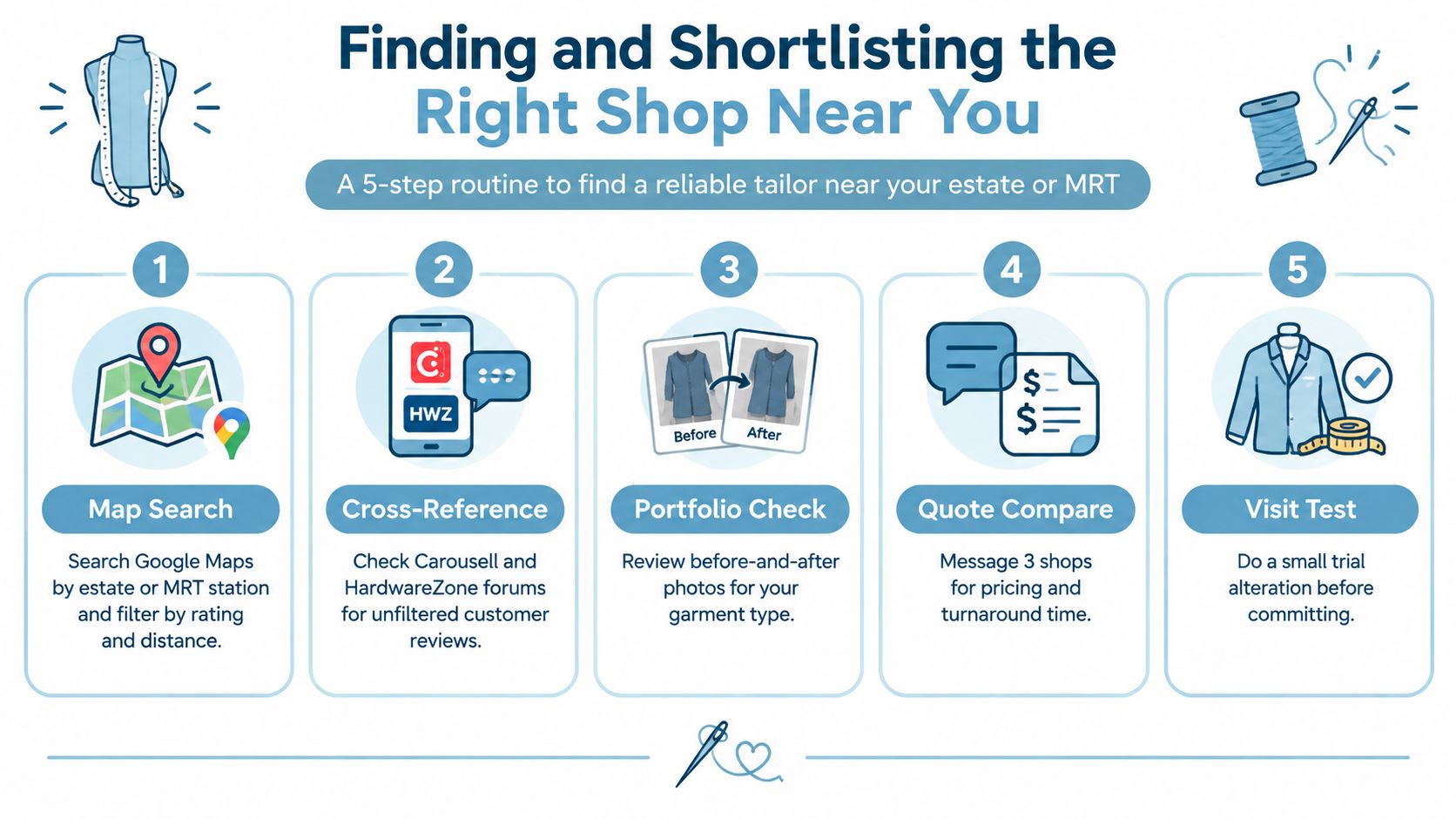
Cross-check the shortlist on Carousell and HardwareZone forums, because unfiltered complaints and praise often tell you more than polished reviews. Then open the shop's Instagram or Facebook and look for recent work photos, especially garments like yours. A tailor who posts only pressed shirts and no construction details isn't showing you much.
Cleanliness matters. Garments piled on the floor, a messy counter, or pins scattered everywhere usually means the shop is rushed, understaffed, or both.
A quick walk-in tells you even more. Watch how garments are stored, whether there's a queue, and whether staff are willing to explain the process without sounding annoyed. If the shop refuses to pin before cutting, that's a bad sign. So is a flat price quoted before anyone looks at the garment.
Send a short first message like this, then judge the answer:
• Turnaround: “How long will this take for my specific garment?”
• Price: “Can you quote based on this piece, not a generic hem?”
• Fittings: “Is a second fitting included if needed?”
• Fix policy: “What happens if the alteration isn't right?”
• Construction check: “Will you pin and mark before cutting?”
If you want a women-focused reference while comparing cuts and silhouettes, the women's tailoring guide is a useful companion read. It's also smart to compare your shortlist against the store network page at Tumble's store locations if you're trying to bundle errands by district.
Singapore gives you three main options, and they're not interchangeable. Independent neighbourhood tailors are the cheapest and most personal. Mall counters are cleaner, more standardised, and easier to claim against if something goes wrong. Bundled laundry-plus-alteration services suit people with a stack of clothes and no time to shuttle items around town.
The best shops don't just sew, they follow a proper fitting process. That matters because the perfect fit process used in high-end alteration work starts with measurement, balance, and garment structure, not with a pair of scissors. If a provider skips that logic, the result usually shows.
ChannelPrice RangeTurnaroundBest ForWatch Out ForIndependent corner tailorUsually lowestOften a few daysBasic hems, quick local fixesQuality varies, communication can be informalMall-based alteration counterMid-range and predictableUsually faster than neighbourhood shopsWorkwear, receipts, simpler adjustmentsLess flexible on complex restylingBundled laundry-plus-alteration serviceHigher overall because of convenienceFast for coordinated pickup jobsBusy households, stacked garments, repeat errandsYou may pay more for the convenience
Independent shops in heartland areas like Bedok, Bukit Batok, and Jurong work well when you know exactly what you want and can tolerate some variability. Mall counters in places such as Orchard or major shopping centres are better when you want a receipt, a visible counter, and less back-and-forth. Bundled services are the most sensible choice for a week full of laundry, dry cleaning, and a few garments that need altering together.
Use Tumble's service overview as a reminder that some service providers are built around convenience first, which can matter more than a minor price difference when you're juggling multiple garments.
Pricing in Singapore is driven by garment construction, fabric, and how much risk the tailor is taking on. Basic jobs can start very low, while complicated work rises quickly once lining, structure, or delicate fabric enters the picture. A common mistake is treating every quote as if it should look like a simple hem.
Local references describe simple alterations starting around S$5, while more complex tailoring jobs can exceed S$80 depending on construction and design complexity (Stitch and Steam). That broad spread makes sense, because a straight trouser hem is not the same job as reshaping a lined blazer or reconstructing a formal dress.
Garment TypeCommon JobsPrice Range (S$)Cost DriverPantsHemming, tapering, waist suppressionS$10 to S$25Length only is simpler, waist and taper changes need more labourBlouse or dressSide seams, waist shaping, strap changesS$15 to S$40Fabric type, darts, and whether the piece is linedSuit jacketSleeve shortening, cuff re-stitchingS$25 to S$60Lining, buttons, and preserving the jacket shapeFull suit restructureBack, shoulder, and trouser workS$50 to S$80+Structural changes, fittings, and precision risk
Silk, chiffon, leather, and lined garments push quotes up because they're harder to undo if the cut is wrong. Rush work under a few days also costs more, and mall counters often price higher because you're paying for overhead and convenience. If a shop quotes you a low number without asking about lining, fabric, or fit issues, expect that price to move later.
If you're comparing garments that need care after alteration, the dry cleaning service in Singapore page is a sensible reference point for understanding why cleaning and pressing often get bundled with tailoring work.
Good question to ask: “Is this quote for a simple hem, or does it include lining, finishing, and a second fitting if needed?”
A proper tailor starts with the garment on your body, not with scissors. Bring the shoes and base layers you'll wear, because hem length, shoulder balance, and drape all change once the full outfit is assembled. That is the standard you want, and TaF.tc treats fit evaluation and correct pinning as the base of the trade.
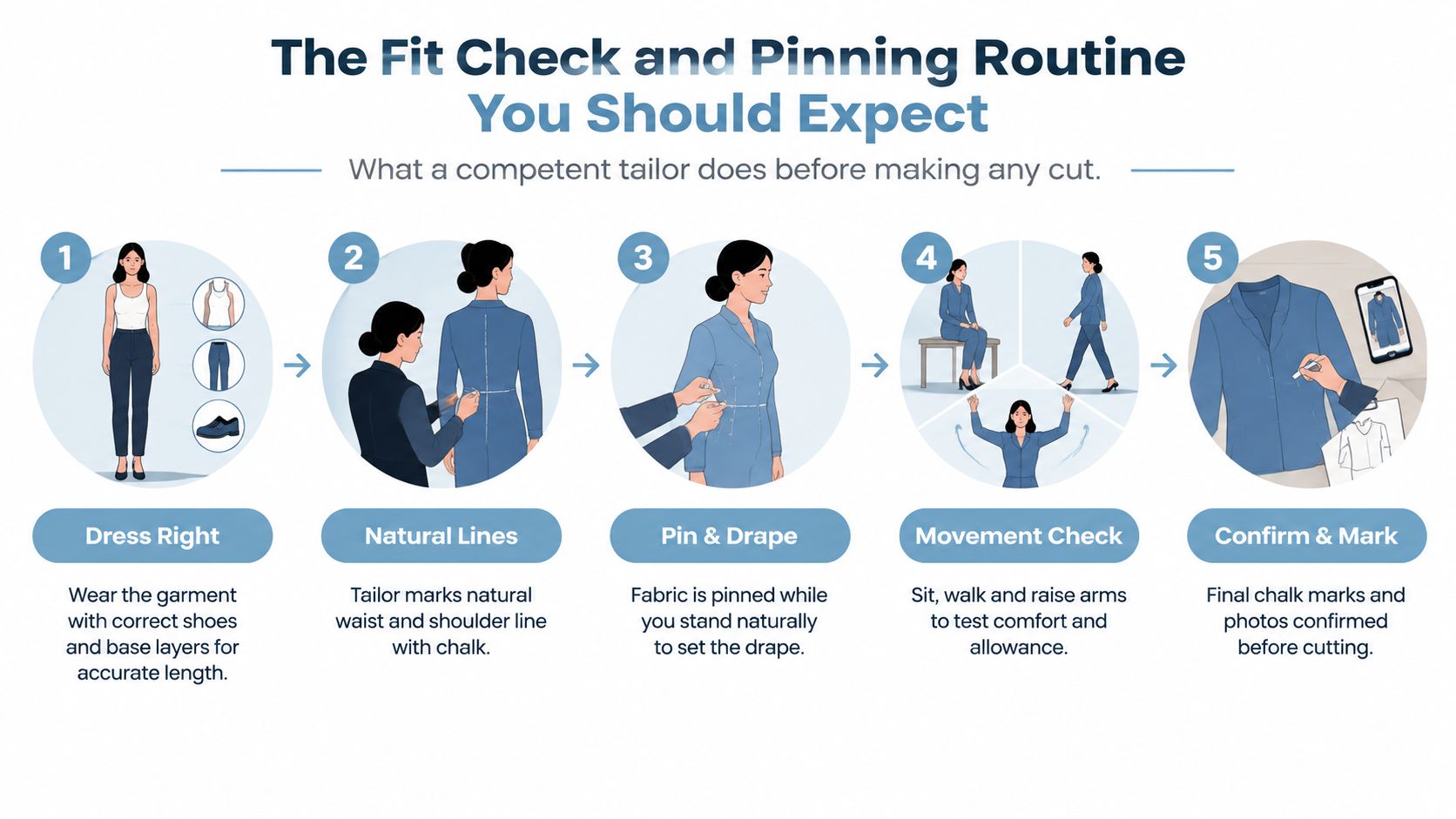
A good fitting looks disciplined. The tailor checks how the garment sits on you, marks the waist and shoulder line with chalk, pins excess fabric where needed, and checks sleeve pitch by asking you to move. Trousers should be assessed in the shoes you plan to wear, not in slippers.
Chalk, pins, basting, and cutting are four different stages. Chalk and pins are reversible. Basting is temporary stitching. Cutting is the point where mistakes become expensive. If a tailor rushes from fitting to scissors, walk away.
The common failure is skipping the balance check. That is how you end up with a shirt that looks fine in front of the mirror, then pulls across the chest, twists at the seams, or makes the pockets sit wrong once you move.
Ask these questions during the try-on:
• Can I sit down?
• Can I raise my arms?
• Will the pockets still sit flat?
A shop that handles structured pieces well will usually test movement, not just posture. If you are bringing a suit, the 2-piece suits guide is worth reading before you approve sleeve or trouser changes.
A shop worth your money treats this stage as technical work, not a quick glance and a pin or two. Precision takes time, and the fitting room is where you see whether the tailor knows the difference between a clean adjustment and a bad cut.
Alteration, dry cleaning, and curtain care belong in the same garment-care routine. If you're already hauling clothes across town, you're doing the hardest part of the job yourself. The smarter move is to clean first when the item is dirty, then alter it once the fabric is in its true state.
Oil stains can shift chalk marks, and sweat or deodorant residue can make seams behave differently once the tailor starts work. That's why pre-cleaning matters for formalwear, cheongsam, kebaya, and evening suits. A clean garment gives cleaner markings, and a better chance that the altered fit holds after the first wear.

Use a simple workflow. Put alteration items in a separate bag, pin a note to each one, and keep them away from the rest of your laundry. If a pickup service is already collecting your weekly wash, bundle in curtains or home textiles at the same time so you stop turning garment care into three different errands.
Clean first, alter second, press last. That sequence saves mistakes.
This is also where pickup-and-delivery laundry makes life easier. You can coordinate collection, keep delicate items apart, and avoid the common mistake of sending a garment for sewing before it's properly cleaned. After the alteration, a final press resets the seams and hems so the outfit looks finished instead of handled.
For people with busy workwear and home textile rotations, the Sunday Laundry services page is a good model of how a pickup routine can keep everything moving without another trip out.
A practical rhythm works better than ambition. Sunday laundry pickup, Monday drop at the tailor, Wednesday collect the altered pieces with the next batch, then Friday curtain dry clean before month-end. That cadence keeps the wardrobe in motion instead of building a pile.
Alteration is a sustainability decision when the garment still has life left in it. Singapore discarded 231,000 tonnes of clothing and textiles in 2025, and only 3% was recycled, which makes reuse and repair far more useful than pretending every unwanted piece can be thrown away guilt-free (Cloop). NEA's position is simple, clothes should go to reuse or repair channels when they're still in good condition, and NUS-linked thinking on circularity says repair and repurposing keep garments in use longer than recycling can.
That doesn't mean every item deserves saving. Alter when the fabric is sound, the seams still have allowance, and the problem is mostly fit or small construction issues. Replace when the cloth is pilled, the seam allowance is already exhausted, or the item is a very cheap fast-fashion purchase bought for under S$20 and the labour will outrun the value.
A quick decision tree helps.
• Alter it: the fabric looks healthy, the fit is off, and the garment would still be worth wearing after a cleaner silhouette.
•Replace it: the fabric is tired, the structure is collapsing, or the repair will chase bad cloth with good money.
• Leave it alone: if you're unsure, get one quote before you commit to a second fitting or a complex fix.
My rule: if you'd still be excited to wear it after it fits properly, alter it. If you'd only wear it out of obligation, let it go.
The action plan should be boring and efficient. Photograph every candidate piece, note two possible alterations for each item, and message three shops back-to-back so you can compare their answers. Group the drop-off with your next laundry or dry cleaning run, and reserve the final week before a deadline for fitting and collection, not for panic.
If your pile of clothes is growing faster than your free time, Tumble Laundry can take the cleaning side off your plate while you sort out the tailoring side. Use Tumble Laundry for pickup-and-delivery laundry, dry cleaning, and curtain care, then hand your altered pieces back into a cleaner, easier wardrobe routine.

We make laundry days fast and easy for you. We collect, clean and deliver your laundry and dry-cleaning.
53 Ubi Ave 1 #03-43, Singapore 408934
Mon - Fri | 8:30 am–5:30 pm
Sat | 8:30 am–12:30 pm
hello@tumble.sg
+65 62554222
Whatsapp Us


