Steam Cleaning of Curtains: A Practical Home Guide
This is some text inside of a div block.

You've probably stood in front of a closed blackout curtain on a humid Singapore afternoon, noticed a faint stale smell when the air-con switches off, and wondered why the fabric seems to hold onto dust even after you've wiped the windowsill. In a flat or condo, curtains don't just catch sunlight, they also sit in warm, damp air for months at a time, which is why steam cleaning of curtains deserves a different mindset from the usual “wash it when it looks dirty” approach.
In many Singapore homes, the curtain problem shows up before the curtain itself looks dirty. A heavy drape hangs neatly, the room feels fine with the air-con on, then the moment the cooling stops, the fabric gives off that slightly damp, musty note that tells you moisture has been sitting in the folds for too long.
That smell usually isn't coming from one dramatic spill. It's the result of moisture trapped in pleats, dust sitting in header folds, and particles collecting where airflow is weakest. Local curtain-care guidance notes that Singapore's humidity can stay high enough year-round to slow drying and encourage mould and mildew, which is why the same curtain routine that works in a dry climate doesn't travel well here. For homes where windows face traffic, cooking fumes, or sea air, that damp layer becomes a maintenance issue, not just a cosmetic one.
Generic advice falls short here. A blog written for a temperate climate often assumes the fabric will dry quickly after cleaning, but here the room can stay humid long after you've finished. For practical laundry habits that fit the same climate reality, Singapore laundry best practices make the same point in a different context, moisture control matters as much as cleanliness.
Practical rule: in Singapore, a curtain that looks clean but holds moisture is still a problem, because damp fabric gives dust and odour more time to settle.
If you're shopping for replacements or comparing window treatment materials, it also helps to browse window treatments online with humidity in mind. Fabric choice affects how often you'll need service, and how forgiving the curtain is when cleaning day comes around.
Steam cleaning sounds simple, but the mechanism matters. A steamer heats water into vapour, then sends that vapour into the curtain weave so heat can loosen grime, soften embedded dust, and help oils release from the fibres. On Singapore-region cleaning guidance, steam-based curtain equipment is described as operating at about 95°C and 3.5 bar pressure, and one local provider says that high-temperature treatment can kill 99.99% of bacteria, viruses, dust mites, and mould spores. Those numbers matter because this is not just about making fabric look fresh, it's about reducing what humid fabric can keep alive.
The cleaner usually works top to bottom so loosened dirt doesn't drip onto already cleaned sections. The steam head stays close enough to penetrate the cloth, but not so close that it saturates the panel. The hot vapour reaches the weave, the fibres relax, and the dirt releases into a wipeable layer. A microfiber cloth then lifts away what the steam has freed.
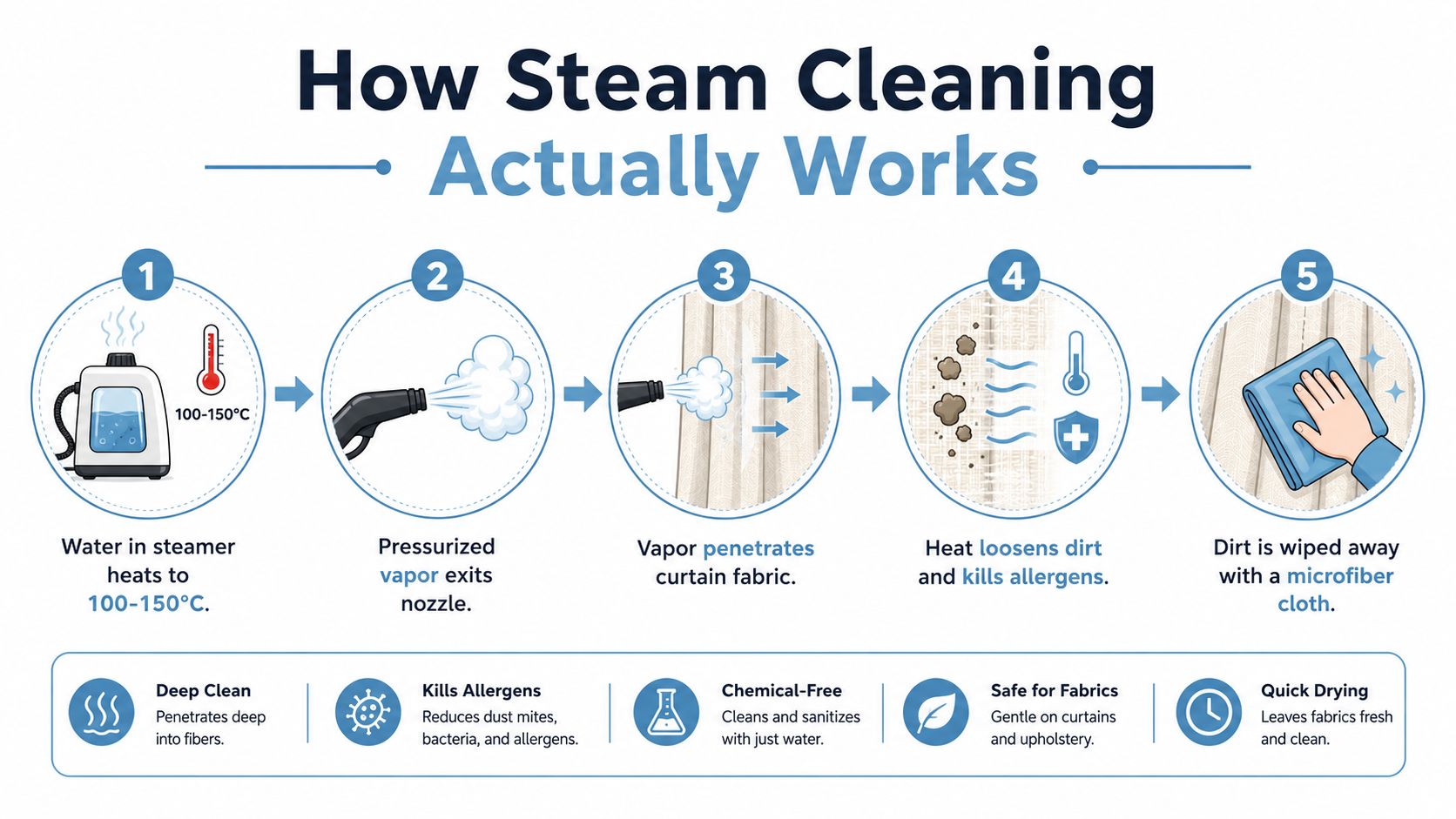
Steam adds moisture, but only a little compared with a full soak. That's why it's useful for curtains that stay installed, especially in flats where taking everything down, washing, and rehanging would leave the room open to humidity for too long. It also explains why technique matters. If the nozzle is held too far away, the steam just drifts off. If it's held too close for too long, delicate fabric can mark or distort.
Work from the heading down, keep steady passes, and let the fibres dry before closing the curtains again.
For a useful comparison of steam and pressing methods on other fabrics, steaming vs ironing shows why steam is usually the safer approach when a material shouldn't be flattened under heat.
Curtains are not one fabric category, and that's where most mistakes start. A synthetic panel can shrug off steam while a silk drape may spot or change sheen from the same treatment. In Singapore homes, the safest habit is to treat the curtain like a care-label question first, cleaning method second.
Polyester, most synthetic blends, and many cotton mixes are usually the easiest to steam because they tolerate heat and don't trap water as aggressively as more delicate fibres. Cotton can cope too, but in a humid room it takes longer to settle dry, so the airflow around the window matters. Linen is more temperamental. It can crease sharply and shrink if heat is too aggressive, so a hidden test patch is the sensible starting point.
Silk is a risk because water spotting, dye lift, and a change in finish can happen if the heat is wrong. Velvet and chenille can crush under pressure, which is why a soft attachment or professional handling is safer than leaning in with a hot nozzle. Blackout-coated backing also deserves care, because the coating can bubble or delaminate under excessive heat.
Useful filter: if the curtain has a coating, a pile, or an expensive natural fibre, test first. If you're still unsure, don't guess.
For homeowners who already handle upholstery carefully, the same logic applies to window fabrics. A practical guide on how to clean upholstery without damaging fabric is a good reminder that a fabric's structure matters as much as its colour.
FabricSteam cleaning suitabilityCaveat or alternativePolyesterGoodUse moderate heat and keep passes evenCotton blendsGoodAllow extra drying time in humid roomsPure cottonGenerally suitableWatch for slower drying and wrinklesLinenCautiousTest hidden corner first, use the lowest effective heatSilkPoorDry cleaning is usually saferVelvetCautiousSoft brush attachment or professional handlingChenilleCautiousAvoid heavy nozzle pressureBlackout-coated panelsCautious to poorCheck for heat damage, consider professional service
If you want to check care symbols before touching any of these fabrics, laundry symbols and care labels is worth keeping handy.
A curtain clean in Singapore has to answer four questions at once. How long will the room be disrupted, how much does it cost, how much fabric risk is involved, and how well does the method deal with humidity? Once you judge all four together, the “cheapest” option isn't always the one that makes sense.
Steam cleaning usually wins when you want the curtains refreshed in place and don't want a wet bundle sitting around the flat. Hand washing can be gentle, but it still creates a damp load that needs space and patience to dry. Machine washing works for some light polyester panels that can handle a spin cycle, yet it becomes a poor fit the moment linings, coatings, or complex pleats enter the picture. Dry cleaning is still the safer route for lined, embroidered, or otherwise structured drapes, especially where the fabric can't be risked in water.
MethodTypical TimeCost (SGD)Fabric RiskHumidity HandlingSteam cleaningModerate, often same visitAbout S$25–40 per panel, or S$35–50 for heavily soiled or special fabrics, with some local price guides listing S$35 per panel for day, night, or sheer curtains and S$40 for blackout curtainsLow to moderate, depending on fabricStrong, because it avoids full saturationHand washingLonger, because of soaking and dryingVaries by effort and detergentModerate, especially for trims and structureWeak in humid homes, because drying is slowMachine washingFast for suitable panelsUsually lower for simple fabricModerate to high for lined or delicate curtainsWeak if the load can't dry quicklyDry cleaningSlower overall, due to off-site handlingUsually higher than steam for simple panelsLow for unsuitable-for-water fabricsGood for fabric safety, but still involves takedown and return
For a deeper look at off-site processing, dry cleaning process explains why that route suits certain fabrics but not every flat or timeline.
A simple rule helps. If the curtain is simple, sturdy, and synthetic, steam or machine washing can both work. If the curtain is structured, lined, coated, or delicate, dry cleaning or professional steam care is usually the safer decision. If the biggest concern is humidity and turnaround, steam cleaning of curtains is often the most practical middle ground.
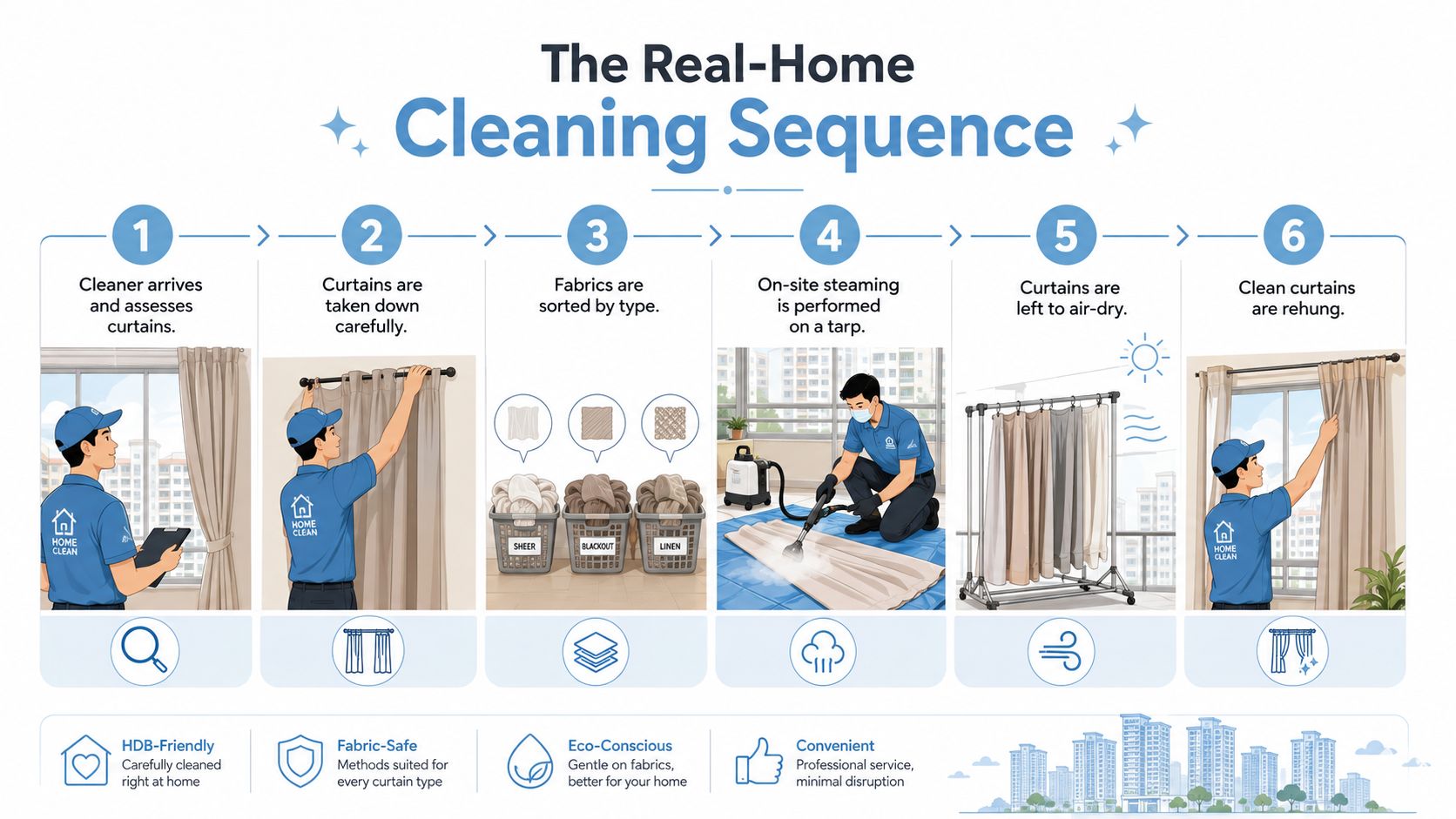
A real curtain service in an HDB or condo doesn't happen in a showroom. It starts with a cleaner looking at how the panel hangs, checking whether the hooks, rings, and header are stable, then deciding whether the fabric can stay on the rail or should come down first. That choice matters because a set of curtains is often more awkward to handle than people expect, especially in narrow living rooms where the sofa sits close to the window.
The first pass is inspection. The cleaner checks fabric type, stain level, and the condition of the track or rod. Then the floor space under the curtain drop is cleared, furniture is nudged away, and the area is protected so the steamer or takedown work doesn't hit the sofa or side table.
After that comes the actual cleaning, either in place or after removal, depending on fabric and access. Hooks and ring positions need to be marked so the pleats go back where they were. Once the fabric is treated, it's rehung, straightened, and re-pleated if needed so the curtain falls properly again.
The infographic below shows the full sequence in a typical domestic setting.
A paid quote for curtain work usually covers the cleaning itself, and sometimes the takedown and rehanging if that's part of the package. Track wiping, heavy stain work, and extra hardware cleaning can be separate. If the rails are hard to reach, or the curtains are especially long, those details should be clear before anyone starts.
Move the furniture first. In small flats, that single step saves the crew from squeezing around the window and makes the job cleaner.
For a service example that includes curtain care and reinstallation support, Tumble Laundry's curtain cleaning page is useful to review before you book anything similar elsewhere.
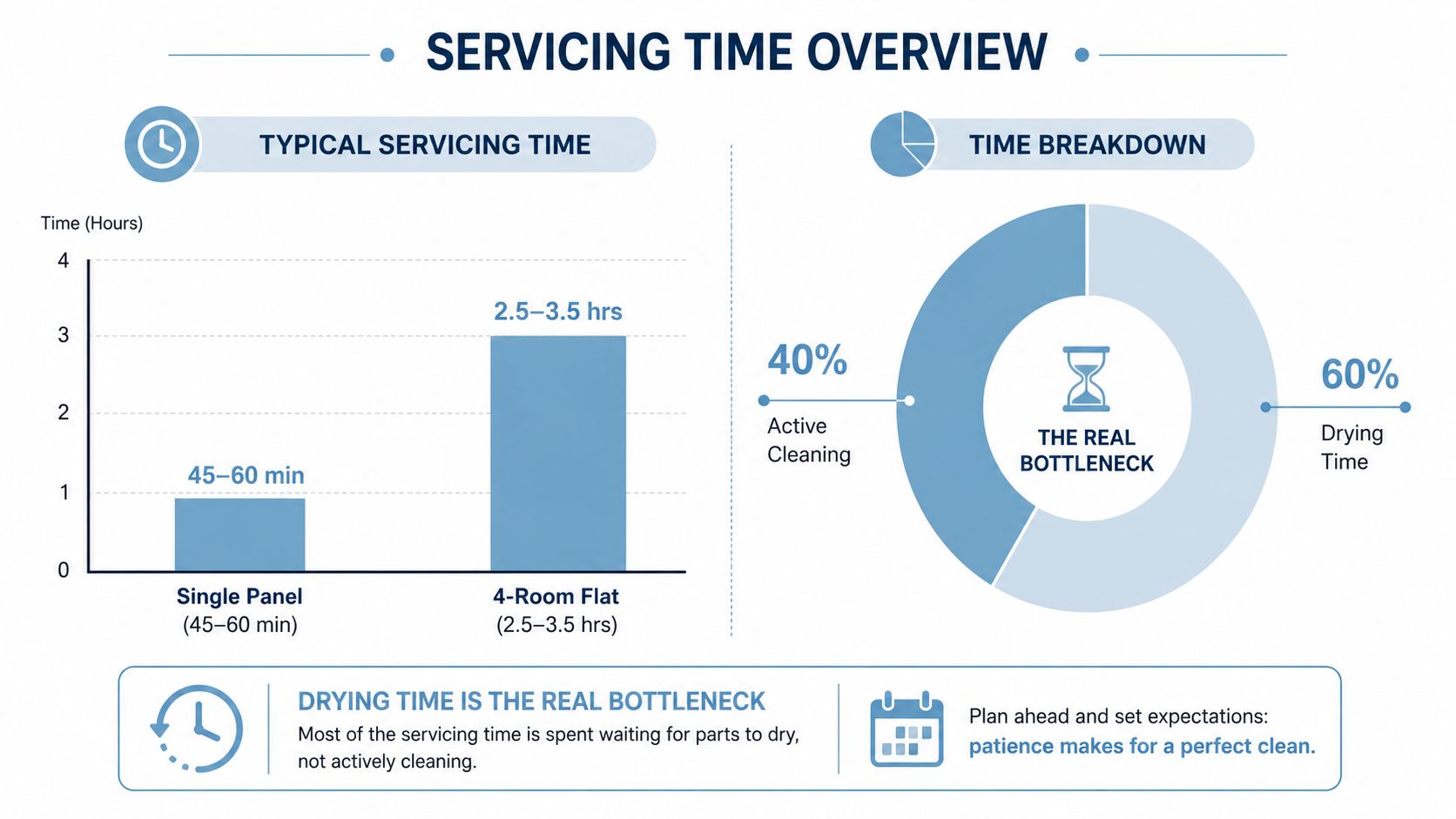
In Singapore, drying is the bottleneck, not the cleaning itself. That's why steam has a practical advantage. Local guidance says steam-cleaned curtains can be dry in about 2 to 4 hours or 4 to 6 hours, depending on fabric and airflow, and another Singapore guide describes professional steam or hot-water extraction as leaving fabric dry to the touch in about 4 to 6 hours. In a humid flat, those hours matter because you're trying to avoid leaving windows bare or curtains clammy overnight.
A single panel can be handled fairly quickly if access is good and the fabric cooperates. A full home takes longer because the cleaning is only one part of the job. Rehanging, straightening, and waiting for the final dry-down all add time, which is why families often prefer a method that doesn't leave a soaked bundle sitting in the bedroom while the air stays damp.
Local curtain price guides put steam-cleaned curtain panels at about S$35 per panel for day, night, or sheer curtains, S$40 per panel for blackout curtains, and S$60 per set for day-plus-night bundles. Another Singapore service guide gives a broader professional range of about S$25–40 per curtain panel, or S$35–50 for heavily soiled or special fabrics. Those numbers give you a decent benchmark when a quote lands in your inbox.
Price pointWhat it suggestsLower per-panel quoteLikely standard fabric, simple access, lighter soilHigher per-panel quoteHeavier fabric, more staining, or special handlingBundle pricingMore likely when several window treatments are cleaned together
The infographic below puts the time split in plain view.
If a quote seems unusually low, ask what's included. Track cleaning, stain pre-treatment, and takedown can change the final bill, especially when the job needs more handling than the headline price suggests.
Steam isn't a cure-all, and that's where people save money by choosing the right method first. If a curtain has heavy cooking soot near a kitchen window, steam often pushes the issue around instead of lifting it properly. If the fabric carries deep pet odour or tobacco residue, the smell can sit below the surface and need a more thorough wash or dry-cleaning route.
A rental unit with kopi splashes on voile near an open window, or a bedroom curtain that still smells of smoke after airing out, both point to the same decision. If the stain has changed the look of the fabric or the odour comes back when the room gets warm, steam alone probably isn't enough.
The wrong method costs more when you have to clean twice, so it's cheaper to match the fabric and the problem properly the first time.
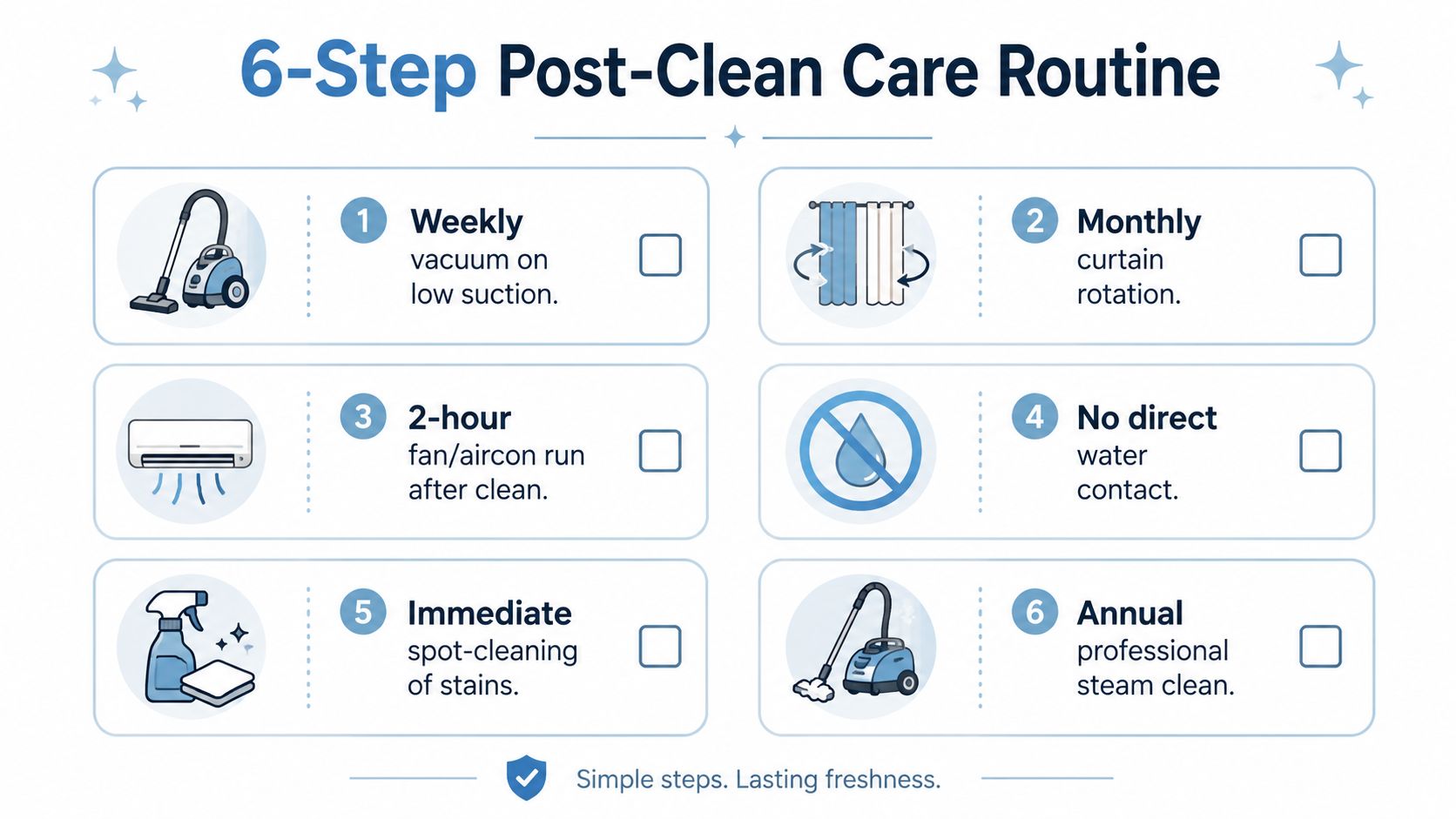
The best curtain routine is the one that fits Singapore humidity instead of fighting it. Start with weekly low-suction vacuuming, because loose dust sitting in the folds gives mould and odour more to work with. Rotate the curtains monthly so the pleats and hanging points don't age unevenly, especially on windows that get stronger sun or damp afternoon air.
• Weekly vacuum on low suction: Pull dust off the surface before it settles into the weave or track line.
• Monthly curtain rotation: Shift the folds so one side isn't taking all the wear.
• Run a fan or air-con for two hours after any wipe-down: Give moisture a chance to leave the fabric and header.
• No direct water contact: Avoid accidental soaking, because damp headers and linings are where mould starts first.
• Immediate spot-cleaning of stains: Handle spills within a day so marks don't bond into the fibres.
• Annual professional steam clean: Keep the fabric refreshed before humidity turns residue into smell.
The infographic below turns that into a simple checklist.
Inspect hooks and tracks every few months too, because rust and grime at the hardware can undo clean fabric fast. If you live near the coast or on a brighter east-facing window, keep an eye on discolouration and salt-air residue as well.
Keep the windows closed during the stickiest parts of the day. That simple habit reduces the moisture load on the curtains, helps the room stay fresher after cleaning, and makes every other step on this list work better.
If you want curtain care handled without juggling takedown, drying, and rehanging in a humid flat, Tumble Laundry offers curtain cleaning alongside pickup, delivery, and fabric-specific care options in Singapore. Visit Tumble Laundry to see how its curtain service fits your home, especially if you'd rather book one visit than manage the whole job yourself.

We make laundry days fast and easy for you. We collect, clean and deliver your laundry and dry-cleaning.
53 Ubi Ave 1 #03-43, Singapore 408934
Mon - Fri | 8:30 am–5:30 pm
Sat | 8:30 am–12:30 pm
hello@tumble.sg
+65 62554222
Whatsapp Us


