How Much Is Dry Cleaning in Singapore (2026 Prices)
This is some text inside of a div block.


Dry cleaning in Singapore usually starts at about S$5 to S$8 for everyday pieces, rises to around S$15 to S$20 for structured garments, and can run from roughly S$45 to S$120 or more for formalwear. If you've got shirts, a blazer, and a set of curtains sitting in the same weekend pile, the bill can move fast because each item lands in a different pricing tier.
Monday morning is when that bill becomes real. A working professional in an HDB or condo opens the laundry bag and sees office shirts, a blazer from Friday's meeting, and curtains that have gone dull near the window. The price gap looks random until you've priced enough orders to see the pattern, and the pattern is simple, item type, fabric, staining, finishing, and add-ons decide almost everything.
The quickest way to understand how much is dry cleaning is to look at a mixed real-life pile, not a neat price table. A shirt that only needs light pressing is usually on the lower end of the bill, while a blazer or jacket immediately moves into a different lane because it needs shape retention, careful pressing, and more checking at the counter. Curtains sit in a separate category again, because the fabric is bulky and the service often includes handling work beyond the wash itself.
A stack of three office shirts, one structured blazer, and a set of living-room curtains doesn't behave like one job. The shirts are the easy part, but the blazer needs more labour per piece, and the curtains may need takedown and rehanging before anyone even starts cleaning. That's why Singapore operators price dry cleaning by garment class rather than by a loose “per load” assumption, as shown in local pricing pages for itemised dry cleaning at Tumble Laundry.
Practical rule: if the item has shoulders, lining, pleats, embroidery, or hooks, assume it will cost more than a basic shirt.
The useful part for households is that the bill is predictable once you sort the items properly. Everyday shirts commonly sit around the mid-single digits to low teens, structured pieces sit higher, and household textiles can jump again if the cleaner has to remove, clean, and reinstall them. In other words, the problem isn't that dry cleaning is mysterious, it's that mixed wardrobes hide different jobs in the same bag.
For a cleaner view of what happens to each garment after drop-off, see the dry cleaning process guide. The practical takeaway is simple, don't judge the bill by the number of items alone, judge it by the mix.
The five drivers that shape the total are garment construction, fibre type, staining, special treatments, and add-on handling. Once you know those, the quote stops feeling arbitrary.
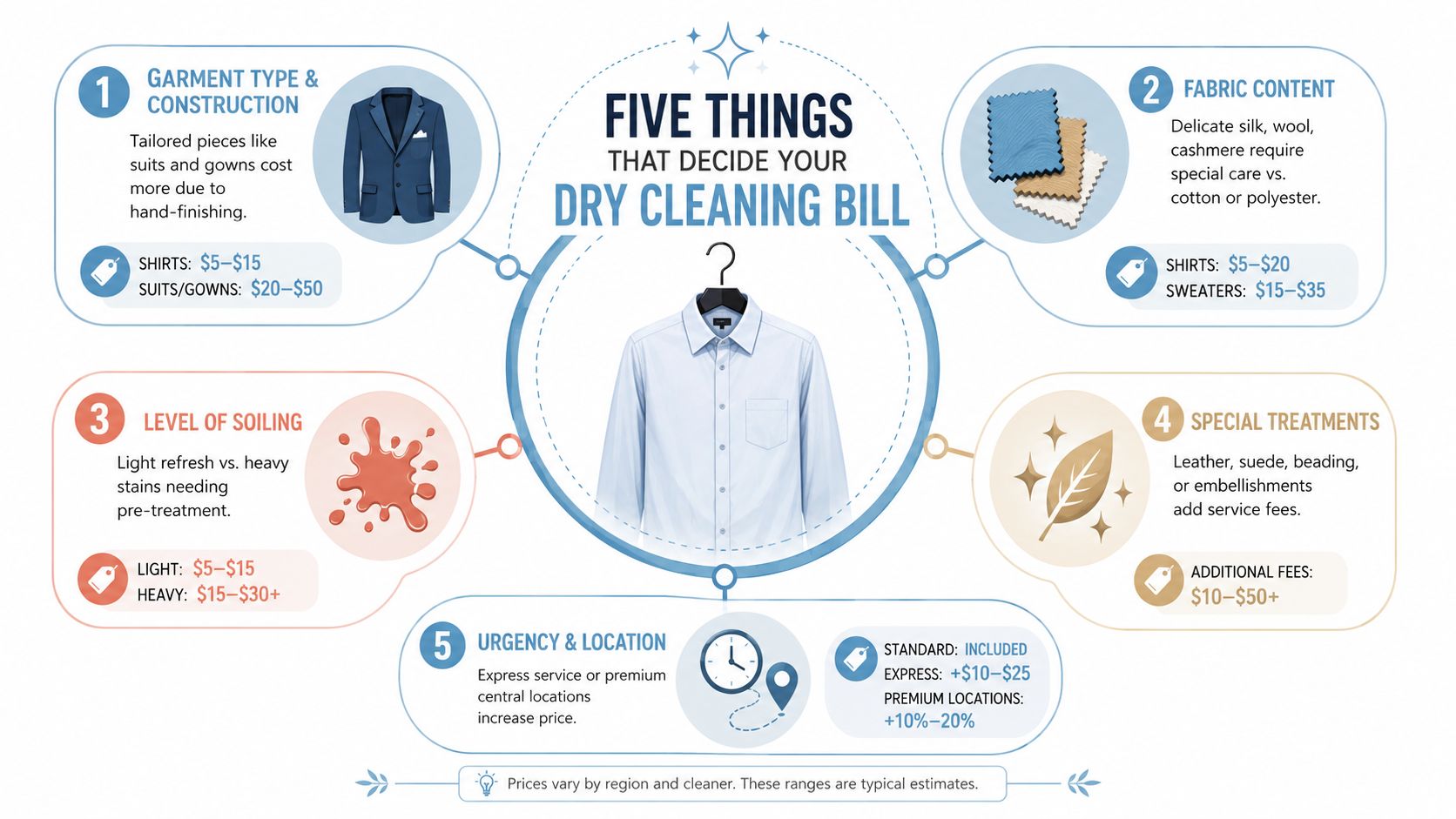
Think of dry cleaning like car servicing. An express shirt press is the equivalent of a basic oil change, a blazer is closer to a full service, and a beaded gown is specialist work that needs more hands, more time, and more care. That mental model helps because the cleaner is not charging for the label alone, they're charging for the amount of attention the item forces them to spend.
Garment type and construction matter first. A flat shirt is simple, but a lined blazer, a suit jacket, or a formal gown has shape that must be preserved through cleaning and pressing.
Fabric content comes next. Delicate silk, wool, cashmere, and other speciality fabrics need more careful handling than sturdy everyday cotton blends.
Level of soiling changes the amount of pre-treatment work. A lightly worn office shirt is one thing, a work uniform with set-in collar marks is another.
Special treatments cover items with leather, suede, beadwork, heavy embellishment, or wedding preservation needs.
Urgency and location can also shift the quote, especially when the operator offers express service or works in a higher-rent area.
A cleaner is really pricing risk, not just fabric. More structure means more labour, more inspection, and more chances for a mistake if the process is rushed.
If you want a deeper look at garment handling, the dry cleaning services overview is useful because it shows how cleaners separate different jobs rather than treating everything like a standard wash. The main thing to remember is that a label change can move an item across pricing tiers. A garment that can be washed normally will almost always cost less than one that must be solvent cleaned, pressed by hand, and checked for shape.
A dry cleaning bill in Singapore usually starts feeling expensive once the garment stops being a simple shirt. Everyday pieces sit in the lower band, but anything with structure, lining, embellishment, or careful pressing moves up fast. One local price list shows shirts and blouses at S$5.00 to S$6.00, trousers and slacks at S$6.00 to S$7.00, suits at S$14.00 to S$16.00, cheong sam and saree at S$15.00 to S$16.00, and wedding gowns at S$120.00 (LaundryMart Singapore pricing).
A separate Singapore guide puts everyday garments around S$7.80, blazers at S$17.80, full-length dresses at S$16.80, tuxedos at S$46.80, and wedding gowns from S$120 (Stitch and Steam dry cleaning cost guide). It also lists baju kurung/kebaya at S$21.80 and cheongsam at S$21.80. Traditional wear usually lands in the middle of the range because detailing and fabric care add labour.
CategoryExample itemsTypical price (S$)Everyday wearShirts, t-shirts, trousers, blouses5.00 to 8.80Structured wearBlazers, suit jackets, suits14.00 to 20.95Traditional wearCheongsam, baju kurung, kebaya, saree15.00 to 21.80FormalwearTuxedos, evening gowns16.80 to 46.80Ceremonial wearWedding gownsfrom 120.00Household textilesCurtains8.00 per kg or piece, 16.00 with installation
The gap is mostly about handling, not branding. A shirt and a tuxedo can sit far apart in price because the tuxedo needs more shape retention, more finishing, and more inspection time (Stitch and Steam rates).
Curtains are a separate line item many households forget to budget for. One Singapore list prices curtain cleaning at S$8.00 per kg or per piece, rising to S$16.00 with installation (LaundryMart Singapore pricing).
Most households are choosing between three ways to pay, per-piece dry cleaning, monthly subscription bundles, and weight-based wash-and-fold. The right choice depends on whether your wardrobe is mostly shirts and trousers, or whether you're paying for structured garments that need special handling. For recurring laundry planning, subscription pricing models are also easy to compare with other service businesses, including subscription app fees for Shopify merchants, because the logic is the same, recurring volume needs a different price structure than one-off jobs.
Take a common month, 6 dress shirts, 2 blouses, 1 blazer, 1 cheongsam, 1 pair of trousers, and 1 set of curtains. Under per-piece pricing, that mix will usually cost the most on the blazer, cheongsam, and curtains, because those items are not priced like standard shirts. Under subscription pricing, the shirts and blouses can become better value if you regularly hit enough items each month, but formalwear and curtain work are often excluded or charged separately. Under wash-and-fold, only the casual cottons and household basics really fit, because structured and formal garments should not be forced into a bulk wash model.
Wash-and-fold in Singapore commonly sits around S$5.5 to S$7 per kg, while dry-clean-only items often start around S$7 to S$8 per piece and can rise sharply for formalwear and structured items (LaundryHeap Singapore pricing). That is why subscriptions can make sense once your month is full of repeat shirts and blouses, but not when your bag is mostly one-off formal pieces. If your clothes are mostly office basics, the economy favours bundled volume. If your clothes include a cheongsam, a blazer, and curtains, per-piece pricing is usually the cleaner fit.
Start by sorting your items into three buckets, everyday, structured, and formal. Shirts and trousers go one way, blazers and uniforms go another, and cheongsam, baju kurung, gowns, and tuxedos should be treated as special-care items from the start.
Read the care label for fibre content and the dry-clean-only symbol. Silk, lined garments, embroidery, and beadwork often signal that the cleaner has to slow down and handle the item differently.
Then look for obvious stains, collar grime, cuff marks, broken seams, loose buttons, and damaged lining. Those are the details that create surcharge risk because the operator may need pre-treatment or extra inspection before cleaning.
If you can see the stain from arm's length, assume the counter can see it too.
Ask the counter three direct questions, base price per item, surcharge for stains or special treatment, and whether curtain takedown or pressing-only is billed separately. If you do that, you'll get a real ceiling instead of a hopeful guess.
For a quick mental estimate, count everyday pieces at S$6 to S$8, structured items at S$15 to S$20, and formalwear at S$45+, then add any special handling on top. That won't give you the exact bill, but it will stop the shock when the receipt comes back.
The first myth is that dry cleaning is always expensive. In Singapore, basic shirt cleaning can sit in the same practical range as what many people already spend on laundering, pressing, and the time it takes to do clothes at home. If you are paying for ironing space, storage, and your own labour, a per-piece shirt clean can be the better trade-off.
The second myth is that every dry cleaner charges the same. They do not. Solvent choice, finishing labour, shop rent, and whether a cleaner handles curtains or structured formalwear all affect the bill. That is why a neighbourhood counter and a premium hotel-style service can feel like different markets even when they clean the same garment. For a clearer breakdown of the process, see our guide on laundry vs. dry cleaning.
Curtains are not a once-in-a-blue-moon item. They collect dust, dull the room, and are awkward enough to remove that households often delay the job until the fabric looks tired.
A separate Singapore price list puts curtain cleaning at S$8.00 per kg or piece, rising to S$16.00 with installation. If you treat curtains as routine home care instead of an emergency refresh, you avoid bigger replacement costs later and keep the room looking cleaner for longer.
The final myth is that the cheapest option is always the smartest one. The hidden cost is often your own time, especially for shirts that need pressing and formalwear that cannot be treated casually. The better question is not “what is the lowest ticket price”, it is “what is the cheapest way to get this item back in wearable shape”.
Start with consolidation. If you drop off ten shirts in one run instead of splitting them across two smaller visits, you cut down on handling overhead and make the trip count more efficiently. Cleaners spend time on intake, tagging, sorting, and tracking, so fewer separate visits usually helps.
Use subscription pricing when volume is steady. Once your monthly dry-clean-only count starts getting into repeated shirts and blouses, a bundle can beat item-by-item charging. The exact threshold depends on the cleaner, but the economics improve when the same categories keep coming back every month.
Rotate structured garments instead of over-cleaning them. A blazer or cheongsam doesn't need to be cleaned after every wear if it was only worn briefly and aired properly after use. Letting the fabric rest between outings gives you a longer wear cycle.
Spot-treat before the stain sets. A damp microfibre cloth and a little mild detergent on collars or cuffs can save you from a heavier stain-treatment charge later. This works best on fresh marks, not on old, rubbed-in stains.
Keep one rule in mind, fresh stains are easier to manage at home than on the counter.
Use wash-and-fold for true basics. Cotton tees, pyjamas, and casual dresses that tolerate water should not be pushed into dry-clean pricing. Tumble Laundry's subscription wash and fold service is one example of how recurring household laundry can be priced differently from per-piece garment care.
Skip extras unless you need them. Moth-proofing, express turnaround, and similar add-ons are useful in the right situation, but they raise the bill quickly. Same-day service routinely costs more, so don't pay for urgency when the garment can wait.
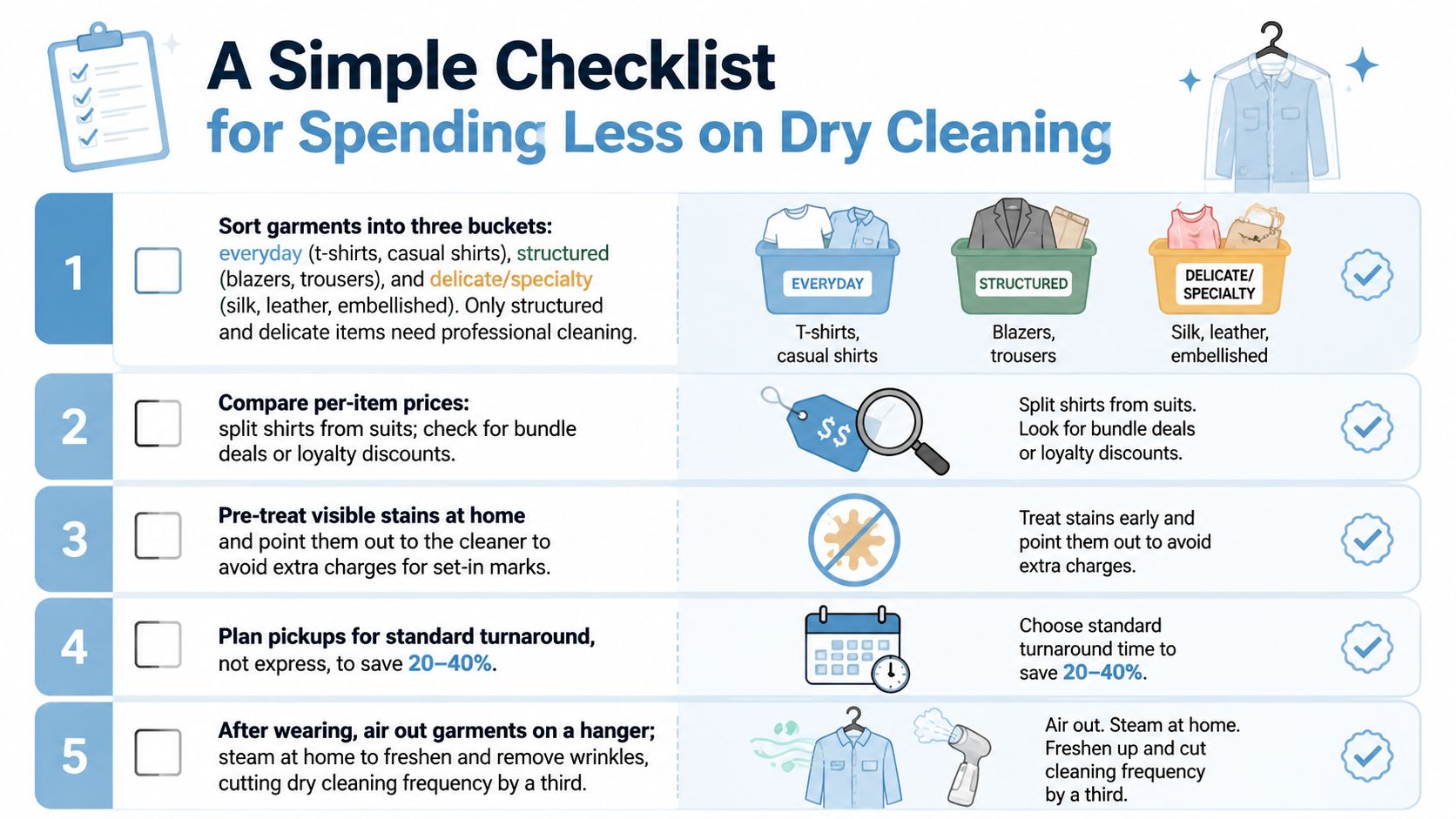
Use this checklist before your next drop-off.
1. Sort the wardrobe properly. Put everyday items, structured garments, and delicate or formal pieces into separate piles so you only send what needs professional care.
2. Check the price class, not just the fabric. Split shirts from suits, and blouses from beaded traditional wear, because the base price changes fast once the garment needs shape retention or extra finishing.
3. Treat visible stains early. Pre-treat collar marks and food spots at home, and point them out to the cleaner if they're still there, because set-in stains are the ones that trigger extra work.
4. Plan for standard turnaround. Book ahead and avoid express service unless you really need it, because rush handling can cost noticeably more than standard processing.
5. Air items out after wearing. A hanger, some ventilation, and a little steam often extend the time between visits, especially for structured pieces that don't need cleaning after every outing.
The checklist is simple, but it keeps the bill under control because it forces you to decide what needs per-piece care. That's the difference between paying for precision and paying for habit.
Tumble Laundry handles wash & fold, dry cleaning, ironing, and curtain care with islandwide pickup and delivery, so it fits neatly into the same everyday decisions covered above. If you want a clearer way to compare per-piece cleaning, subscriptions, and household textile care in Singapore, visit Tumble Laundry and check the service that matches your wardrobe mix.

We make laundry days fast and easy for you. We collect, clean and deliver your laundry and dry-cleaning.
53 Ubi Ave 1 #03-43, Singapore 408934
Mon - Fri | 8:30 am–5:30 pm
Sat | 8:30 am–12:30 pm
hello@tumble.sg
+65 62554222
Whatsapp Us


