Commercial Laundry Machines in Singapore: A Buyer's Guide
This is some text inside of a div block.


You're standing in a plant room or back-of-house corridor with a shortlist on paper, a vendor quote in hand, and a nagging problem nobody has answered yet. The washer-extractor looks right, the dryers sound right, but nobody has confirmed whether the site can support the load, the drain, the heat, or the maintenance access without costly rework.
That's the core commercial laundry machine decision in Singapore. Not brand first. Not drum size first. Site first, then capacity, then efficiency, then maintenance, then vendor. The operators who get this sequence wrong end up paying for it in retrofit work, downtime, and under-used equipment that looked impressive in a brochure.
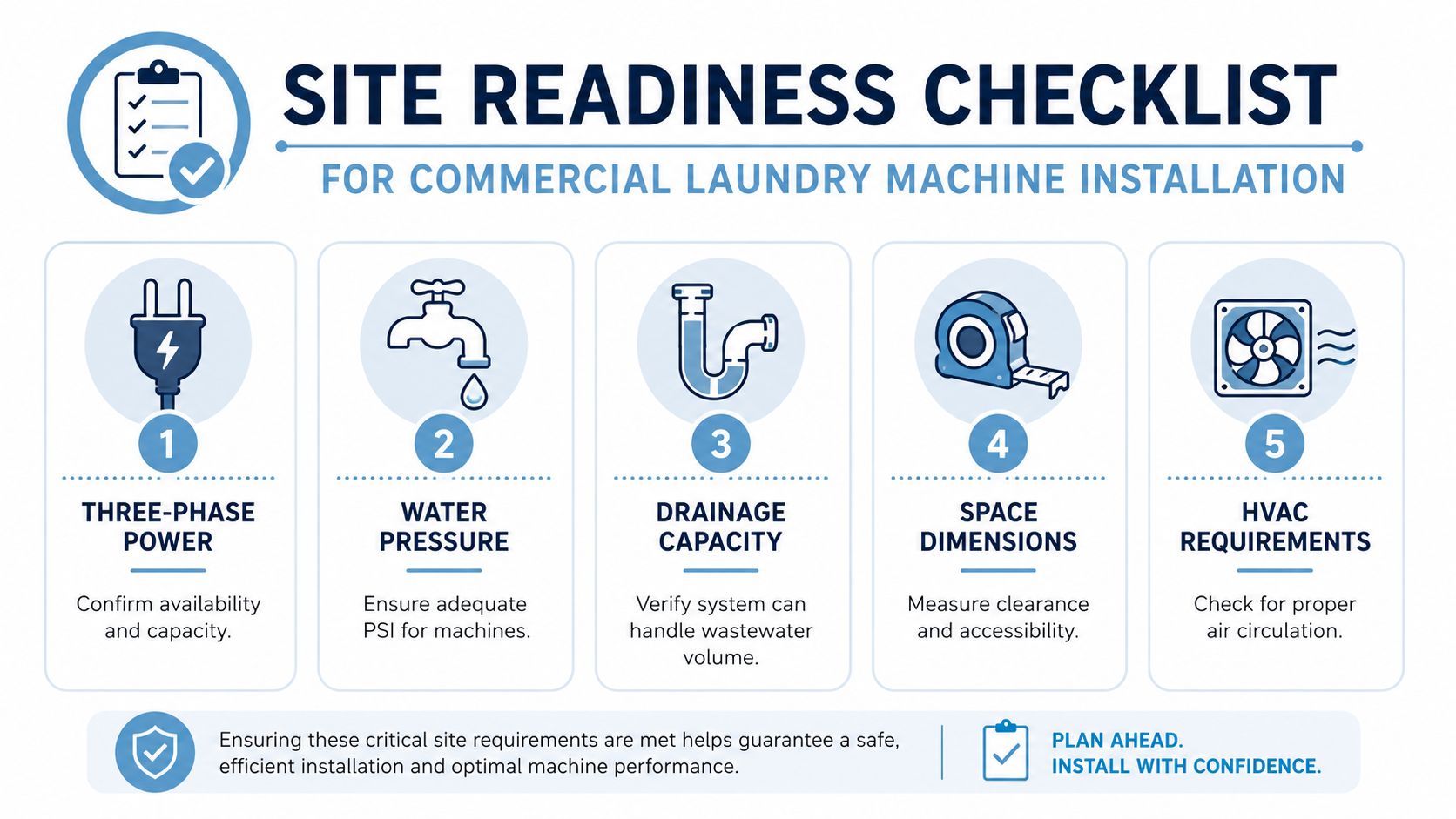
A lot of Singapore teams start with a capacity number because it feels concrete. A 35 kg washer-extractor sounds decisive until someone realises the room may not have the right electrical feed, drainage path, or clearances to install it properly. That is how procurement turns into a retrofit problem.
A proper site review checks water supply, gas or electric heat, drainage loading, clearance for door swings, and maintenance access before anyone signs. Independent facility guidance says commercial laundry projects should verify water, gas, electric, venting, drainage, and clearance requirements in advance, and larger units may need three-phase power and dedicated circuits, which matters in dense urban sites where the room was never designed for heavy laundry infrastructure (facility guidance on commercial laundry area design).
That matters in Singapore because the common buyers are not standalone industrial plants. They're hotels, schools, condos, HDB-adjacent laundries, and outsourced wash-and-fold operators squeezing serious throughput into tight rooms with limited service corridors.
Practical rule: if the machine needs an upgrade to the building just to get installed, the machine is probably oversized for the site.
The sequence should stay simple. Site, capacity, efficiency, maintenance, vendor. If the site fails, every other comparison is irrelevant. If the site passes, then the machine spec starts to matter.
For operators who already run regular laundry workflows and want a local reference point for operational practices, Tumble Laundry's Singapore laundry best practices is a useful internal read, but the bigger lesson is still the same. Don't buy a drum size. Buy a machine that your site can support, service, and power without hidden work.
The commercial laundry stack is easier to buy once you stop treating every machine as a generic washer or dryer. Different equipment families exist for different workloads, and the wrong match usually shows up later as slow turnaround, wet linen, or a room that's too cramped to work in.
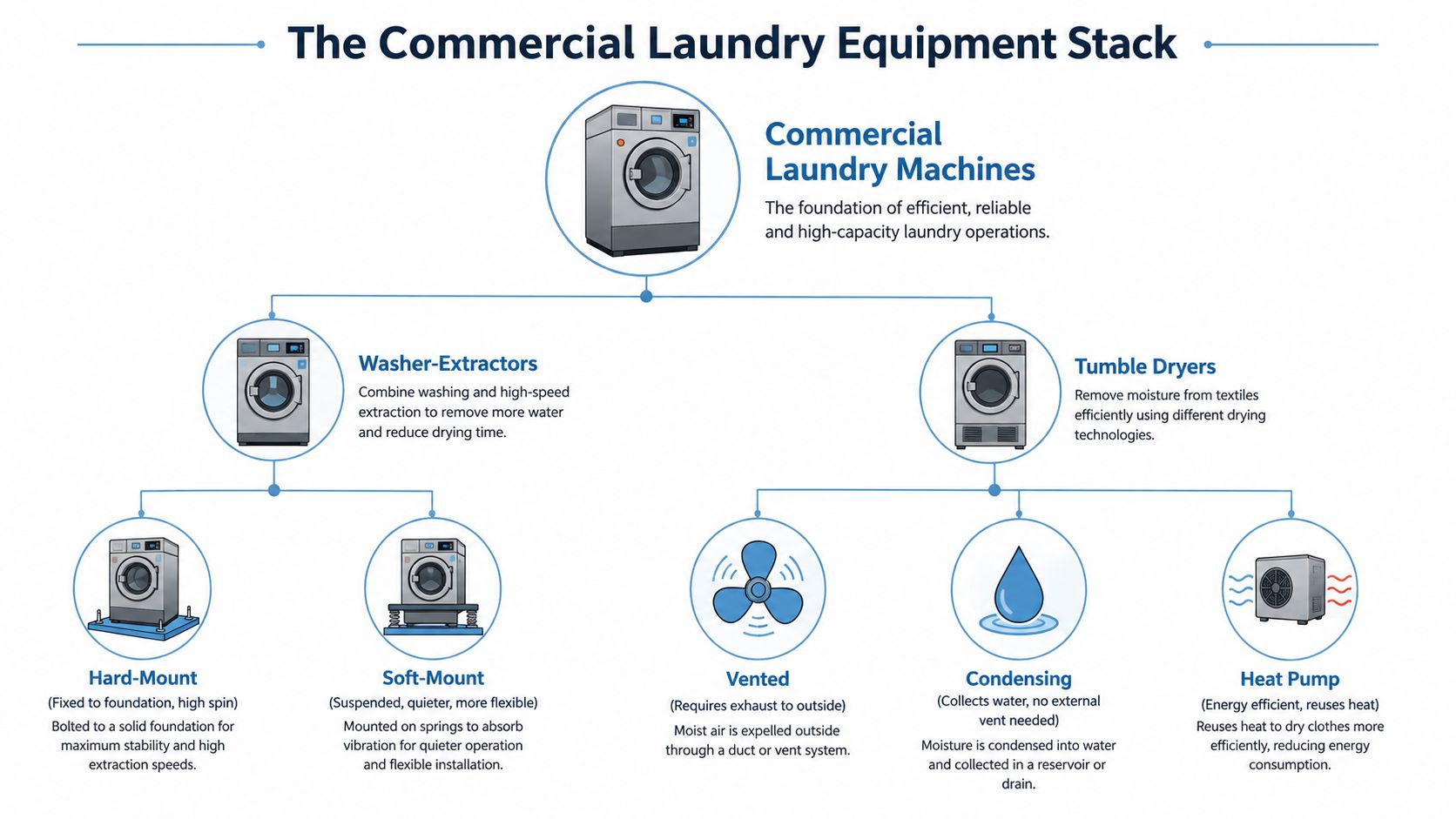
A washer-extractor is the workhorse. It washes, then spins hard enough to remove a large share of water before drying. That spin stage matters because it shortens dryer time, cuts energy use downstream, and lifts throughput in busy facilities.
Mounting style changes the installation profile. Hard-mount units are fixed to a foundation, suit more rigid installs, and are usually the simpler structural choice. Soft-mount machines are suspended, quieter, and more flexible on siting, which is why they're attractive in upper-floor or retrofit environments.
Dryers come in three practical forms. Vented dryers exhaust hot air outside. Condensing dryers collect moisture internally and avoid an external vent. Heat-pump dryers reuse heat and are the most resource-conscious option in long-run operations, though they usually ask for more capex.
Then there's finishing. Irons, ironers, and flatwork finishing lines exist for linen, table cloths, sheets, and any workload where appearance and speed matter. Ancillary systems like water-reuse and chemical dosing aren't nice extras in serious operations, they're part of how you keep quality consistent.
The distinction that trips up Singapore buyers is the difference between on-premises laundry, or OPL, and heavier industrial or coin-operated formats. Most hotels, schools, care homes, and back-of-house service rooms sit in the OPL class. They need durable, high-throughput equipment, not a full industrial tunnel system.
Buy the machine family that matches the laundry item, not the machine family that looks toughest in a sales deck.
For a simple consumer-facing contrast between laundry formats, this Tumble Laundry explainer on front-load versus top-load machines is useful background, but in commercial settings the core issue is workload fit. Most Singapore businesses need OPL-grade equipment, so that's the envelope the rest of this guide stays inside.
A buyer who starts with drum size alone is asking the wrong question. In Singapore, the better comparison is kg per cycle, spin performance, footprint, and the dryer bank the washer forces you to install. A bigger washer that leaves goods wetter can cost more than a smaller machine with better extraction, because it pushes the burden downstream into drying, utilities, and labour.
Commercial laundry guidance often tracks drying by production and efficiency, and towel loads should dry in under 35 minutes (ISSA benchmarking guidance on laundry). That is why extraction matters so much. A 35 kg washer with 1,060 rpm spin speed and g-factor 502 pushes out more water before drying and cuts the load on the next stage. A 27 kg unit at g-factor 500+ sits in the same useful class for many sites.
The table is the part most buyers should read carefully. Bigger only works if the surrounding system can keep up.
A washer that outpaces the dryer bank does not improve throughput, it creates a queue.
The common Singapore sweet spot is the 35 kg class when weekly volume is steady and the room can support the utilities. Smaller units still make sense when the site is tight or the workflow needs flexibility. The rule is simple, choose the capacity band that keeps the room moving, not the one that looks impressive on paper.
Large drums feel like future-proofing. In real operations, they're often just expensive under-utilisation. If a 50 kg-plus washer runs below its natural load most days, you're spreading utilities, detergent, labour, and capex across too few kilograms of laundry.
A machine only earns its keep when it's loaded and turning. If your weekly volume doesn't justify the drum, you pay for the empty space inside it every time it runs. That cost shows up as higher utility intensity per kg, more detergent per useful batch, and a larger capital base than the workflow needs.
The dryer side makes this even sharper. A larger washer usually means a larger dryer bank, or at least more drying capacity waiting behind it. If the dryer room, venting, or electrical supply can't support that expansion, the washer becomes a bottleneck disguised as an upgrade.
Singapore's labour reality matters. A single 35 kg machine can still be operator-bound because someone has to sort, load, unload, move linen, and fold it. If the team can't keep pace, the extra drum size doesn't create more output, it just creates more waiting.
Two smaller matched machines can sometimes beat one big one. They let one unit wash while the other is being unloaded, which smooths the flow and reduces the pressure on a single point of failure. That can be the smarter choice in condos, schools, and small hotels where room layout and staffing are tight.
For operators comparing outsourced service versus in-house purchase, Tumble Laundry's commercial laundry service page is a reminder that buying equipment is only one route. In a low-volume site, the better decision may be to avoid the capital expense entirely.
Marketing copy loves the word eco. Utility bills do not. If you are comparing commercial laundry machines properly, use metrics that show what the equipment consumes and how much water it removes.
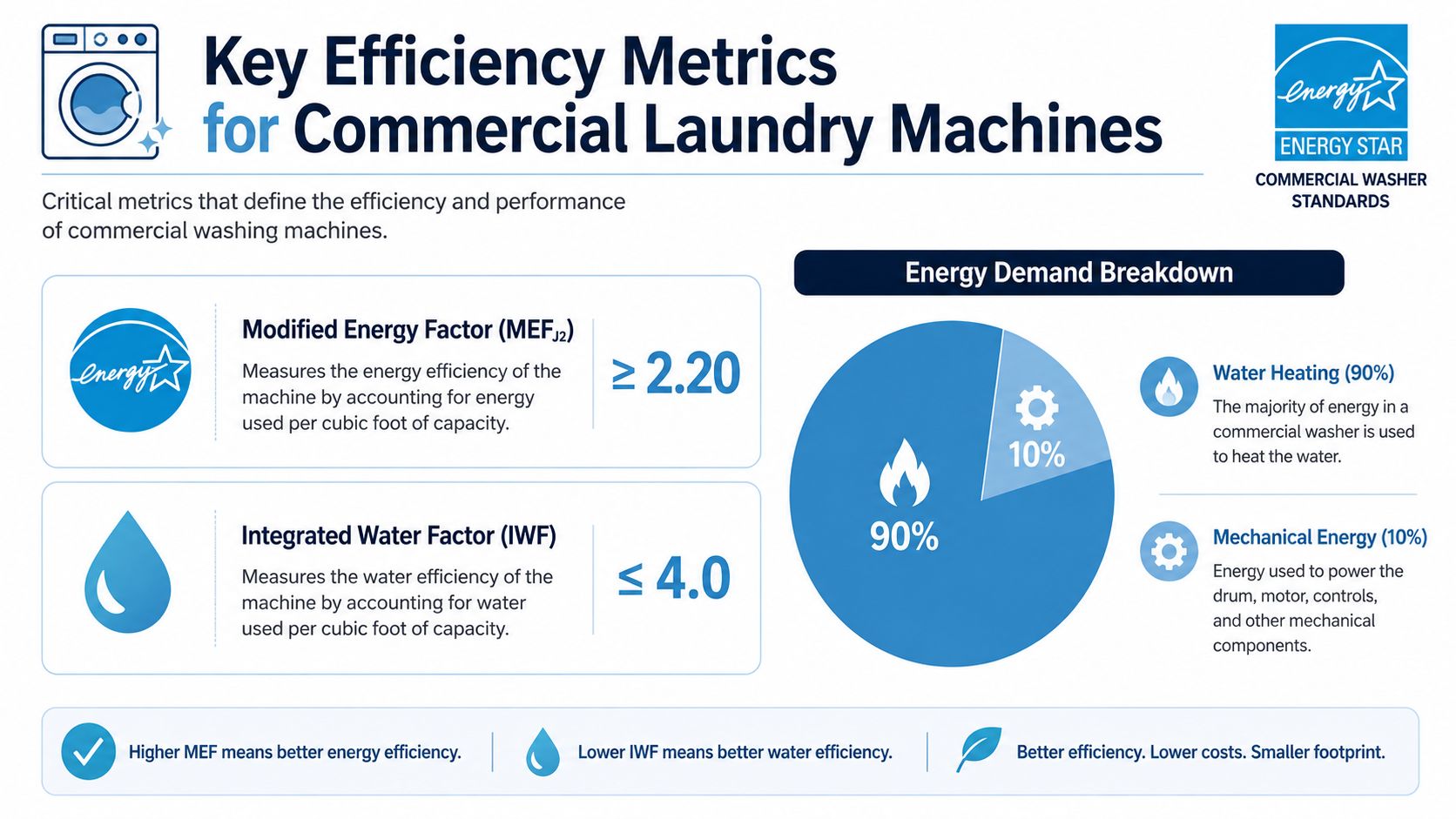
For commercial clothes washers, ENERGY STAR's current benchmark is MEFJ2 ≥ 2.20 and IWF ≤ 4.0 (ENERGY STAR product criteria). Those are useful procurement screens because they tie performance to both energy and water use, which is exactly what matters in dense, cost-sensitive operations.
The same guidance also exposes the hidden cost. Water heating accounts for about 90% of a washer's energy demand in commercial laundry contexts (EPA WaterSense commercial laundry equipment guidance). That is why cold-water cycles, full loads, and leak monitoring matter more than glossy eco labels. If a vendor cannot explain where the heat goes, they are selling features, not operating savings.
Commercial drying is usually assessed by production, meaning pounds of water removed per minute, and efficiency, meaning BTU used per pound of water removed (ISSA benchmarking guidance on laundry). A practical target is towel loads drying in under 35 minutes. That matters because a dryer that misses it slows the entire turn cycle.
Heat-pump and heat-recovery options usually make sense where runs are long and electricity costs bite hard. Vented dryers are simpler, condensing dryers simplify installation, and heat-pump units trade higher capex for better operating discipline. My view is blunt. If your site runs long shifts and you cannot waste power, pay for efficiency up front and stop pretending the cheap dryer is the cheap option.
The right spec depends on the business model, not just the floor plan. Three Singapore buyer types come up again and again, and each one needs a different machine profile.
A subscription laundry operation serving apartments or condos needs flexibility and traceability. Mixed household loads, bed linen, towels, and everyday garments all hit the system, so the equipment needs to handle volume without creating confusion in the workflow. A soft-mount washer-extractor pair in the 25 to 35 kg range with matching condensing dryers is the practical fit.
The workflow matters as much as the machines. Itemised tracking, dedicated customer loads, and simple staging reduce mistakes and keep turnaround predictable. That's also where packaging and bag handling start to matter, which is why Tumble Laundry's note on commercial laundry bags is a relevant operational read for teams building a service model around collection and delivery.
Machine profile in one sentence: a flexible mid-capacity soft-mount setup with dryers that can keep pace with mixed residential loads.
Hotels live or die on linen turnaround. Towels, sheets, and flatwork need to move fast, and the system has to be friendly to repeated daily use. That points to a larger washer-extractor, a dryer bank sized to match extraction, and an ironer or flatwork finisher for presentation quality.
Heat-pump dryers make sense here when the workload is steady and energy discipline matters. The point isn't to make the laundry room fancy, it's to keep guest-facing linen moving without waste or bottlenecks.
Machine profile in one sentence: a high-throughput OPL line with strong extraction, matched drying, and finishing for flatwork.
These sites need predictability. Uniforms, sports kits, and clinical-style items benefit from lower-temperature chemistry, hygiene discipline, and repeatable cycles. A mid-capacity hard-mount washer often makes sense because the loads are easier to forecast and the install can be simpler.
The priority here is consistency, not novelty. Keep the chemistry controlled, keep the cycles repeatable, and keep the maintenance schedule strict.
Machine profile in one sentence: a durable mid-size hard-mount platform built for repeatable weekly loads and controlled wash programmes.
The sale is the easy part. The first year of uptime is where the true cost shows up. Commercial laundry machines are hard-working assets, but only if someone keeps an eye on the parts that tend to fail.
A serious site follows a simple rhythm. Daily checks cover gaskets and lint. Weekly inspections cover drain paths and dosing lines. Quarterly work checks bearings and belt tension. Annual service reviews the motor and electrical system, especially on high-g-factor machines.
That schedule isn't bureaucracy. It's how you stop a minor seal problem from becoming a lost laundry day. If you want a technician brief that's easy to hand over, this Tumble Laundry guide on cleaning a laundry washing machine is a useful practical reference.
Singapore operators often underestimate water-treatment scaling, detergent mismatch, and the cost of supply downtime. If hot water or cold water fails, the entire wash aisle can stall. If dosing is off, seals and finishes suffer. If maintenance access is poor, every service call takes longer than it should.
For teams looking at financing against those lifecycle realities, get commercial laundry equipment funding from Noreast Capital Corporation is worth reviewing as a capital-planning resource, especially when the install is bigger than the cash flow can comfortably absorb.
My advice is direct. Price the machine over its real life, not just its invoice. A 5-year capex case can beat a longer one when the operator is growing fast and needs fresher equipment, better reliability, and fewer surprise repairs. The cheapest machine up front is often the most expensive one in the room.
Use this as the actual procurement screen, not a polite summary for the file. A machine that fails here should not move forward, no matter how good the brochure looks.
1. Confirm the site first. Check water supply, drainage, ventilation, clearance, and whether the room has three-phase power or can realistically be upgraded to take it. In Singapore, retrofit feasibility decides a deal long before drum size does.
2. Set a weekly kg target. Do not guess. Use actual loads from your hotel, school, condo, or delivery route, then compare that against the washer bank you can physically fit.
3. Choose the capacity band one tier above the target, not two. That gives you buffer without forcing unnecessary capex, heavier utility loads, or wasted floor space.
4. Screen on performance, not brand familiarity. Compare MEFJ2, IWF, and extraction quality, then check g-factor and spin speed against the site's labour profile and drying setup.
5. Design the dryer bank at the same time. A washer that outruns the dryers only builds queue time and eats floor area.
6. Price total cost of ownership for 5 years. Include utilities, labour, detergent, service, retrofit work, and downtime risk, not just the sticker price.
For guidance on the contractual side, resources on negotiating commercial cleaning deals can help when you are comparing ownership, outsourcing, and service commitments. That matters because the machine decision is rarely just a machine decision, it usually sits inside a wider operating contract.
If you are comparing in-house machinery against a managed service model, a Singapore laundry partner like commercial laundry services from Tumble Laundry can handle pickup, cleaning, and delivery while you avoid the retrofit burden entirely.
A good laundry room in Singapore is not the biggest one. It is the one that fits the site, matches the load, and stays up. If you are still comparing specs, see how a managed laundry service works and use that benchmark to decide whether equipment ownership is the right next step.

We make laundry days fast and easy for you. We collect, clean and deliver your laundry and dry-cleaning.
53 Ubi Ave 1 #03-43, Singapore 408934
Mon - Fri | 8:30 am–5:30 pm
Sat | 8:30 am–12:30 pm
hello@tumble.sg
+65 62554222
Whatsapp Us


