Commercial Laundry Basket Guide for Singapore Businesses
This is some text inside of a div block.

You've got linen piling up in a narrow back-of-house corridor, a housekeeper waiting for the next cart, and a service lift that's already half full. In Singapore, that's not a minor nuisance, it's a workflow problem. The wrong commercial laundry basket slows movement, holds moisture, and makes a tidy operation feel chaotic.
That's why basket choice isn't a shopping decision. It's a movement decision, a hygiene decision, and a space-planning decision. If you get it wrong, staff waste steps, linen stays damp longer than it should, and your back-of-house starts fighting its own layout. For a practical view on laundry handling habits in Singapore, the workflow mindset in Tumble's laundry best practices guide is a useful reference point.
A hotel corridor in Singapore leaves very little room for error. One overfilled cart, one awkward turn, and the whole housekeeping run slows down. Staff start stacking linen on top of linen, the basket traps heat and moisture, and the route that should move cleanly from room to laundry room becomes clumsy and unsafe.
That's the core job of a commercial laundry basket, it keeps the linen flow moving without getting in the way. In a compact operation, the basket is part of the transport system, not a storage box. It affects how quickly soiled items leave guest floors, how neatly clean linen comes back, and how much physical strain staff carry through a shift.
Singapore's urban layout makes that more obvious than in many other markets. The country's high-rise, apartment-dominant environment already makes outsourcing and centralised handling operationally important, and commercial laundry demand sits inside a broader Asia-Pacific market that is growing. The commercial segment in Asia Pacific was valued at US$45,958.6 million in 2024 and is projected to reach US$61,374.7 million by 2030, implying a 5% CAGR over 2025 to 2030, with Asia Pacific as the largest revenue-generating region in the benchmark used here, according to Grand View Research's commercial laundry care market data.
Practical rule: if the basket slows staff down or blocks a lift, it's the wrong basket, even if the spec sheet looks impressive.
The buying questions are straightforward, and they matter more than brand names. Can the basket fit the route? Does it dry out properly in humid conditions? Can staff clean it fast? Can it handle a full shift without rolling badly or taking up too much floor space? Those are the questions that decide whether a back-of-house works or keeps fighting itself.
In Singapore, moisture is not an edge case. It is the operating environment. That's why material choice needs to start with resistance to damp storage, easy wash-down, and how much the basket will snag or mark surrounding surfaces.
Open-wire and mesh constructions work well when drainage and airflow matter most. Smooth plastic works better when hygiene wipe-downs and snag prevention are the priority. Fabric-lined systems help with delicate items, but they ask for tighter cleaning discipline because the liner becomes part of the hygiene load.
Bigger is not automatically better. A basket that carries more linen can reduce the number of trips, but it only pays off if the route has enough clearance and the staff can move it safely. In a tight service lift or narrow corridor, a smaller basket that moves quickly can outperform a larger one that gets in the way.
In a humid climate, ventilation matters more than many buyers expect. Perforated sides and open frames help reduce trapped dampness and reduce the chance that soiled linen sits in a closed, sweaty container longer than necessary. That matters for hotels, care homes, and laundromats where loads sit briefly before the next processing step.
Stackable or nesting designs can help, but only if your back-of-house has a proper storage zone. If the stacked units still block access to detergents, trolleys, or fire exits, the “space saving” is fake. Measure the storage area, then decide whether nesting improves the workflow.
A clean-looking basket isn't enough. You need a surface that can be wiped down properly, a material that tolerates repeated cleaning, and a design that doesn't hold moisture in seams or liner pockets. If your SOPs include frequent disinfection, the basket has to support that routine without wearing out quickly.
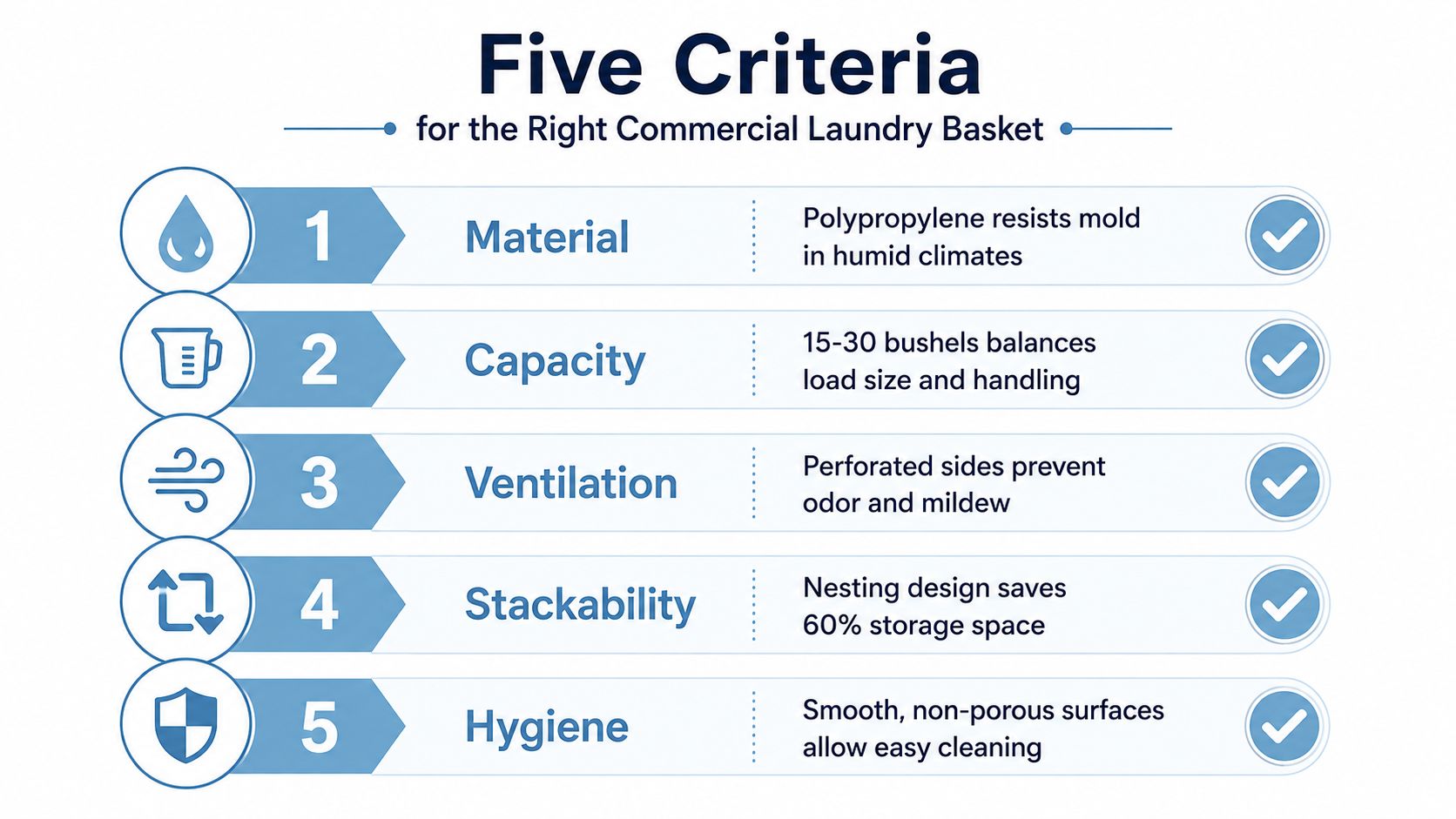
A simple way to shortlist: material for moisture, capacity for route length, ventilation for humid storage, stackability for floor space, hygiene for SOP compliance.
The wrong basket choice shows up fast in Singapore. A hotel linen room, a school storeroom, and a care home utility bay all punish different weak points, so pick the material against the actual workflow instead of the sample on the rack.
Open-wire construction has a clear advantage where airflow and drainage matter. The ARCAT commercial laundry cart specifications list corrosion-resistant wire and steel frames, plus 5-inch swivel polyurethane casters and air-cushion bumpers in some systems, with capacities ranging from 175 lb on compact commercial basket systems up to 500 lb on larger truck-style carts. That tells you build quality and mobility matter as much as volume. In humid back-of-house areas, open construction also helps keep moisture from sitting in the basket.
Plastic wins when cleaning simplicity matters most. You can wipe it down quickly, it is less likely to snag towels or uniforms, and it suits teams that need a low-fuss container for mixed linen or return handling. The trade-off is reduced ventilation, so do not use a sealed plastic container for loads that sit around damp for long periods.
Fabric-lined and vinyl-bag systems make sense when handling priorities change. If the linen is delicate, if you need a softer transport surface, or if the workflow involves clear separation of clean, soiled, or potentially contaminated items, those systems are more useful. For outsourced handovers, the bag itself becomes part of the control process, which is why product-level guides on commercial laundry bags are worth reading alongside basket choices.
Bottom line: pick the material that matches the longest part of the workflow, not the prettiest sample on the showroom floor.
Capacity sounds like the easiest number to chase, until you put the cart in a lift. Then width, height, turning radius, and wheel quality matter just as much as how much linen it can hold.
The supplied commercial cart benchmarks show why. A common institutional wire cart can come in at 4.5 bushels with a 500 lb load rating and external dimensions of 37-3/4" x 19" x 71-1/2". Another profile is a larger cart rated at 400 lb with 19" x 41" x 33.5" footprints, while compact hamper-style units sit around 6 bushels (211 L) at 28.25" x 36" x 23.25" Imperial Supplies cart specifications. Those numbers tell you one thing clearly, footprint and manoeuvrability can't be separated from payload.

A tall narrow truck suits sites where vertical storage is available and the route is straightforward. It can carry more without spreading across the corridor, but it becomes annoying if the lift is tight or the cart needs to pivot often.
A low-profile hamper works better where sightlines, loading height, and collision risk matter. Staff can guide it more easily through cramped utility spaces. It's also less likely to clip walls, trolley handles, or door frames.
Mid-size wheeled baskets sit in the middle. They're often the sensible compromise for laundromats, schools, and smaller hotels where the route is mixed, some tight corners, some open stretches.
Wheel quality isn't a minor detail. The commercial specs in the supplied data note 5-inch swivel polyurethane casters, and that matters because polyurethane rolls well under load, reduces floor marking, and handles wet utility routes better than cheap wheels. Air-cushion bumpers also help protect walls and equipment when carts move through dense back-of-house spaces ARCAT commercial laundry cart specifications.
If a full cart is hard to steer with one hand, staff will start pushing it badly. Bad pushing causes wall damage, fatigue, and slower turnaround.
Use the route, not the catalogue photo, to choose the size. Measure door widths, service lift entry, turning corners, and the space beside washing, pressing, and dispatch points. That's the only way to know whether a cart profile fits the daily route.

Hotels need speed first. Housekeeping routes should use tall, narrow trucks or compact wheeled baskets that roll smoothly and don't eat corridor space. Clean linen movement and soiled linen removal are both repetitive, so the basket must be easy to steer, easy to stop, and easy to wipe down.
Schools need different discipline. Their laundry loads are usually mixed, and the storage zones are rarely generous. Stackable, lightweight hampers make more sense than oversized carts, because school staff need to move items without blocking storerooms or service walkways. If the route includes uniforms, costumes, or sports kit, avoid containers that hold moisture too long.
Care homes should be stricter. Infection-control thinking matters here, so colour-coded vinyl liners, clearly separated bins, and smooth-cleanable surfaces are the right starting point. The point is not to make the basket “medical-looking”. The point is to stop cross-contamination risk from creeping into an already busy care environment.
For laundromats and pickup-driven operations, the basket has to survive the grind of repeated handling. That means durable frames, wheels that don't wobble, and a container that can tolerate daily pickup cycles without deforming. If the business also needs centralised laundry support, Tumble Laundry's commercial laundry service is one operational option, since the service model itself changes how much on-site handling you need to build around.
A return-bin setup works differently from an in-house transport cart. For outsourced handovers, you want clear segregation, durable outer surfaces, and a format that staff can move to the collection point without fuss. For in-house processing, you need stronger transport ergonomics, better airflow, and less time spent transferring linen between stages.
The best choice follows the handling pattern. If the basket is staying in one room, choose by storage efficiency. If it's travelling through the building, choose by mobility and control. If it's going out and coming back every cycle, choose by durability first.
Purchase price is the wrong starting point. A cheaper basket that breaks casters, holds smells, or wears out in a humid utility room costs more in the long run because it creates replacements, extra labour, and more operational friction.
Key difference: in-house processing needs transport efficiency, while outsourced handovers need cleaner segregation and better return-bin discipline.
Lifecycle thinking matters. The supplied market notes on commercial laundry baskets point to an underserved question in Singapore, whether the cost comes from the cart itself, or from maintenance, corrosion, and replacement frequency in humid conditions. That's the correct way to think about it. Buy for the environment you run, not for the cheapest visible shell.
For operators weighing whether to keep laundry in-house or hand it off, vendor risk and cost analysis deserves attention too. A useful outside perspective is vendor risk and cost analysis from Facility Management Insights, because basket design often changes once the operating model changes.
The same logic applies to basket type. In-house systems need carts that can move between collection, wash, pressing, and dispatch with minimal fatigue. Outsourced systems often need return bins, sort carts, and separation tools that make handovers more orderly and easier to audit. The basket should support the process you've chosen, not force you into a different one.
If you're deciding between simpler handling and full internal control, Tumble's own commercial laundry service exists as a reference point for what happens when a site removes some of the back-of-house burden entirely. Once the handling model changes, so should the basket specification.
Start with the route. If the basket can't clear the lift, corridor, and storage turns, stop there. No capacity number fixes a cart that doesn't move cleanly through the building.
Then match the material to hygiene SOPs. Use open-wire or mesh when drainage and airflow matter, use smooth plastic when wipe-downs and snag prevention matter, and use liners or vinyl bags when separation and contamination control are part of the job.
Next, size it to the shift, not to the biggest load you can imagine. A basket that's too large becomes a storage problem and a steering problem. A basket that's sized for the actual load pattern keeps staff moving without unnecessary strain.
Finally, check the hardware. Corrosion-resistant casters, smooth rolling, and wall protection matter more than glossy finishes. In Singapore, humid conditions punish weak fittings faster than most buyers expect.
Buy the basket that fits the workflow, not the one with the biggest number on the spec sheet.
If you'd rather not build the handling system yourself, use a commercial laundry partner that already manages collection, cleaning, and delivery around business schedules. That removes a lot of basket-related guesswork from the operation.
If your current linen flow is slowing staff down, Tumble Laundry can handle the pickup, cleaning, and delivery side of the process so your team isn't fighting carts and corridors every day. Visit Tumble Laundry to see how commercial laundry support can fit into your Singapore operation and reduce the pressure on your back-of-house.

We make laundry days fast and easy for you. We collect, clean and deliver your laundry and dry-cleaning.
53 Ubi Ave 1 #03-43, Singapore 408934
Mon - Fri | 8:30 am–5:30 pm
Sat | 8:30 am–12:30 pm
hello@tumble.sg
+65 62554222
Whatsapp Us


