Day Curtain vs Night Curtain: A Practical Singapore Guide
This is some text inside of a div block.


You're standing in a Singapore living room at night, lights on, curtains drawn, and the neighbour's unit is close enough that you can tell when they're in the room too. The question isn't whether the fabric looks nice. It's whether your window treatment gives you privacy, cuts glare, handles heat, and doesn't become a chore to maintain in a humid climate.
For most Singapore homes, the choice is not day curtain vs night curtain as if you must pick one forever. It's whether you need a layered setup, or whether a single layer is enough for a smaller, less exposed space. In dense housing, especially where windows face other units, the wrong choice shows up fast, either in a room that feels exposed after dark or in a space that feels closed in during the day.
Singapore's housing pattern makes this decision practical, not decorative. In 2024, about 77.6% of resident households lived in HDB flats, while 16.1% lived in condominiums or apartments and 4.4% lived in landed properties, according to household profile data. That means a very large share of homes deal with close sightlines, shared-facing windows, and the everyday question of who can see in when the lights go on.
A typical evening makes the problem obvious. During the day, you want daylight without the harshness. At night, you want the room sealed off from the block across the way. In that setting, a day curtain vs night curtain decision is really a decision about how your home behaves across two very different lighting conditions, not how it looks in a furniture catalogue.
Singapore's tropical weather keeps windows active all year. You're dealing with bright mornings, strong sun, and a need to balance comfort with air-conditioning use. A lighter layer softens the room while a heavier layer handles the harder jobs, like blocking glare and cutting visual exposure after sunset.
Historically, curtains became more functionally split as fabrics and blackout needs evolved, and blackout use has a serious wartime origin, not a decorative one. Britannica notes that 20th-century curtain fabrics added synthetics such as fibreglass and polyester, and that blackout regulations in Britain in 1939 required windows and doors to be covered at night so no light escaped to enemy pilots. That background helps explain today's practical split between day curtains and night curtains, especially in homes where daytime brightness and nighttime privacy both matter.
In Singapore, the wrong curtain choice usually fails in the same two places, daytime glare or nighttime exposure.
For readers in HDBs and condos, the consequence is simple. Pick too light a setup, and you'll keep the airy feel but lose privacy once the room is lit. Go too heavy without a sheer layer, and the room can feel boxed in even when the sun is out. If you want to see how this plays out in real local homes, start with the layout reality of Singapore housing types.
A day curtain is usually a lightweight sheer or semi-transparent fabric. Its job is to soften daylight, reduce harsh glare, and keep the room feeling open. It's the curtain you use when you want the window to stay visually light rather than heavily covered.
That also means a day curtain is not a privacy solution after dark. It can blur the view and make a room feel softer, but it does not shut out outside sightlines once your interior lights are on. In practice, it behaves more like a daylight filter than a barrier.
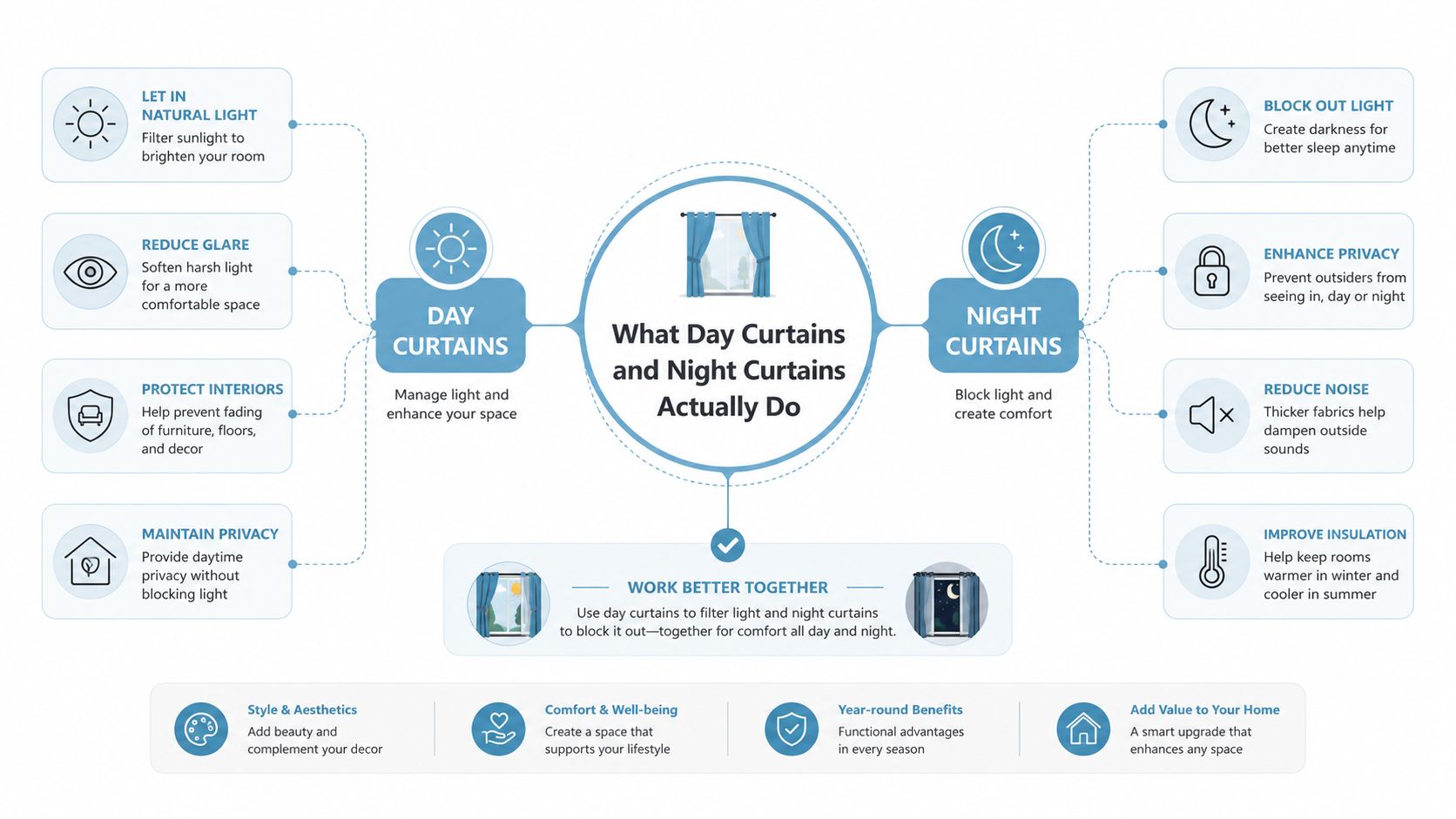
A night curtain is heavier, more opaque, and often lined or blackout-treated. Its job is privacy, room-darkening, and a better degree of thermal and acoustic buffering than a sheer can give. In a Singapore bedroom or living room facing another block, this is the layer that carries the load.
One useful way to keep the terminology straight is this. Blackout means the fabric is engineered for very high light blocking, dim-out usually means it reduces light without eliminating it, and room-darkening is not the same thing as total darkness. A good night curtain can get you very close, but the result still depends on fit, installation, and window edges.
Practical rule: if the window faces people, not sky, the night curtain is the serious layer.
This distinction matters because shop labels can be slippery. A curtain that looks dramatic on display may still leak light, and a sheer that feels elegant in the afternoon may do almost nothing once your lights are switched on. If you can correctly label the fabric and its job, you'll make a much better buying decision.
CriterionDay CurtainNight CurtainLight controlSoftens daylight, cuts glare, keeps the room brightBlocks far more light, supports room-darkening and blackout usePrivacy in daytimeGood for filtered daytime privacyStrong privacy, though often unnecessary in full sun unless you want darknessPrivacy at nightWeak once interior lights are onStrong, and the layer that matters after darkHeat and comfortHelps diffuse sun, but isn't a heavy thermal barrierBetter for reducing solar gain and helping with heat managementSoundMinimal effectBetter than a sheer, especially in heavier fabricsStylingAiry, light, minimal, easy to keep visually calmFuller, more dramatic, more dominant in the roomMaintenanceEasier to handle and washHeavier, dustier, and more awkward to take down
The clearest split is privacy after dark. A day curtain can look fine in bright afternoon light, especially when the sun is behind it and the room stays lighter than the exterior. Once night falls and your lights are on, that same fabric stops screening much and starts acting like a soft veil.
The next split is heat and upkeep. In a Singapore flat, especially one that faces strong sun or gets direct afternoon heat, a sheer can cut glare without adding much weight or cleaning burden. A night curtain does more for heat buffering and room-darkening, but it also holds more dust, takes more effort to remove, and needs a proper wash routine, not occasional attention.
That is why the comparison is never just about fabric looks. In a dual-purpose living room, the curtain has to work during the day, then still behave when the room becomes a TV space, guest space, or family space after dark. A sheer keeps the room light and easy to maintain. A heavier panel gives you more control, but it asks for more care.
For a broader layout reference, Singapore condos often show why this choice gets sharper in real homes, because windows are exposed, neighbour sightlines are close, and the room has to serve more than one job.
The practical choice in Singapore is not a fabric preference. It is whether you want easier cleaning, better night privacy, or a room that can handle both.
If the window must stay dressed all day and night, a layered setup usually wins. A sheer handles daylight and keeps the room from feeling closed in, while the heavier curtain covers privacy and glare control when the sun drops. That is also the setup most owners find easier to live with, because you can wash the lighter layer more often and leave the heavier one for a less frequent cleaning cycle.
If privacy is the only weak point and drilling is not an option, a renter-friendly privacy film can cover the glass itself and reduce direct sightlines. It will not replace the look or softness of curtains, but it does solve one problem cleanly without adding another layer of fabric to maintain.
Many buyers misjudge a day curtain vs night curtain setup. A sheer can look private in the afternoon because your eyes adjust to the bright light outside and the fabric reads softly from inside the room. After dark, the situation flips. The room is lit, the exterior is darker, and the same curtain turns much more transparent.
In Singapore homes, that matters more than fabric preference. A sheer alone may be acceptable in daytime, but in an HDB flat with a neighbour facing your window, it often gives away far too much once the lights come on. The same problem shows up in many condo window setups, where units sit close together and the room has to work as both a living space and a private one.
A curtain that looks private at 3 p.m. may be almost see-through at 8 p.m.
The reason is simple. Visibility follows the brighter side of the glass. If the room is brighter than the outside, the curtain stops hiding much. Evening privacy needs a heavier layer, or another solution that blocks sightlines.
If privacy is the only problem and you are in a rental or a room where drilling is not an option, a renter-friendly privacy film can help on the glass itself. It will not give you the softness or finish of curtains, but it does cover direct sightlines without adding more fabric to wash, vacuum, and manage.
Do not rely on a sheer alone if people can see straight into the room after dark. If you want real evening privacy, use a heavier curtain layer, or a layered setup where the sheer handles daytime glare and the night curtain takes over at night. That choice also affects upkeep, because more fabric means more cleaning, and Singapore's humidity makes neglected curtains look tired faster.
A layered curtain system is usually the better answer in Singapore homes. Daytime sun needs softening, nighttime needs privacy, and one panel rarely does both without compromise. A double-track or double-rail setup lets each layer do one job properly instead of forcing one fabric to carry the whole room.
That matters in a hot, bright city where rooms often serve as living rooms, workspaces, and TV spaces at the same time. A sheer layer keeps the room bright enough to feel open, while a heavier layer takes over when you need darkness, privacy, or both. That split also makes maintenance easier to plan, because you can clean the lighter layer more often and leave the heavier one to handle the tougher privacy work.
A single curtain still makes sense in a few cases. Small windows that do not face other units, a study nook that only needs glare control, or a rental where you cannot install extra tracks can all work with one layer. Kitchens and service yards often sit in that simpler category too, especially where moisture and easy access matter more than full drapery drama.
The trade-off is plain. Fewer layers mean less hardware, less cleaning, and a lighter visual feel. They also mean less flexibility, and Singapore rooms usually need flexibility. Once you ask one curtain to do everything, you give up control over light, privacy, and how often the fabric needs attention.
If you want a room-by-room layering reference, window layering for light control is a useful way to see how different setups handle glare and privacy in practice. For the maintenance side, Tumble Laundry's services page helps you judge what regular cleaning looks like when you are managing more than one curtain layer. That cleaning reality is part of the decision, not an afterthought.
My rule of thumb is blunt. Use a sheer during the day, a heavy night curtain after dark, and put them on separate tracks so each layer can work properly. If you are buying for a Singapore home and can fit two layers, do it. It is the most practical setup for glare, privacy, heat, and everyday upkeep.
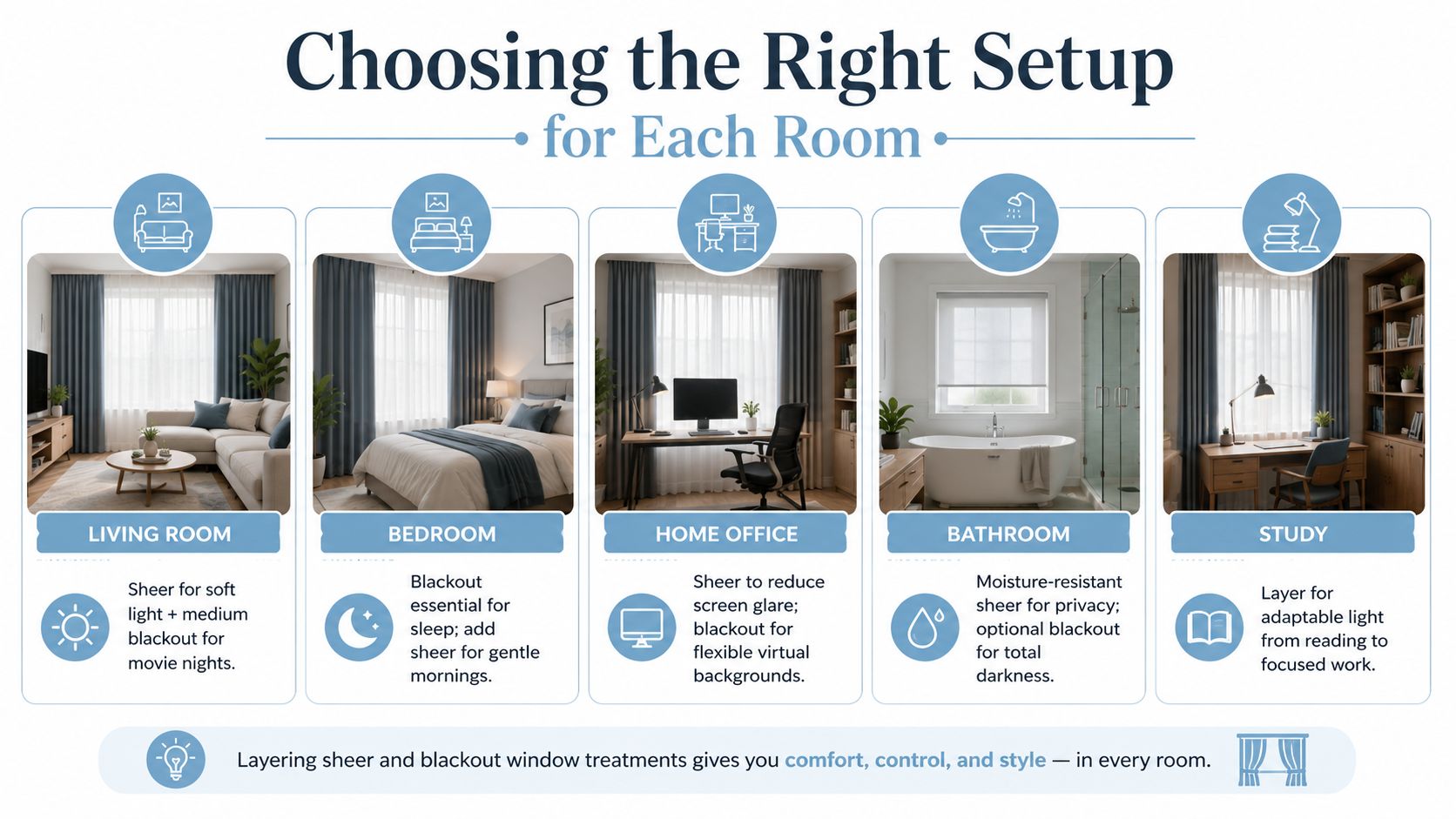
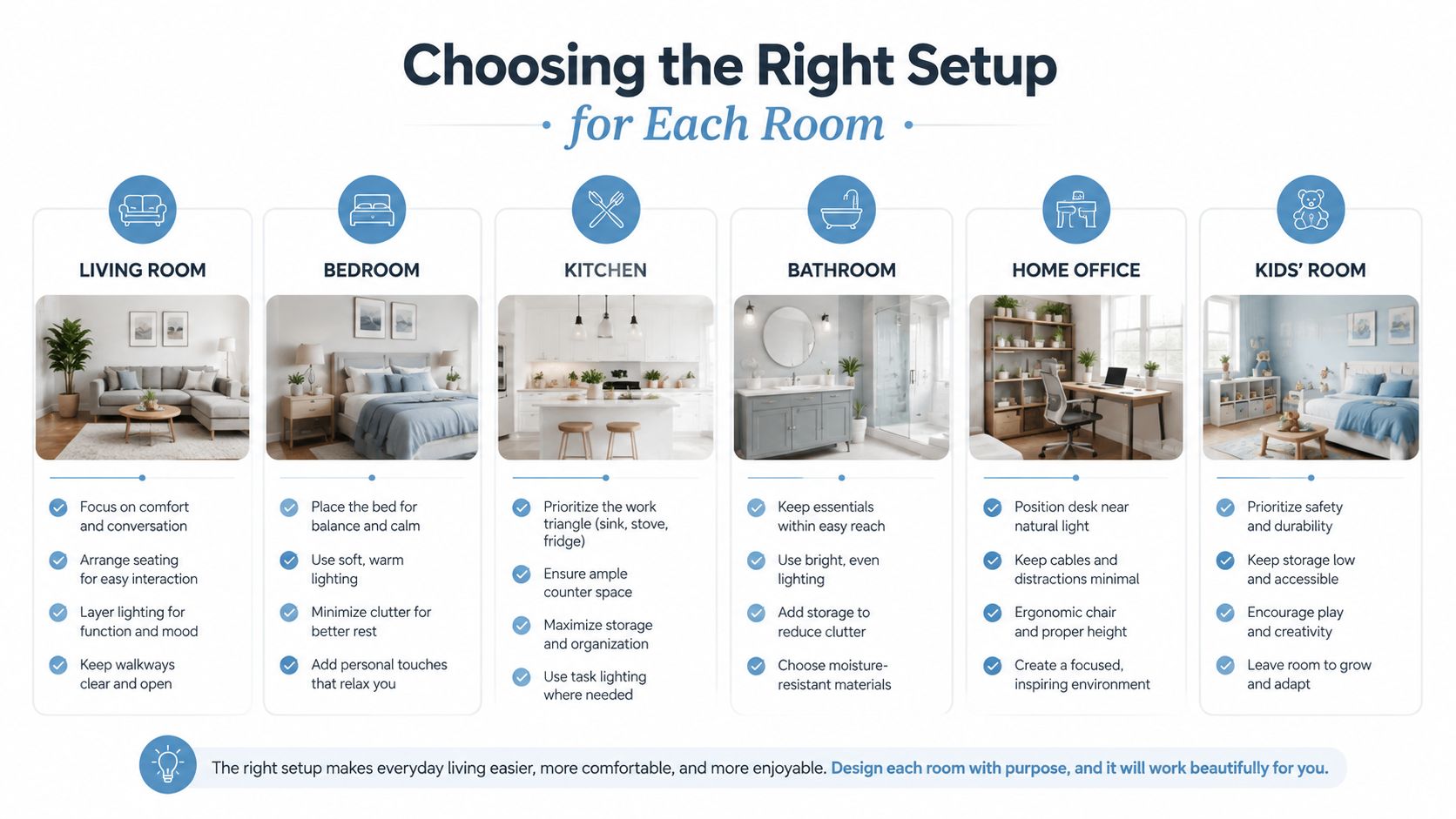
A living room in Singapore often does three jobs, hosting, TV viewing, and general daytime living. A sheer plus a medium-weight night curtain is the practical combination because it keeps the room bright during the day and gives you the option to darken it for movies or evening use. If you only fit a heavy curtain, you'll spend the daytime pulling back bulky fabric just to get enough light.
Bedrooms are different. If you sleep late, work shifts, or wake easily, a sheer plus true blackout setup is the right call. The sheer gives you a softer morning and some daytime elegance, while the blackout layer carries the actual sleep function. In a bedroom, privacy and darkness are not decorative extras, they're the point.
For studies and home offices, the better setup is a light-filtering layer plus a dim-out curtain. That gives you control over screen glare without flattening the room into a dark box. You want enough daylight to stay alert, but not so much that your monitor turns into a mirror.
Kitchens and service yards usually don't need full layered curtains. A lightweight day curtain can be enough where you want a softer look, but many homes do better with very simple treatments or none at all. These spaces deal with more moisture, more mess, and more movement, so overbuilding the window treatment is usually a mistake.
One Singapore-specific note. In dual-purpose living rooms, where guests, work, and family time all happen in one space, the layered solution gives you the most control with the least regret. That's why it keeps winning in real homes, not because it sounds fancy.
Day curtains are easier to live with. They're lighter, simpler to remove, and easier to wash or refresh. Night curtains, especially blackout or lined ones, are heavier, catch more dust, and are more annoying to take down and rehung properly. In Singapore's humidity, that maintenance gap matters more than people expect.
If you're choosing a layered system, plan for upkeep at the same time you choose fabric. A bedroom with two long panels and a double track looks great, but it also creates a bigger cleaning job than a single sheer. If you hate dealing with ladders, hooks, and awkward reinstallation, the fabric choice should reflect that reality.
Tumble Laundry offers curtain cleaning with optional takedown and rehang support, and its curtain service is listed from $100 with a 5-working-day turnaround. For households that want a practical local option instead of managing the whole removal process themselves, that kind of service is the difference between keeping layered curtains clean and letting them go too long.
Heavier curtains don't just cost more upfront, they cost more in attention.
For care guidance, their curtain cleaning advice is worth reading before you commit to a thick night curtain or a double-layer system. The point isn't to frighten you off. It's to make sure you buy a setup you can realistically maintain in a Singapore home.
If you want the cleanest long-term routine, think like this. Sheers get lighter, more frequent attention. Night curtains get less frequent but more involved care. Once you accept that split, the curtain choice becomes much easier to live with.
• Do your windows face another unit closely? If yes, you need a real night layer.
• Do you want daylight without harsh glare? If yes, keep a sheer.
• Do you use the room at night with lights on? If yes, don't rely on a day curtain alone.
• Are you willing to maintain two layers? If yes, layered is the smarter Singapore choice. If no, simplify the room and accept the trade-off.
How much privacy does a sheer give after dark in an HDB or condo? Very little when the room lights are on and the outside is darker. It's fine for softened daylight, not for real nighttime privacy in close-facing homes.
How often do blackout curtains need professional cleaning in Singapore's climate? There isn't a fixed universal schedule, but heavier blackout curtains should be cleaned with enough frequency that dust and humidity don't build up unnoticed. If you're already seeing a heavier layer hold more dust, that's your sign to plan service instead of waiting for visible grime.
For direct help with choosing the right care or service path, use Tumble Laundry support. My recommendation is simple, fit a sheer and a night curtain in the rooms that matter, because Singapore homes usually need both daylight control and genuine evening privacy.
If you want a practical local solution for curtain care, Tumble Laundry handles curtain cleaning with takedown and rehang support, which is exactly what layered Singapore homes need. Visit Tumble Laundry if you want to keep your day and night curtains working properly without making the maintenance your own weekend project.

We make laundry days fast and easy for you. We collect, clean and deliver your laundry and dry-cleaning.
53 Ubi Ave 1 #03-43, Singapore 408934
Mon - Fri | 8:30 am–5:30 pm
Sat | 8:30 am–12:30 pm
hello@tumble.sg
+65 62554222
Whatsapp Us


