8 Ways to Keep Your Home Clean and Tidy in 2026
This is some text inside of a div block.


From overflowing laundry baskets to a wardrobe that never seems to close properly, the mess usually looks bigger at the end of a long day in Singapore. Between work, commuting, family routines, and the quiet pile-up of clothes waiting to be folded, it's easy to feel like “clean and tidy” is always one chore behind. The good news is that a home stays calmer when you use systems, not just bursts of energy.
For busy households, the fastest wins usually come from two places, decluttering the things you don't need and making laundry predictable. That matters even more in Singapore, where apartment living, limited storage, and routine care work can turn small chores into daily friction. If you want an easier way to keep your home in shape, start with the habits that reduce visual clutter and reduce laundry load at the same time. One useful place to begin is linen closet organization ideas, especially if you're short on storage and need every shelf to work harder.
Marie Kondo's appeal is simple. You stop organising by where things are stored and start deciding, category by category, what deserves space in your home. That shift matters because it changes the question from “Where do I put this?” to “Do I still want to live with this?” For Singapore households, that can be especially useful for wardrobes, because fewer clothes usually means less washing, less folding, and less fighting for storage space.
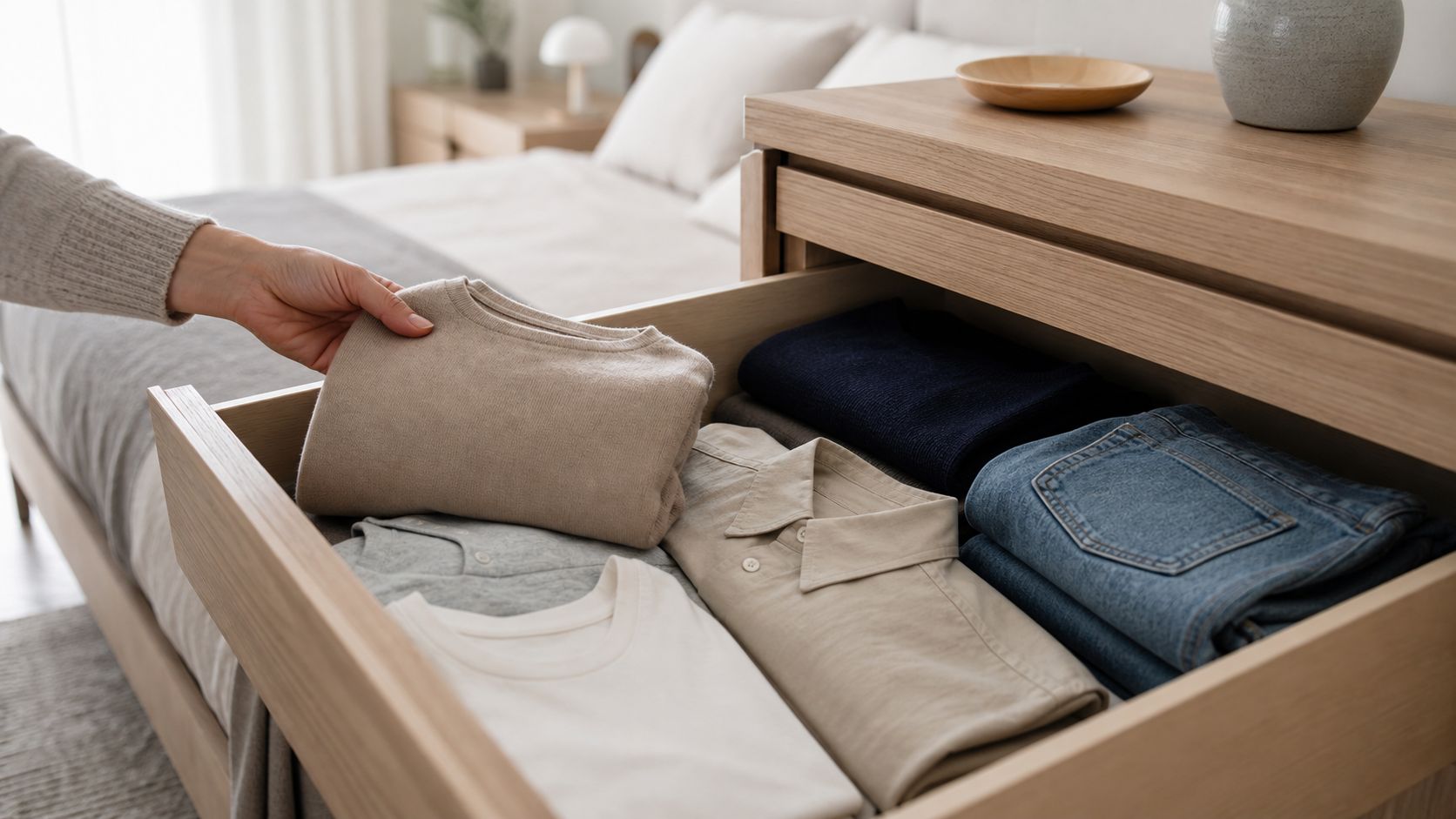
Start with categories that feel easier to judge. Papers and books usually carry less emotional weight than clothing, so they're a practical warm-up before you deal with work shirts, dresses, or pieces you bought for a specific occasion. Handle each item, decide quickly, and avoid re-reading or re-trying everything three times. The point is to build confidence, not to create a bigger mess halfway through the process.
Practical rule: if an item only survives because it is “still good enough,” it probably doesn't belong in a curated wardrobe.
For clothing, vertical drawer folding helps the method stick because you can see what you own at a glance. That's where the laundry side of the system matters. If the wardrobe is trimmed down, a service like Tumble's best way to sort laundry guide can help you keep categories separate and return each load to the right place faster, which is exactly what busy households need after decluttering.
A sensible habit is to review the wardrobe quarterly. Off-season pieces can be stored away clean and dry, while the clothes you wear stay visible and easy to reach. That makes the home look tidier, but it also prevents the quiet rebuild of clutter that happens when every piece of clothing stays within daily reach.
A small part of a wardrobe sees frequent use. The 80/20 mindset turns that reality into a useful system: keep the core pieces that work hard and stop paying attention to the rest every morning. For professionals in Singapore, that often means a few dependable work shirts, trousers, and casual basics that can be mixed without thought.
The easiest wardrobe is the one you don't have to negotiate with. A narrow colour palette, a few reliable fits, and fabrics that suit your routine make daily dressing faster and laundry simpler. If your everyday clothes all require different wash settings, different drying methods, and different ironing effort, the wardrobe is working against you.
That's why many busy people do better with uniform-style dressing. The same shirt cut in more than one colour, the same trouser shape across several pairs, and one or two clean layers for air-conditioned spaces can cover a surprising amount of weekly use. The goal isn't style minimalism for its own sake, it's fewer decision points and fewer garments rotating through the hamper.
A smaller wardrobe only works if the pieces are wearable often. “Special” clothes that stay in the cupboard don't help you get dressed faster.
A professional laundry service fits this system well because it keeps the core wardrobe moving. If you rely on recurring workwear, wash-and-fold or clean-and-iron support can reduce the time spent sorting loads by fabric type and garment purpose. It also helps when you want your clothing plan to stay stable instead of collapsing after a busy week.
The trade-off is obvious. A smaller wardrobe means less variety, so you need pieces that hold up well and work together. But that trade-off is often worth it for anyone who'd rather spend less time deciding what to wear and more time leaving the house on time.
The Four-Box Method works because it forces a decision. You sort everything into Keep, Donate, Sell, or Trash, then move on. There's no long debate over whether an old shirt might be useful one day, and that speed is exactly what makes the method useful when a wardrobe has become a storage problem rather than a clothing system.
Set up the boxes before you start. If you begin sorting with no labels and no exit plan, you'll spend half your energy carrying things around instead of making decisions. A quick timer also helps because it limits overthinking, which is usually what keeps clutter in place.
Clothing is the best place to apply this method with honesty. If something doesn't fit, doesn't flatter, or isn't something you'd buy again, it probably belongs in the out pile. Don't keep a stained item in the “maybe” pile just because it cost a lot originally. The money is already gone, the only question now is whether it deserves space.
Here's the useful part for laundry. Once the keep pile is smaller, your washing routine becomes easier to manage. Fewer worn-out items means fewer cycles wasted on clothes you never reach for, and less time spent folding garments that should have left the wardrobe months ago.
• Keep: only the pieces that fit your current life and current body.
• Donate: items in good condition that someone else can wear now.
• Sell: pieces with enough value to justify the effort.
• Trash: anything stained, stretched, torn, or no longer wearable.
The strongest habit is to remove the Donate and Trash bags immediately. If they stay in the room, they start to feel like decisions you can reopen later. A clean and tidy home gets harder to maintain when every purge is treated as temporary.
Laundry becomes stressful when it's treated like an emergency. It works much better as a scheduled process, with clear days for washing, drying, folding, and putting away. That matters in Singapore because the weekly rhythm of work, family obligations, and apartment living leaves little room for random laundry experiments that spill into the rest of the home.
The best laundry schedule is the one that fits the household, not the one that looks neat on paper. A family with school uniforms may need one rhythm, while a professional with mostly office wear needs another. If you're juggling different clothing types, separate the loads by purpose instead of waiting until the basket is full of everything at once.
Outsourced laundry helps the most here. A service like Tumble's ultimate laundry schedule guide supports the idea that laundry should be planned, not improvised. When pickups and returns are predictable, you can build the rest of the week around them instead of letting clothing pile up on chairs and bedroom floors.
A useful pattern is to choose one or two fixed collection days and stick to them. That reduces the mental load of deciding whether this week is a laundry week or a “maybe later” week. It also makes it easier to separate regular wear from special-care items that need more attention.
Laundry gets messy fastest when it has no home, no day, and no deadline.
The trade-off is that a schedule asks for consistency. If you miss the day often, clothes drift into piles again. But for busy households, a clear routine usually beats waiting until everything feels urgent. Predictability keeps the home calmer, and calm is what clean and tidy feels like in daily life.
Vertical storage solves a very ordinary problem. If you can see what you own, you're less likely to forget it, repurchase it, or leave it buried under a pile of clean clothes. In Singapore homes, where storage is often tight and drawers get crowded quickly, visibility matters as much as neatness.
The method is simple. Fold items so they stand upright, then group similar pieces together. Work shirts go together, casual tees go together, and sweaters stay in their own section. Drawer dividers help the system hold shape, especially when different family members share one storage area or when wardrobes are small and hard to reorganise after every wash.
That visibility changes behaviour. People tend to over-wash or over-buy items they can't see clearly. When clothes are stacked in layers, the bottom pieces disappear from daily use. Vertical storage reduces that problem because every item stays part of the rotation.
A practical routine is to put freshly washed clothes away immediately in the same order every time. If laundry returns folded and sorted, the job becomes a placement task rather than a second folding session. That is one reason wash-and-fold services work well for busy households, they remove the step most likely to be delayed.
• Use dividers: keep each category upright and separated.
• Group by use: daily wear, workwear, and seasonal pieces should not mix.
• Store fresh loads immediately: don't leave clean laundry in baskets overnight if you can avoid it.
• Photograph the finished drawer: it's easier to restore a standard than invent one each time.
The main trade-off is that vertical storage needs upkeep. If you cram too much into a drawer, the whole system collapses. Still, for apartments and condos, it is one of the simplest ways to keep a wardrobe tidy without buying more furniture.
A home can look tidy and still be doing damage to the clothes inside it. Fabric care matters because the wrong wash setting, the wrong temperature, or the wrong drying method shortens garment life and creates more replacement shopping later. In practice, good care is part of being clean and tidy, not separate from it.
Care labels tell you whether a piece belongs in your home routine or in professional care. If you buy silk, wool, embellished formal wear, or anything that needs delicate handling, you need a plan before the first wash, not after a shrinkage mistake. That's where laundry becomes a maintenance system instead of a rescue mission.
For many wardrobes, a mix of home washing and professional handling works best. Everyday pieces can go through regular care, while valuable items, delicate fabrics, or formal wear can be handled separately through services like Tumble's laundry symbols and care labels guide. If you also keep a photo inventory of labels on your phone, you can send the right instructions quickly when needed.
Cold-water washing and gentle cycles are useful because they help preserve clothing, but the bigger win is consistency. Clothes that are treated properly stay in rotation longer, which means fewer emergency purchases and less cupboard clutter. For families with sensitive skin, it also makes sense to choose detergent preferences carefully so the laundry routine suits everyone in the household.
Good fabric care is invisible when it works. The clothes keep their shape, and the wardrobe stays manageable.
The trade-off is that proper care takes a little more thought at the start. But that thought saves time later because you stop ruining garments that still had plenty of life left. If a piece is expensive, sentimental, or worn often, treat the label as part of the purchase decision, not an afterthought.
Wardrobes often grow stale because no one decides when items should leave. The Donation Rotation System fixes that by creating a regular review point where a set number of pieces must be reassessed, refreshed, donated, or sold. That keeps the closet dynamic without letting it explode.
The method works especially well for busy professionals and growing families. Workwear gets outgrown, tastes change, and children's sizes shift quickly, so a once-a-year clear-out is usually too slow. A rotation review every few months is easier to manage because it turns decluttering into a recurring habit instead of a major event.
Before review day, give the wardrobe a proper reset. Clean items are easier to judge fairly, and dirty or rumpled clothes can make you keep things that are only hanging around because they look unfinished. If a garment has a visible stain or a stubborn mark, a stain-removal reference like Tumble's stain removal guide can help you decide whether the item is worth saving or should leave the rotation.
A useful approach is to try on items you haven't worn recently. If something still fits but hasn't been used in months, it needs a stronger reason to stay than sentimental habit. Donation rotation also works well with second-hand reselling, especially if you want the wardrobe to stay lean without wasting usable clothing.
• Set review dates early: put them in the calendar before the season gets busy.
• Refresh first: assess clothing when it's clean and ready to wear.
• Replace one-for-one: if something enters the wardrobe, something else should leave.
• Track patterns: note which types of items always get ignored.
The downside is that rotation asks for discipline. But the payoff is a closet that feels current, useful, and easier to maintain. That is a cleaner home in the practical sense, not just the visual one.
Some items don't belong in a standard home laundry cycle. Curtains, suits, dresses, traditional attire, and delicate garments need more than routine washing because the risk of damage is too high. For busy Singapore households, recognising those exceptions is part of keeping a home clean and tidy without creating avoidable problems.
Curtains are a good example because they're easy to forget until they collect dust or hold onto smells. They're also awkward to take down, wash, dry, and rehang if you're already managing a full household. That's why services such as Tumble's curtain cleaning guide are relevant to home organisation, not just cleaning.
Formal wear and traditional attire need similar care. A suit that loses shape or a dress that loses structure no longer serves the purpose it was bought for. Traditional garments, including pieces with special fabric, embroidery, or decorative elements, are often too valuable to treat casually. In those cases, professional handling is less a luxury and more the sensible way to protect the item.
The practical rule is simple. If an item is worn often, hard to replace, or vulnerable to damage, it deserves a separate care plan. Store it properly between uses, keep it breathable, and don't force it into the same routine as t-shirts and towels. That alone can reduce clutter because specialty items usually stop circulating between the laundry basket and the bedroom chair.
If the item takes extra effort to replace, give it extra effort to maintain.
A pickup-and-delivery laundry service can support a cleaner home. It reduces the number of bulky items waiting for attention and helps families handle pieces that need careful finishing. For apartments and condos, that also means less time spent wrestling with curtains or delicate clothes in already tight spaces.
A clean and tidy home rarely comes from one big cleaning day. It comes from small systems that reduce clutter, make laundry predictable, and stop certain jobs from piling up in the background. When you combine decluttering habits with a workable laundry routine, the home feels easier to live in because you're not constantly fighting the same mess in different forms.
The strongest systems are the ones you can repeat. The KonMari Method helps you own less. The 80/20 Rule helps you wear more of what you keep. The Four-Box Method gets decision-making moving. Vertical storage keeps what remains visible and easy to return. Specialty care keeps delicate pieces from becoming problems. Together, those habits make tidiness less reactive and more sustainable.
For many Singapore households, laundry is the hinge that keeps the whole system steady. If washing, sorting, folding, and special-care items keep slipping, the house starts to feel cluttered again even when the surfaces are clean. That's why professional support can be useful, especially when it gives you a reliable way to keep clothes ready to wear and out of the way.
Tumble Laundry fits naturally into that routine because it offers pickup, professional cleaning, and delivery for households that want less laundry friction. If your goal is a home that stays organised without constant catch-up work, it's worth building a system that supports the way you already live.
If your wardrobes, laundry baskets, and specialty garments are competing for time every week, make the routine simpler now. Visit Tumble Laundry to see how pickup, wash-and-fold, ironing, and curtain care can support a cleaner, more organised home in Singapore.

We make laundry days fast and easy for you. We collect, clean and deliver your laundry and dry-cleaning.
53 Ubi Ave 1 #03-43, Singapore 408934
Mon - Fri | 8:30 am–5:30 pm
Sat | 8:30 am–12:30 pm
hello@tumble.sg
+65 62554222
Whatsapp Us


